sales@hu-steel.com
 English
 Español
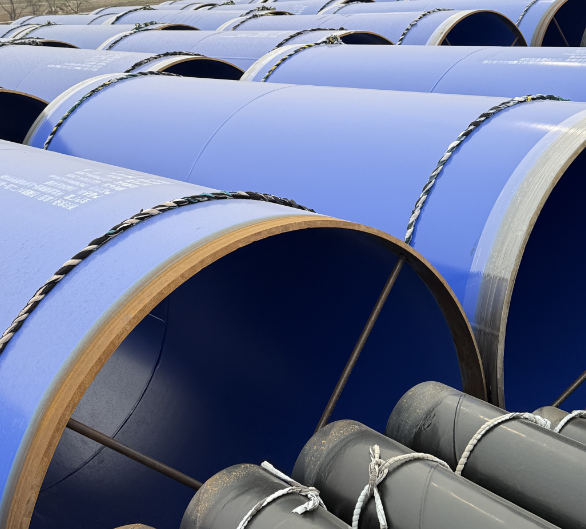
If you're specifying or procuring steel water pipes 6 inches and larger, the ANSI/AWWA C200 is the standard you'll need to follow. This guide covers dimensions, materials, coatings, welding, and testing — with a practical wall thickness table and FAQs — to help you specify the right pipe for your project.
△ Version Alert: The C200-97 (1997 version) has been superseded by AWWA C200-17 (2017 version). In engineering tenders and manufacturing, the currently valid version must be clearly specified and used.
▶ [Download the AWWA C200 Standard PDF] - the complete manufacturing specification for steel water pipes 6" and larger.
Officially titled "Steel Water Pipe - 6 In. and Larger," this standard was developed by the American Water Works Association (AWWA). It details all technical requirements for the materials, design, manufacture, testing, and delivery of steel pipes with nominal diameters of 6 inches (approx. 150 mm) and above used in water supply systems. This standard is not only a common specification for water projects in the United States but is also widely followed by many engineering projects worldwide that adopt the American standard system.
Main Applications:
● Municipal water supply mains
● Main water lines
● Raw water delivery
● Large-scale drainage
● Pressurized sewage systems
Size Range: Covers large-diameter steel pipes with a nominal diameter of 6 inches (150 mm) and above. For detailed pipe dimensions including OD, ID, and wall thickness, refer to the sections below.
Pressure Rating: Suitable for various working pressures; specific wall thickness must be determined through design calculations.
⚠️ Important: Many C200 standard pipes are manufactured with the inner diameter (ID) as the nominal size, not the outer diameter (OD). For example, a "60‑inch" C200 steel pipe may actually have an inner diameter of 60 inches. When connecting new and old pipes or procuring fittings, measure and confirm in advance.
When you see an engineering project specifying steel pipes conforming to the "C200-97" standard, it's almost certain that these pipes will be used in municipal water supply trunk lines, large-scale water transmission projects, raw water diversion, or as critical infrastructure such as pressurized sewage pipes, and are unrelated to fuel or automotive systems.
2. Design and wall thickness: Provides scientific formulas for calculating wall thickness. Engineers need to comprehensively consider the internal working pressure of the pipe, the load of the external soil cover, and necessary safety factors to determine the final pipe wall thickness.
4. Coating and Corrosion Protection: Standards mandate that pipelines undergo both internal and external corrosion protection. A common combination is to use a cement mortar lining on the inner wall to ensure water quality and durability, and a coating such as polyethylene wrapping tape or epoxy coal tar pitch on the outer wall to prevent soil corrosion. Specific corrosion protection measures are usually detailed in other specialized AWWA standards (such as C205, C210, and C214).
The AWWA C200 standard references mature ASTM material standards, clearly defining the grades and properties of steel:
| Material Standard | Description |
|---|---|
| ASTM A139 | Electric‑fusion‑welded steel pipe for water applications |
| ASTM A252 | Welded and seamless steel pipe piles |
| ASTM A53 | General‑purpose carbon steel pipe |
The AWWA C200-97 standard adopts an open approach to steel pipe manufacturing methods, covering several mainstream processes in the industry:
1. Welded steel pipe: This is the most common form
● LSAW steel pipe (Longitudinally Submerged Arc Welded) – high production efficiency, stable quality
● SSAW steel pipe (Spiral Submerged Arc Welded) – suitable for extra-large diameters
3. Rolled steel plate pipe: Can be manufactured in a factory or on-site, offering high flexibility.
The AWWA C200 standard mandates that pipelines undergo both internal and external corrosion protection. The most common and proven combinations are:
| Protection Type | AWWA Standard | Description |
|---|---|---|
| Internal: Cement Mortar Lining | C205 | Most commonly used; provides long‑term water quality stability, prevents scaling |
| Internal: Epoxy Resin Lining | C210 | For high water quality requirements or corrosive components |
| External: Polyethylene Tape | C214 | Mainstream method; good insulation and durability |
| External: Fusion‑Bonded Epoxy | C213 | Uniform coating and strong adhesion |
| External: 3‑Layer PE Coating | — | High‑performance choice for heavily corrosive environments |
| External: Coal Tar Enamel | C203 | Traditional, mature, economical option |
C602: On-site repair and coating of cement mortar lining
ANSI/AWWA C200 steel water pipes are the authoritative and fundamental standard in the North American water engineering field. It ensures the safety, reliability, durability, and hygiene of water pipelines and serves as the core technical basis for engineering design, bidding and procurement, and final acceptance.
For large-diameter steel pipes used in water supply systems (such as those conforming to ANSI/AWWA C200 standards), the wall thickness is not a fixed "schedule" series (unlike SCH 40 or SCH 80). Instead, it is determined through engineering design calculations based on:
a. Internal Pressure: The maximum working pressure and water hammer pressure the pipe needs to withstand.
b. External Loads: Including soil loads, traffic loads (for buried pipelines), and construction loads.
c. Safety Factor: Determined based on the importance of the pipeline, materials, and design specifications.
The following sections detail AWWA C200 pipe dimensions, covering NPS, wall thickness, and OD/ID relationships.
Understanding the relationship between Nominal Pipe Size (NPS), outside diameter (OD), and inside diameter (ID) is critical for AWWA C200 applications. Unlike many other pipe standards that are OD‑based, AWWA C200 pipes are often manufactured with the inner diameter (ID) as the nominal size — meaning a 60" C200 pipe may have a 60‑inch ID, with the OD varying depending on wall thickness.
| Nominal Pipe Size (NPS) | Outside Diameter (OD) | Inside Diameter (ID) Basis | Wall Thickness Range |
|---|---|---|---|
| 6" – 12" | Varies with wall thickness | ID = NPS | 4.0 – 6.5 mm |
| 14" – 24" | Varies with wall thickness | ID = NPS | 5.0 – 9.5 mm |
| 26" – 36" | Varies with wall thickness | ID = NPS | 6.5 – 12.5 mm |
| 38" – 48" | Varies with wall thickness | ID = NPS | 8.0 – 16.0 mm |
| 48" and above | Varies with wall thickness | ID = NPS | 10.0 – 25.0+ mm |
Although the wall thickness is a calculated value, in long-term engineering practice, for common pipe diameters and working pressures, the wall thickness will fall within a typical empirical range. The following table estimates are based on common steel grades (e.g., ASTM A139 Gr. B, minimum yield strength 290 MPa) and moderate installation conditions:
| Nominal Pipe Diameter (NPS) | Wall Thickness Range | Key Considerations |
|---|---|---|
| 6" – 12" | 4.0 – 6.5 mm | Smaller diameter; relatively balanced influence of pressure and external loads |
| 14" – 24" | 5.0 – 9.5 mm | Most common range for main pipes; significantly affected by external earth pressure |
| 26" – 36" | 6.5 – 12.5 mm | Wall thickness mainly determined by controlling stiffness (ellipticization) and external pressure |
| 38" – 48" | 8.0 – 16.0 mm | Extra‑large diameter; manufacturing and installation stiffness are critical |
| 48" and above | 10.0 – 25.0+ mm | Large‑scale water diversion projects; requires precise calculation |
Under ANSI/AWWA C200, wall thickness calculation considers two independent working conditions and takes the larger of the two values:
● Internal Pressure Condition: Calculate the required pressure-bearing wall thickness based on the working pressure, water hammer pressure, and pipe diameter. (Based on the circumferential stress formula)
● External Pressure Condition: The wall thickness to prevent pipeline crushing and excessive deformation is calculated based on pipeline burial depth, soil load, ground live load (such as vehicles), and construction conditions. For large-diameter thin-walled pipes, this condition is often the controlling factor. The calculation involves complex soil-structure interaction analysis.
● Process qualification: Welding processes and welders must undergo rigorous evaluation and certification.
● Weld type: Primarily uses submerged arc welding, including longitudinal straight seam welding and spiral welding.
● Non-destructive testing: All main welds must undergo 100% radiographic (RT) or ultrasonic (UT) non-destructive testing to ensure the absence of internal defects.
● Inspection standards: Weld quality must comply with AWWA C200 and relevant ASME or API standards.
Q1: What types of pipes does the AWWA C200 standard apply to?
A: This standard applies to welded steel pipes with a nominal diameter of 6 inches or more, including straight seam welded pipes and spiral welded pipes, primarily used in water supply and distribution systems. The standard covers pipe manufacturing, welding operations, dimensional and weight tolerances, pipe end treatment, fitting manufacturing, inspection, and testing procedures.
Common applications include: hydroelectric power station pressure pipelines, drinking water transportation, agricultural irrigation pressure pipelines, and sewage treatment pipelines. In engineering applications, C200 steel pipes are commonly used as an alternative to ductile iron pipes for main pipelines with a nominal diameter of 42 inches or more.
Q2: Does the diameter of an AWWA C200 steel pipe refer to the inner diameter or the outer diameter?
A: This is an important point to note. Based on engineering experience, many C200 standard pipes are manufactured with the inner diameter (ID) as the nominal size, not the outer diameter (OD). For example, a "60-inch" C200 steel pipe may actually have an inner diameter of 60 inches. When connecting new and old pipes or procuring fittings, be sure to measure and confirm in advance to avoid size mismatches.
Q3: What are the standard AWWA C200 pipe dimensions?
A: AWWA C200 covers nominal pipe sizes from 6 inches and above. Key dimensions include:
● Nominal Pipe Size (NPS): The designated size (e.g., 24", 48")
● Inside Diameter (ID): Often equals the NPS — this is a critical distinction from OD‑based standards
● Outside Diameter (OD): Varies depending on wall thickness
● Wall Thickness: Determined by design calculation, not fixed schedules
Q4: What are the regulations for pipe defects in AWWA C200?
A: The standard has clear regulations on defects:
A defect is considered unacceptable when its depth is greater than 12.5% of the nominal wall thickness.
If the defect depth exceeds 1/3 of the nominal wall thickness, and the length of the defect exceeding 12.5% of the depth is greater than 25% of the pipe's outer diameter, repair is not permitted.
Q5: What welding methods can be used for AWWA C200 steel pipes?
A: The standard covers steel pipe types including: butt welded (electrofusion welded), straight seam welded, or spiral welded steel pipes. For on-site welding, the requirements of AWWA C206 "On-site Welding of Steel Water Pipes" standard should be followed.
Based on engineering practice and project specifications, the main connection methods are as follows:
On-site lap welding: using sliding sleeve pipe ends.
On-site butt welding: using single or double bevel pipe ends.
O-ring socket joint: O-rings provide a reliable flexible connection.
Mechanical joints: such as Dresser couplings, etc.
Q6: What standard should be followed for flange connections of steel water pipes?
A: Flange connections should follow AWWA C207 "Steel Water Pipe Flanges" standard. During installation, the following should be noted: all buried steel flanges should be wrapped with petroleum jelly tape for corrosion protection; flange bolts should be tightened evenly in three passes to the specified torque; bolt threads should protrude at least 1/2 inch from the nut.
Q7: Under what circumstances is polyurethane or epoxy coating required?
A: When the groundwater level is high, the soil is highly corrosive, or the pipeline needs to be laid in the open, polyurethane (AWWA C222) or liquid epoxy (AWWA C210) coating is usually selected. For pipe fittings, irregular parts, and field joints, if machine coating is not possible, heat shrink sleeves (AWWA C216) or cold-applied tape (AWWA C209) can be used for coating.
A: Yes. The C200 standard requires a hydrostatic test on every steel pipe. For short sections cut from tested pipe materials, if a hydrostatic test cannot be performed, radiographic testing can be used as an alternative verification method.
Hunan Standard Steel Co., Ltd (HSCO). specializes in the manufacturing and export of steel pipes to international standards, including AWWA C200, ASTM A139, ASTM A252, and API 5L. Our capabilities include:
● Full range of LSAW, SSAW, and seamless steel pipes
● Strict compliance with AWWA C200 coating and testing requirements
● Experienced in export documentation and logistics
● Competitive pricing with quality assurance
▶ For inquiries or technical assistance, please contact our sales team.
Read more:
● AWWA C200 Steel Water Pipe: Quality Assurance, Testing & Inspection
● ERW vs. LSAW vs. SSAW: Which One to Choose?
● Packaging Methods of Anti-corrosion Spiral Steel Pipes (SSAW)
Related information
Copyright @2017 Hunan Standard Steel Co.,Ltd and Husteel Industry Group All Rights Reserved