The common wall thickness of
seamless carbon steel pipes depends on the pipe's outer diameter and application. Wall thickness is defined using the standardized "
Schedule Number" system (
ASME B36.10M), which is the most common way to select and express wall thickness in industry. For any given nominal pipe size, the outer diameter is fixed, and the Schedule number corresponds to a specific wall thickness for that outer diameter. The larger the number, the thicker the wall and the stronger the pressure resistance. The most common are
SCH 40 and SCH 80.
Common Wall Thickness Series:
The selection of seamless carbon steel pipe wall thickness depends on design pressure, mechanical strength requirements, and economics. The most commonly used method is the Schedule table, which, along with the outer diameter, determines the wall thickness.
1. Standard Weight Series
SCH 40/STD: Used for most medium and low pressure fluid transport and general structural applications.
Example: The wall thickness of DN100 (4″) SCH 40 is approximately 6.02 mm.
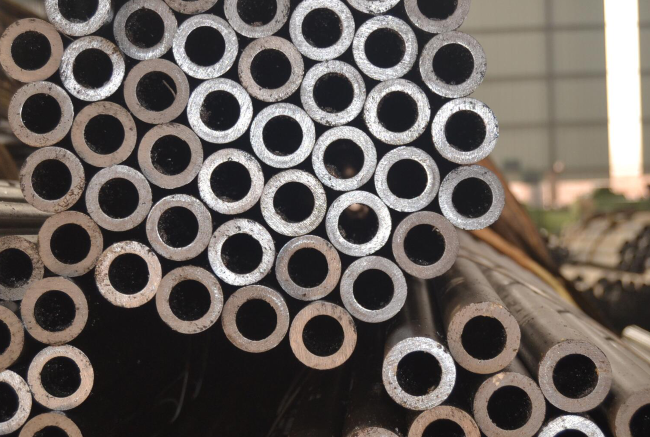
2. Reinforced Series
SCH 80/XS: For applications requiring higher pressure or additional mechanical strength.
Example: The wall thickness of DN100 (4″) SCH 80 is approximately 8.56 mm.
3. Extra-Strength Series
SCH 160/XXS: For high-pressure, high-mechanical-load, or severely corrosive environments.
Example: The wall thickness of DN100 (4″) SCH 160 is approximately 13.49 mm.
4. Thin-walled Series
SCH 5S/SCH 10/SCH 20: Used for low-pressure, only-sealed applications to reduce weight and cost.
Seamless Carbon Steel Pipe Sizes by Application:
Common outer diameter and wall thickness ranges for seamless carbon steel tubes, depending on their application, are as follows:
1. Building Structures (
ASTM A53/
ASTM A500)
Common outer diameter range: 48 mm ~ 325 mm (2″ ~ 12″)
Common wall thickness range: 3.5 mm ~ 16 mm
Applications: Commonly used as columns, beams, and trusses. The wall thickness of seamless structural tubes is determined by structural load-bearing capacity calculations and slenderness ratio, not pressure. For example, a Φ114 mm column commonly uses a wall thickness of 4.5 mm or 6 mm; a Φ219 mm truss tube commonly uses a wall thickness of 8 mm or 10 mm.
2. Mechanical Manufacturing (ASTM A513/ASTM A519)
Common outer diameter range: 6mm ~ 219mm (mainly small diameter)
Common wall thickness range: 1mm ~ 12mm, from thin walls (1-3mm) to extremely thick walls.
Applications: Used for shafts, rollers, hydraulic cylinders, and bearing sleeves. The wall thickness of
seamless mechanical tubes depends on the mechanical design of the part, requiring high dimensional accuracy and surface quality.
3. Fluid Transportation (ASTM A53)
Common outer diameter range: 21mm ~ 610mm
Common wall thickness range: SCH 40 (standard wall thickness), SCH 80 (high pressure applications)
Applications: Commonly used for transporting water, gas, oil, etc. Carbon steel seamless fluid tubes select the schedule number according to the design pressure. SCH 40 can meet the transportation requirements of most media such as water, gas, and oil.
4. Boiler/Pressure Vessel Applications (ASTM A213/ASTM A106)
Common outer diameter range: Mainly small and medium diameters
Common wall thickness range: Relatively thick, adhering to specific standards.
Applications:
Seamless boiler tube requires high-temperature resistance and strength; wall thickness calculations are rigorous, such as Φ42×5, Φ89×10, etc.
5. Petrochemical Industry (
API 5L Seamless/ASTM A53/A106/A179/
A333)
Common outer diameter range: Wide range of sizes from D15 to D600, from instrument tubing to main pipelines.
Common wall thickness range: Extremely wide range, from SCH 40 to SCH 160.
Applications: Selected based on design pressure and medium.
Note:
In actual engineering projects, specifications cannot be arbitrarily selected. The minimum required wall thickness should be determined through strength calculations according to ASME, GB, and other standards, or by directly consulting the ASME B36.10M standard size table. The final selected schedule number and wall thickness must be strictly verified and confirmed using formulas from relevant design specifications (such as ASME B31.1 power piping or B31.3 process piping).
Read more: Seamless Steel Pipe Sizes and Weights
 sales@hu-steel.com
 English
 Español