sales@hu-steel.com
 English
 Español
BS EN 10210 Standard is a very important European standard. Its full title is "Hot Finished Structural Hollow Sections of Non-alloy and Fine Grain Steels - Part 1: Technical Delivery Conditions" and "Part 2: Tolerances, Dimensions and Sectional Properties."
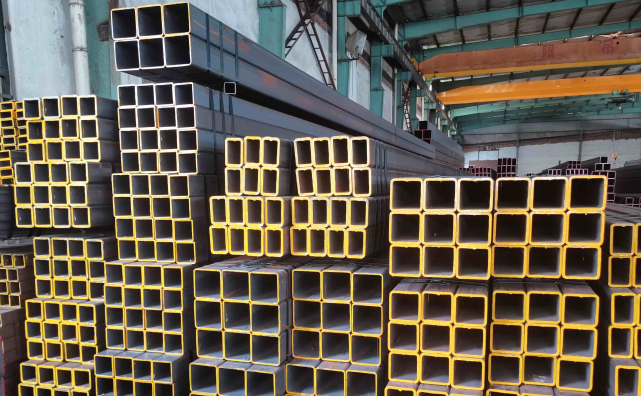
Simply put, BS EN 10210 specifies the material, manufacturing, dimensions, tolerances, sectional properties, and inspection requirements for welded hollow sections (such as square, rectangular, and round tubes) produced by hot forming (hot working) processes for use in building and engineering structures.
| Mechanical Property | Typical Minimum Requirement | Significance & What It Indicates |
|---|---|---|
| Yield Strength (ReH) | ≥ 235 MPa (varies by grade) | The stress at which permanent deformation begins; determines the elastic load-bearing limit. |
| Tensile Strength (Rm) | Minimum value specified (varies by grade) | The maximum stress the material can withstand before fracture; indicates overall strength and safety margin. |
| Elongation (A) | Minimum value specified (varies by grade) | A measure of ductility; higher values indicate better formability and toughness. |
| Impact Energy (KV) | Minimum value specified (varies by grade and temperature) | Measures resistance to impact and brittle fracture; higher values indicate better toughness, especially at low temperatures. |
7. Marking and Certification: Specifies product marking and compliance documentation.
Structural engineers use these tabulated data for structural calculations and design.
Hot forming vs. Cold forming: This is the fundamental difference between EN 10210 and another important standard, EN 10219.
| Feature / Aspect | EN 10210 (Hot-Formed) | EN 10219 (Cold-Formed) |
|---|---|---|
| Forming Process | Pierced, rolled, or extruded from steel billets at high temperatures. | Cold-bent and welded at room temperature from steel sheet/strip. |
| Wall Thickness | Typically thicker walls, heavier weight. | Typically thinner walls, lighter weight. |
| Dimensional Accuracy | Larger tolerances, surface with mill scale (rough, bluish-gray). | High precision, tighter tolerances, smoother surface finish. |
| Corner Radius | Larger outside corner radii, more pronounced round corners. | Smaller outside corner radii, sharper edges. |
| Delivery Condition | Normalized or normalized rolled (improved toughness). | As-formed, no overall heat treatment after forming. |
| Typical Applications | Heavy-duty structures, bridges, heavy machinery, offshore. | Light to medium structures, architectural aesthetics, space trusses. |
| Cost Positioning | "High-performance" version, higher cost. | "Economical & practical" version, high cost-effectiveness. |
▶ For a more detailed comparison, read our full article: [EN 10210 vs EN 10219: Comprehensive Comparison].
EN 10210-1 specifies the technical requirements for welded hollow profiles made of non-alloy and fine-grained structural steel produced by hot forming (hot rolling or hot extrusion). The materials are delivered in normalized or normalized-rolled condition to ensure consistent performance. The most commonly used steel grades under this standard are listed in the table below, along with an explanation of the grade suffixes.
| Steel Grade | Min. Yield Strength (MPa) | Impact Grade | Key Characteristics & Typical Use |
|---|---|---|---|
| S235J2H | 235 | J2 (-20°C) | Basic structural applications, general load-bearing in normal environments. |
| S275J2H | 275 | J2 (-20°C) | General purpose structures, higher strength than S235, suitable for most conventional scenarios. |
| S355J2H | 355 | J2 (-20°C) | High-strength applications, commonly used in bridges, heavy machinery, and critical structures. |
| S355K2H | 355 | K2 (-20°C, higher impact energy) | Demanding applications requiring superior low-temperature impact toughness. |
Grade explanation (e.g., S355K2H):
S: Structural steel.
355: Minimum yield strength is 355 MPa.
K2: Impact toughness grade. Indicates a higher minimum impact energy required when tested at -20°C (higher than J2 grade).
Suffix "H" : Hollow section.
2. Bridge construction: Used in bridge main structures, piers, and support frames.
3. Heavy machinery and equipment: Crane booms, excavator frames, support structures for heavy equipment, agricultural machinery, and other components subject to heavy and dynamic loads.
4. Offshore structures: Oil platforms, port facilities, and other structures require excellent impact and low-temperature resistance.
Q1: What is the main difference between EN 10210 and EN 10219?
A: EN 10210 covers hot-formed hollow sections, produced at high temperatures and typically normalized for improved toughness. EN 10219 covers cold-formed hollow sections, formed at room temperature. Hot-formed sections have thicker walls, larger corner radii, and are suited for heavy-duty, dynamic, or low-temperature applications. Cold-formed sections offer tighter tolerances, smoother surfaces, and are more cost-effective for general structures.
Q2: What does the "H" suffix mean in EN 10210 steel grades (e.g., S355J2H)?
A: In EN 10210, the "H" stands for "Hollow section". It is the standard suffix used to designate that the steel grade applies to a structural hollow section. While the standard's full name includes "Hot finished," the "H" in the grade itself specifically denotes the product shape, not the forming process.
Q3: When should I choose EN 10210 over EN 10219?
A: Choose EN 10210 when your project demands high safety and reliability under heavy, dynamic, or fatigue loads (e.g., bridges, cranes, seismic areas), low-temperature toughness, or involves thicker wall sections. Choose EN 10219 for general static structures, architectural applications, or where tight dimensional tolerances and cost efficiency are priorities.
Q4: Does EN 10210 require CE marking?
A: Yes. EN 10210 products fall under the Construction Products Regulation (CPR) - Regulation (EU) No. 305/2011. Compliance allows manufacturers to affix CE marking, confirming the products meet EU requirements for construction works.
Q5: What tests are required for EN 10210 certification?
A: EN 10210-1 specifies tests including tensile tests, Charpy V-notch impact tests, flattening tests, and flanging tests. The specific requirements and frequency depend on the steel grade, dimensions, and the manufacturer's Factory Production Control (FPC) system.
BS EN 10210 is a comprehensive European product standard for hot-formed structural hollow sections. It defines tubes produced through hot working and normalizing heat treatment processes. Its core advantages lie in its excellent toughness, uniform wall thickness, and wide corner radii, making it particularly suitable for critical structures subject to heavy and dynamic loads or in harsh environments. The choice between EN 10210 and EN 10219 depends on specific design requirements, loading conditions, cost budget, and performance preferences.
Read more:
● Seamless Square & Rectangular Tube
● ASTM A500 Structural Tubing
● S235JRH and S355J2H Structural Steel
● Steel Hollow Sections: What are HSS, SHS, RHS, and CHS?
Related information
Copyright @2017 Hunan Standard Steel Co.,Ltd and Husteel Industry Group All Rights Reserved