sales@hu-steel.com
 English
 Español
A steel billet is a semi-finished steel product obtained by casting molten steel from a steelmaking furnace. It serves as the raw material for further processing into finished steel products such as bars, wire rods, tubes, and profiles.
Steel billets can be classified by production method into two main types: continuous casting billets and die casting (ingot) billets. Die casting was once the dominant process but has been largely phased out in modern steelmaking due to its lower efficiency and higher material loss. Today, continuous casting accounts for the vast majority of global steel billet production.
Continuous cast billets are typically made from carbon steel, low-carbon low-silicon cold-rolled material, high quality carbon structural steel, low-alloy high-strength steel, and special steel.
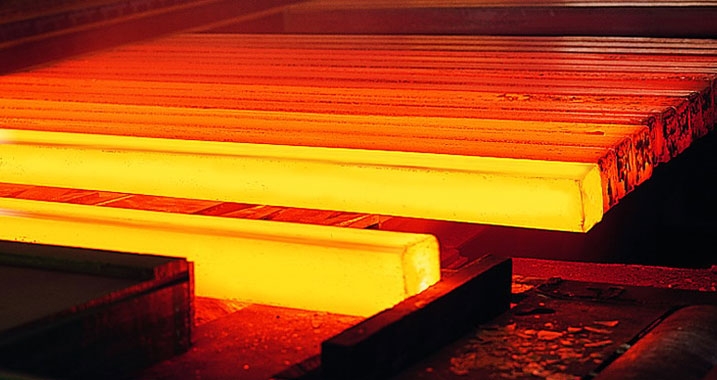
The production of steel billets follows three main routes, depending on the final product and the equipment available.
Route 1: Continuous Casting (Mainstream)
This is the most common method in modern steel plants. Molten steel from the steelmaking furnace is transferred to a continuous casting machine, where it is poured into a water-cooled copper mold. The steel solidifies as it moves through the mold, forming a continuous strand that is then cut into billets of the desired length.
Continuous casting offers several advantages over traditional ingot casting: higher yield, lower energy consumption, better surface quality, and more consistent internal structure. This is why it has become the standard process worldwide.
Route 2: Ingot Casting + Rolling
In this route, molten steel is first poured into ingot molds and allowed to solidify. The resulting ingots are then reheated and rolled through a rolling mill to produce semi-finished products such as billets, blooms, or slabs. This process is still used in some special steel production and smaller mills, but it is less efficient than continuous casting.
Route 3: Ingot Casting + Forging
For certain high-alloy or specialty steels, ingots may be processed through forging equipment instead of rolling mills. Forging produces semi-finished products with superior internal quality, making it suitable for critical applications such as turbine blades, heavy machinery components, and aerospace parts.
| Type | Cross-Section | Typical Use |
|---|---|---|
| Square billet | 100×100 mm to 200×200 mm | Bars, wire rods, rebar |
| Rectangular billet | Up to 400×500 mm | Sections, beams, plates |
| Round billet | φ100 mm to φ350 mm | Seamless pipes, rings |
| Bloom | 200×200 mm to 400×400 mm | Heavy sections, rails, large bars |
| Slab | 150–300 mm thick, 600–2000 mm wide | Flat products, plates, sheets |
△ Round billets are the starting material for seamless steel pipes and rings, where a consistent circular cross-section is essential for the piercing process.
Steel billets are produced according to various international standards, depending on the destination market and end use:
● ASTM (US): ASTM A36, ASTM A572, ASTM A105
● GB/T (China): GB/T 700, GB/T 1591, GB/T 3077
● JIS (Japan): JIS G3101, JIS G3106
● EN (Europe): EN 10025, EN 10250
Steel billets are the starting material for a wide range of products:
● Construction — rebar, wire rod, structural sections
● Automotive — gears, shafts, springs
● Energy — seamless pipes for oil and gas
● Machinery — forging blanks, hydraulic components
● Railway — rails, wheels, axles
Q1: What is the difference between a billet and a bloom?
A billet generally has a square cross-section smaller than 200×200 mm, while a bloom is larger, typically 200×200 mm or above. Both are semi-finished products, but blooms are used for heavier sections and rails.
Q2: Why has continuous casting replaced ingot casting?
Continuous casting offers higher yield (fewer losses), lower energy consumption, better surface quality, and more uniform internal structure. Ingot casting is still used for some specialty steels but is no longer the mainstream process.
Q3: What steel grades are commonly used for billets?
Common grades include carbon steel (Q235, Q345), low-alloy high-strength steel (Q460), and special steel grades for automotive and machinery applications.
Q4: How is billet quality inspected?
Billets are inspected for chemical composition, surface defects, internal soundness (via ultrasonic testing), and dimensional accuracy.
Q5: What is the typical length of a steel billet?
Billets are typically cut to lengths between 3 and 12 meters, depending on the downstream rolling or forging requirements.
Read more:
Related information
Copyright @2017 Hunan Standard Steel Co.,Ltd and Husteel Industry Group All Rights Reserved