sales@hu-steel.com
 English
 Español
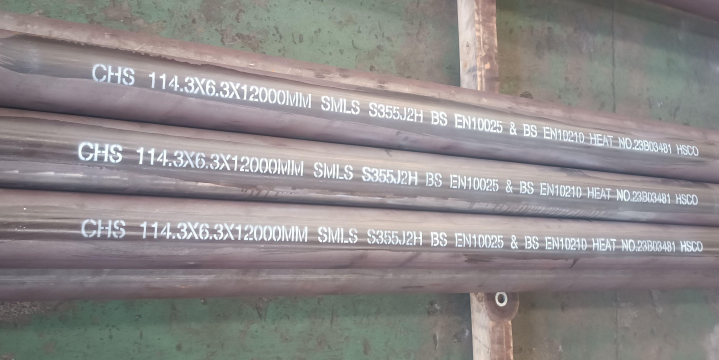
EN 10219 and EN 10210 are two core European standards for structural hollow profiles. Both are harmonized standards under the EU Building Product Regulation (CPR) and are the technical basis for legally affixing the CE marking and entering the European market.
Although their products have similar shapes (round, square, and rectangular tubes) and are widely used in construction, bridges, machinery, and other fields, their most fundamental difference lies in the manufacturing process and the final product condition, which directly affects the material's performance and applicable scenarios.
| Comparison Aspect | EN 10219 (Cold-Formed) | EN 10210 (Hot-Formed) |
|---|---|---|
| Forming Process | Cold-bent and welded at room temperature from steel sheet/strip. | Pierced, rolled, or extruded from billets at high temperatures. |
| Wall Thickness | Typically thinner walls, lighter weight. | Typically thicker walls, heavier weight. |
| Dimensional Accuracy | High precision, tighter tolerances, smoother surface finish. | Larger tolerances, surface with mill scale (rough, bluish-gray). |
| Corner Radius | Smaller outside corner radii, sharper edges. | Larger outside corner radii, more pronounced round corners. |
| Delivery Condition | As-formed, no overall heat treatment after forming. | Normalized or normalized rolled (improved toughness). |
| Impact Toughness | Moderate. | Excellent, particularly suitable for low-temperature and dynamic loads. |
| Typical Applications | Light to medium structures, architectural aesthetics, space trusses. | Heavy-duty structures, bridges, heavy machinery, offshore. |
| Cost Positioning | Economical & practical, high cost-effectiveness. | High-performance version, higher cost. |
| Common Steel Grades | S235JRH, S275J0H, S275J2H, S355J0H, S355J2H, S355K2H. | S235J2H, S275J2H, S355J2H, S355K2H. |
EN 10219 is a harmonized standard published by the European Committee for Standardization (CEN), officially titled "Cold-formed welded structural hollow sections of non-alloy and fine grain steels." It applies to cold-formed and welded hollow structural profiles such as square tubes, rectangular tubes, round tubes, delivered in the as-welded condition without overall heat treatment. These products are widely used in construction, machinery, towers, and other fields, and fall under the EU Construction Products Regulation (CPR, (EU) No 305/2011), requiring CE marking and a Declaration of Performance (DoP). The standard specifies technical delivery conditions including dimensional tolerances, chemical composition, mechanical properties (yield strength, tensile strength, elongation, impact energy), and weldability requirements.
EN 10219 standard is divided into two parts:
1. EN 10219-1: Technical Delivery Conditions - This part specifies the general requirements for chemical composition, mechanical properties, processability (such as weldability), and inspection. The current effective version is EN 10219-1:2006, which supersedes the older version EN 10219-1:1997.2. EN 10219-2: Tolerances, Dimensions and Sectional Properties - This part details the specific dimensional series, permissible deviations, and weight per unit length, and provides the data and methods required to calculate the geometric properties of the section (such as moment of inertia and section modulus). It is the core basis for structural designers to select and calculate materials.
EN 10210 is a harmonized standard published by the European Committee for Standardization (CEN), officially titled "Hot finished structural hollow sections of non-alloy and fine grain steels." It applies to hot-formed (hot-finished) welded and seamless hollow sections such as square, rectangular, and round tubes, which are delivered in the normalized or normalized-rolled condition after overall heat treatment. These products are widely used in critical load-bearing structures including bridges, buildings, and heavy machinery. The standard specifies technical delivery conditions covering dimensional tolerances, chemical composition, mechanical properties (yield strength, tensile strength, elongation), and impact toughness.
1. EN 10210-1: Technical Delivery Conditions - Specifies the technical delivery requirements for hot-finished structural hollow sections, including material grades, chemical composition, mechanical properties, and inspection conditions.
2. EN 10210-2: Tolerances, Dimensions and Sectional Properties - Provides detailed dimension tables, tolerances, and sectional properties (such as cross-sectional area, moment of inertia, section modulus, radius of gyration, etc.) for hot-formed square, rectangular, and round tubes. Structural engineers use these tabulated data for structural calculations and design.
According to the EU Construction Products Regulation (CPR, (EU) No 305/2011), to legally place hollow structural profiles conforming to EN 10219 or EN 10210 standards on the European market, manufacturers must complete the statutory conformity assessment procedures and ultimately issue a Declaration of Performance (DoP) for their products. The manufacturer obtains a Certificate of Conformity and affixes the CE marking.
| Step | Phase | Key Activities |
|---|---|---|
| 1 | Preparation & System Establishment | Understand standards and regulatory requirements; establish FPC (Factory Production Control) system documentation. |
| 2 | Selection & Engagement of a Notified Body | Engage an officially designated EU Notified Body. |
| 3 | Implementation Assessment | Complete the Initial Type Testing (ITT) under Notified Body supervision; undergo on-site audit of the FPC system. |
| 4 | Certification & Declaration | Upon successful audit, Notified Body issues Certificate of Conformity for FPC. Manufacturer signs DoP and affixes CE marking. |
| 5 | Ongoing Surveillance | Undergo regular surveillance by the Notified Body (usually annually) to maintain certificate validity. |
● The CE marking and accompanying performance declaration provide clear, reliable, and comparable product performance data, serving as crucial proof of compliance with building codes and design requirements.
● It ensures that products meet expectations in terms of strength, toughness, dimensional accuracy, and weldability, guaranteeing the safety and reliability of engineering structures.
4. Reasonableness of Fees and Overall Value: Consider fees based on a comprehensive comparison of service content, professionalism, and efficiency, rather than simply pursuing the lowest price.
EN 10219 and EN 10210 are the two major standards for structural hollow profiles in Europe. The key difference is that EN 10219 (cold-formed) represents an economical and reliable standard solution, while EN 10210 (hot-formed) represents a high-performance solution with better toughness and more stable performance. The choice of which standard to use should be determined by specific engineering risks, design life, and performance requirements. Both are cornerstones for ensuring product compliance, transparency, and safety, but they provide precise technical solutions for different structural needs.
Read more:
● S235JRH and S355J2H Structural Steel
Related information
Copyright @2017 Hunan Standard Steel Co.,Ltd and Husteel Industry Group All Rights Reserved