sales@hu-steel.com
 English
 Español

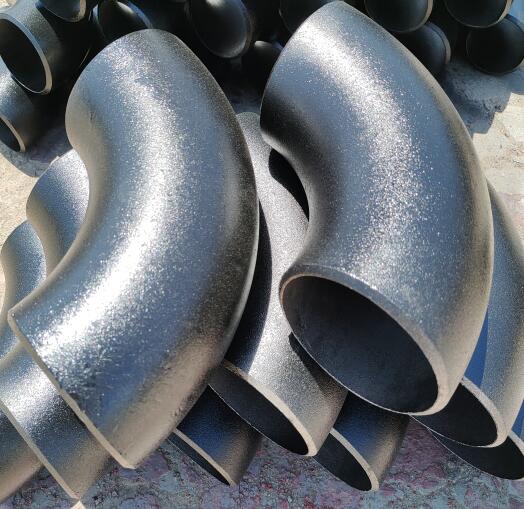
Hot push forming is the most widely used manufacturing process for seamless elbows. It is the primary forming method for carbon steel and alloy steel elbows, and is also used for certain specifications of stainless steel elbows. Among all pipe fittings used in pipeline systems, elbows account for the largest proportion — about 80%. For elbows of different materials and wall thicknesses, different forming processes are selected, and hot push forming is the default choice for most industrial applications.
This article focuses on the hot push forming process itself. For a comparison of all three common forming methods (hot push, stamping, and extrusion), see our comprehensive guide: ▶ [Seamless Elbow Forming Methods – Hot Push, Stamping & Extrusion Compared] .
The hot push forming process uses a specialized elbow pushing machine, a core mold (mandrel), and a heating device. The pipe blank is placed on the mandrel and pushed forward by the pushing machine. As it moves, the blank is heated, expanded, and bent simultaneously — forming the elbow in one continuous operation.
The basic setup:
| Component | Function |
|---|---|
| Pushing machine | Provides the forward force that drives the pipe blank over the mandrel |
| Core mold (mandrel) | Controls the deformation of the blank and determines the final shape and diameter |
| Heating device | Heats the blank to the required forming temperature |
| Pipe blank | The starting material — a seamless pipe section with a diameter smaller than the finished elbow |
The key advantage of hot push forming is its ability to produce elbows with uniform wall thickness. This is achieved through careful control of metal flow during deformation.
The volume-conservation principle:
The diameter of the tube blank is determined according to the law that the volume of the metal material remains unchanged before and after plastic deformation. The tube blank used is smaller in diameter than the finished elbow.
How compensation works:
As the blank is pushed over the mandrel, the metal at the inner arc (the inside of the bend) is compressed. This compressed metal flows and compensates for the thinning that occurs at the outer arc (the outside of the bend) due to expansion. The result is an elbow with wall thickness that remains essentially uniform throughout.
This is the fundamental difference between hot push forming and stamping forming. In stamping, there is no excess metal to compensate for the stretching at the outer arc, so the wall thickness there thins by approximately 10%.
| Heating Method | Description | Typical Application |
|---|---|---|
| Medium frequency induction heating | Heating coil (single or multiple coils) surrounds the pipe blank; precise temperature control | Most common method for carbon steel and alloy steel elbows |
| High frequency induction heating | Similar to medium frequency but with higher heating rate | Used for smaller diameter or thin-walled elbows |
| Flame heating | Gas flame directly heats the blank | Used when induction heating is not available |
| Reverberatory furnace heating | Blank is heated in a furnace before pushing | Used for specific product requirements or energy conditions |
The choice of heating method affects the heating rate and temperature uniformity, and ultimately the quality of the formed elbow.
| Aspect | Details |
|---|---|
| Wall thickness | Uniform — the metal from the inner arc compensates for thinning at the outer arc |
| Production efficiency | High — suitable for continuous, mass production |
| Surface finish | Good — smooth appearance |
| Applicable materials | Carbon steel, alloy steel, and some stainless steel |
| Typical size range | DN15 to DN600 (most common) |
| Tooling cost | Moderate — lower than stamping for large production runs |
To ensure the quality of hot push formed elbows, the following points should be checked:
1. Wall thickness uniformity: Verify that the wall thickness at the outer arc meets the standard requirement. ASME B16.9 limits wall thickness reduction to 12.5% of nominal thickness. Use an ultrasonic thickness gauge, not a caliper.
2. Heating temperature: The forming temperature must be within the correct range for the material. Too low a temperature can cause insufficient plasticity and micro-cracks; too high a temperature can cause grain growth and reduced toughness.
3. Surface quality: Check for cracks, folds, or scratches on the inner and outer surfaces.
4. Dimensional accuracy: Verify the center-to-end distance, outside diameter, and angle against the ASME B16.9 standard.
5. Heat treatment: Confirm that the required heat treatment has been performed (normalizing or annealing for carbon steel, solution treatment for stainless steel).
5. Cost-effective: For medium to large production runs, the cost per elbow is lower than stamping or extrusion.
Q1: What is the difference between hot push forming and stamping forming?
A: Hot push forming produces elbows with uniform wall thickness because the metal from the inner arc compensates for thinning at the outer arc. Stamping forming has no such compensation, so the outer arc thins by approximately 10%. Hot push forming is also faster and more suitable for mass production.
Q2: What materials can be hot push formed?
A: Hot push forming is primarily used for carbon steel and alloy steel elbows. It is also suitable for certain specifications of stainless steel elbows. For thin-walled stainless steel elbows requiring high precision, extrusion forming may be preferred.
Q3: What is the typical size range for hot push formed elbows?
A: Hot push forming is most commonly used for elbows from DN15 to DN600. For larger diameters (above DN600), other methods such as middle plate welding may be used.
Q4: How is the heating temperature controlled during hot push forming?
A: The heating temperature depends on the material being formed. For carbon steel, the typical forming temperature range is approximately 750°C to 950°C. Temperature is monitored and controlled throughout the process to ensure consistent quality.
Hot push forming is the most common and cost-effective method for manufacturing seamless elbows. Its ability to produce uniform wall thickness, combined with high production efficiency and good surface finish, makes it the preferred choice for carbon steel and alloy steel elbows in most industrial applications. For a comparison of all forming methods, refer to our overview guide. For specific dimensions, always refer to the ASME B16.9 standard tables.
Read more:
● Carbon Steel Seamless Elbow – Standards & Selection
● Pipe Elbow Pressure Rating and Selection Guide
● ASME B16.9 Pipe Elbow Dimensions & Sizes– Long & Short Radius Elbow
Related information
Copyright @2017 Hunan Standard Steel Co.,Ltd and Husteel Industry Group All Rights Reserved