sales@hu-steel.com
 English
 Español
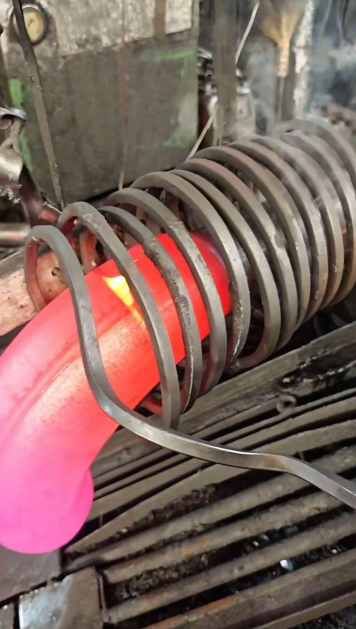
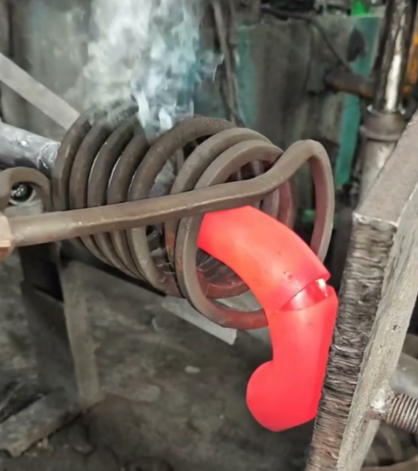
Why the wall thickness stays uniform:
The tube blank diameter is smaller than the finished elbow diameter. As the blank is pushed over the mandrel, the metal at the inner arc is compressed and flows to compensate for the thinning at the outer arc caused by expansion. This volume-conservation principle is what gives hot push forming its characteristic uniform wall thickness.
Key characteristics:
| Aspect | Details |
|---|---|
| Wall thickness | Uniform — the metal from the inner arc is pushed to compensate for the thinning at the outer arc |
| Production efficiency | High — suitable for continuous, mass production |
| Surface finish | Good — smooth appearance |
| Applicable materials | Carbon steel, alloy steel, and some stainless steel |
| Typical size range | DN15 to DN600 (most common) |
Why it is preferred: Hot push forming produces elbows with uniform wall thickness and good mechanical properties at a relatively low cost, making it the default choice for most industrial piping applications.
Stamping forming is an older method that has been largely replaced by hot push forming for mass production. However, it is still used for small-batch production, thick-walled elbows, or special sizes where hot push forming is not economical.
How it works:
A pipe blank is placed in a die. The upper and lower dies close, and a press compresses the blank, forcing it to flow along the gap between the inner and outer dies to form the elbow.
Key characteristics:
| Aspect | Details |
|---|---|
| Wall thickness | Uneven — the outer arc thins by approximately 10% due to stretching |
| Production efficiency | Lower — suitable for small batches |
| Surface finish | Acceptable but not as good as hot push forming |
| Applicable materials | Carbon steel, alloy steel, stainless steel |
| Typical size range | Small to medium diameters, thick or thin walls |
When to use it: Stamping forming is a practical choice when production volume is low, the wall thickness is outside the range suitable for hot push forming, or the required size is non-standard.
| Aspect | Details |
|---|---|
| Wall thickness | Uniform — tightly controlled |
| Production efficiency | Lower — not suitable for mass production |
| Surface finish | Excellent — smooth, bright surface |
| Applicable materials | Stainless steel, copper, and other thin-walled materials |
| Typical size range | Small to medium diameters, thin walls |
When to use it: Extrusion forming is preferred when high dimensional accuracy and a smooth surface finish are required, particularly for stainless steel elbows used in food, pharmaceutical, or high-purity applications.
| Comparison Item | Hot Push Forming | Stamping Forming | Extrusion Forming |
|---|---|---|---|
| Wall thickness uniformity | Good | Fair (outer arc thins ~10%) | Excellent |
| Production efficiency | High | Low | Low |
| Surface finish | Good | Fair | Excellent |
| Tooling cost | Moderate | High (large molds) | High (precision dies) |
| Best for | Mass production of carbon/alloy steel elbows | Small batches, thick/thin walls | Thin-walled stainless steel, high precision |
| Typical materials | Carbon steel, alloy steel | Carbon steel, alloy steel, stainless | Stainless steel, copper |
The choice of forming method depends on several factors:
1. Material: Carbon steel and alloy steel elbows are most commonly hot push formed. Stainless steel elbows may be hot push formed, stamping formed, or extrusion formed, depending on wall thickness and precision requirements.
2. Wall thickness: Hot push forming is suitable for standard wall thicknesses. Stamping forming is often used for very thick or very thin walls. Extrusion forming is preferred for thin-walled stainless steel.
3. Production volume: For large quantities, hot push forming is the most economical. For small batches or non-standard sizes, stamping forming may be more practical.
4. Precision requirements: If tight dimensional tolerances and a smooth surface are critical, extrusion forming is the best choice.
5. Cost: Hot push forming offers the best balance of quality and cost for most applications. Stamping and extrusion forming are typically more expensive per unit but may be necessary for specific requirements.
Regardless of the forming method, the following quality checks are recommended:
1. Wall thickness: Check for thinning at the outer arc. Standards typically limit wall thickness reduction to 12.5% of nominal thickness. Use an ultrasonic thickness gauge, not a caliper.
2. Ovality: The elbow cross-section should remain circular within specified tolerances.
3. Surface defects: Inspect for cracks, folds, or scratches.
4. Hardness: Verify that the hardness is within the specified range for the material.
5. Heat treatment: Confirm that the required heat treatment (normalizing, annealing, or solution treatment) has been performed.
Seamless elbows are made in three main ways: hot push forming, stamping, and extrusion. Each has its place.
Hot push forming is the go-to method for carbon steel and alloy steel elbows — it's fast, consistent, and cost-effective. Stamping is used when you need small batches or non-standard sizes that hot push can't handle. Extrusion is the choice for thin-walled stainless steel where precision and surface finish matter most.
Which one to pick depends on your material, wall thickness, production volume, precision needs, and budget. For most jobs, hot push forming gives you the best balance of quality and cost. For exact dimensions, check the ASME B16.9 elbow size chart.
Read more:
● Carbon Steel Seamless Elbow – Standards & Selection
● Pipe Elbow Pressure Rating and Selection Guide
● ASME B16.9 Pipe Elbow Dimensions & Sizes– Long & Short Radius Elbow
Related information
Copyright @2017 Hunan Standard Steel Co.,Ltd and Husteel Industry Group All Rights Reserved