sales@hu-steel.com
 English
 Español
A carbon steel (CS) seamless elbow is a pipe fitting used to change the direction of fluid flow in a pipeline system. It is widely used in petroleum, chemical, power generation, shipbuilding, and construction industries. Because it has no weld seams, a seamless elbow offers higher strength and better pressure resistance than a welded elbow, making it the preferred choice for high-pressure, high-temperature, and critical service environments.
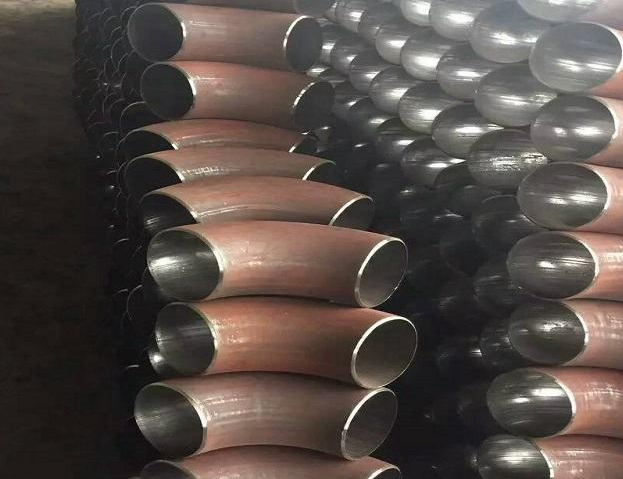
Carbon steel seamless elbows are manufactured to several material standards, depending on the service conditions.
● ASTM A234 WPB is the most widely used standard for carbon steel elbows. It is suitable for moderate and high-temperature services, typically ranging from -29°C to 425°C. It offers good weldability and reliable mechanical properties, and is commonly used in petroleum, chemical, and natural gas piping systems.
● For low-temperature applications, ASTM A420 WPL6 is used, which provides excellent toughness down to -46°C. It is commonly specified for LNG and low-temperature process pipelines.
● For high-temperature services above 425°C, alloy steel grades such as ASTM A234 WP11 or WP22 may be required.
Note: The material standard determines the chemical composition and mechanical properties. The dimensions of the elbow (outside diameter, center-to-end distance, wall thickness) are governed by a separate dimensional standard, most commonly ASME B16.9.
Once the material standard is confirmed, the next step is to determine the correct dimensions for your piping system.
| Type | Radius | Characteristics | Typical Application |
|---|---|---|---|
| Long Radius (LR) | R = 1.5D | Lower flow resistance, less erosion, standard choice | Most piping systems, especially high-pressure and high-flow services |
| Short Radius (SR) | R = 1.0D | More compact, higher flow resistance | Installation where space is severely limited |
Selection rule: Unless space is extremely constrained, always prefer Long Radius (LR) elbows. Short radius elbows should only be used when installation space requires it.
| Schedule | Typical Pressure Range | Applications |
|---|---|---|
| Sch10 | Low pressure | Low-pressure water, air, and non-critical services |
| Sch40 / STD | Up to 2.5 MPa | General water, oil, and gas services |
| Sch80 / XS | Up to 5.0 MPa | Higher pressure or added corrosion allowance |
| Sch160 / XXS | Above 10.0 MPa | High-pressure and critical services |
Higher Schedule = thicker wall = higher pressure capacity. The correct schedule must always be verified against the system design pressure and temperature.
△ Need specific dimensions? → [View the complete ASME B16.9 Elbow Dimensions Chart]
ASTM A350 LF2 is a forged carbon steel material suitable for low-temperature and high-pressure service. It has good low-temperature performance and is widely used in low-temperature piping systems, containers, and equipment.
| Angle | Function | Typical Application |
|---|---|---|
| 45° Elbow | Gradual directional change | Reduces pressure drop compared to 90° elbows |
| 90° Elbow | Right-angle direction change | Most commonly used; standard for most piping layouts |
| 180° Elbow | Complete reversal of flow direction | Return bends, heat exchangers, and U-turn connections |
▶ For detailed of each angle type, refer to the [Steel Pipe Elbow Angles].
Different industries have different priorities when selecting elbows. The table below summarizes common material, radius, and schedule choices for typical applications, serving as a practical reference for your project.
| Industry | Typical Elbow Selection | Key Consideration |
|---|---|---|
| Oil & Gas | ASTM A234 WPB, LR, Sch40/80 | High pressure, long-distance transport |
| Petrochemical | A234 WPB or WP11, LR | High temperature, corrosion resistance |
| Power Generation | A234 WP11/WP22, LR | High-temperature steam, creep resistance |
| LNG / Cryogenic | ASTM A420 WPL6 or A350 LF2 | Low-temperature toughness |
| Water Supply | A234 WPB, LR or SR, Sch10/40 | Cost-effective, low pressure |
| Shipbuilding | A234 WPB, LR | Corrosion resistance, compact layout |
Q1: What is the difference between a seamless elbow and a welded elbow?
A: A seamless elbow is formed from a single piece of seamless pipe with no weld seams, offering higher strength and better pressure resistance. A welded elbow is made by welding two or more pieces together and has one or more weld seams. Seamless elbows are preferred for high-pressure, high-temperature, and critical services.
Q2: What is the difference between long radius and short radius elbows?
A: Long radius (LR) elbows have a bending radius of 1.5 times the pipe diameter (R=1.5D), offering lower flow resistance. Short radius (SR) elbows have a bending radius of 1.0D and are used only when installation space is limited. LR is the standard choice for most applications.
Q3: What is the maximum temperature for ASTM A234 WPB elbows?
A: ASTM A234 WPB is suitable for service temperatures up to 425°C. Above this temperature, graphitization may occur, and alloy steel grades such as A234 WP11 or WP22 should be used instead.
Related Resources:
[Seamless Elbow Forming Methods] – Hot Push, Stamping & Extrusion Compared
[45 Degree Elbow – Selection Guide] – Detailed guide for 45° elbows.
[90 Degree Elbow – Standards, Materials & Selection] – Detailed guide for 90° elbows.
[Concentric Reducer vs. Eccentric Reducer: When to Use Which?] – How to choose the right reducer.
Related information
Copyright @2017 Hunan Standard Steel Co.,Ltd and Husteel Industry Group All Rights Reserved