sales@hu-steel.com
 English
 Español
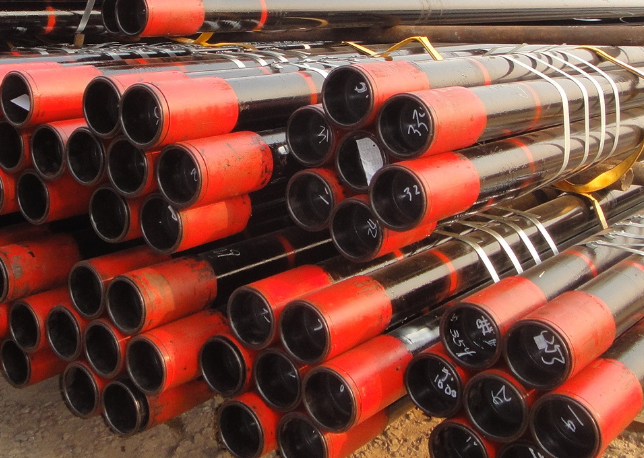
Oil casing pipe refers to the steel pipe used to support the well wall of oil and gas wells to ensure the normal operation of the entire oil well during the drilling process and after completion. There are two main types of steel pipes commonly used as raw materials for petroleum casing: Seamless Casing and ERW Casing. So, what's the difference between the two? Let's analyze and compare in detail below.
ERW (Electric Resistance Welded) pipe refers to a straight seam welded pipe manufactured through high-frequency resistance welding process. The raw material steel plate (coil plate) of ERW welded pipe is made of low carbon micro-alloy steel rolled by TMCP (Thermo-Mechanical Control Process).
ERW casing offers better dimensional accuracy, wall thickness uniformity, and cost-effectiveness for most standard oil and gas applications. Seamless casing remains the preferred choice where a weld-free structure is mandatory—typically in certain high-pressure, sour service, or critical environments where the absence of a weld seam is a design requirement. Continue reading for detailed technical comparisons.
| Comparison Item | Seamless Casing | ERW Casing |
|---|---|---|
| Outer Diameter Tolerance | Large fluctuation, difficult to control accurately | Small fluctuation, accurately controlled |
| Wall Thickness Tolerance | ±5~10%t (larger deviation) | ±0.05mm (highly uniform) |
| Surface Quality | May have surface defects from billet; spiral path marks | Superior, based on hot-rolled coil surface quality |
| Ovality | Larger fluctuation | Small fluctuation, more round |
| Tensile Strength | Generally at upper limit; plasticity at lower limit | Balanced, strength and plasticity optimized |
| Hardness Uniformity | Less uniform | Highly uniform across the coil |
| Grain Size | Columnar crystal area, shrinkage cavity, and looseness may exist | Fine grain, dense structure, controlled cooling |
| Collapse Resistance | Lower due to wall thickness and ovality variations | Higher, due to uniform wall thickness and roundness |
| Impact Toughness | Moderate | Higher (weld impact energy can reach ≥60% of base metal) |
| Burst Test Performance | Standard | Much higher than standard requirements |
| Straightness | More difficult to control | Better, due to cold processing and online straightening |
| Casing Consumption per 10,000m | Higher steel consumption | 5-10% lower, reducing purchase cost |
Note: ERW casing's raw material—hot-rolled coil—is produced through microalloying, out-of-furnace refining, and controlled cooling and rolling, ensuring consistent and superior performance across all dimensions.
1. Outer diameter tolerance
The wall thickness of ERW steel pipes is uniform and its wall thickness tolerance is negligible, while the control accuracy limit of the wall thickness difference of seamless steel pipes is ±5%t, which is generally controlled at ±5~10%t. In order to ensure that the minimum wall thickness can meet the standard requirements and performance, the only solution is to increase the wall thickness appropriately. Therefore, for casing of the same specifications and weight, ERW steel pipes are 5 to 10% longer than seamless steel pipes, or even more, which reduces the steel consumption of casing per 10,000 meters of footage by 5 to 10%. Even at the same price, ERW casing can virtually save users 5% to 10% of the purchase cost.
● Standard Oil & Gas Wells: Choose ERW Casing – offers superior dimensional accuracy, uniform wall thickness, and 5-10% cost savings.
● High-Pressure / Sour Service / Critical Wells: Choose Seamless Casing – required where the absence of a weld seam is mandatory for design or safety reasons.
● Cost-Sensitive Projects: Choose ERW Casing – reduces steel consumption and purchase cost without compromising API performance.
● Collapse / Burst Critical Applications: Choose ERW Casing – outperforms seamless in collapse and burst tests due to better dimensional uniformity.
Q1: What is the main difference between seamless casing and ERW casing in practical application?
A: The fundamental difference lies in the manufacturing method. Seamless casing has no weld seam, making it suitable for critical, high-pressure, or sour service environments where weld integrity is a concern. ERW casing offers superior dimensional accuracy (tighter OD and wall thickness tolerances), better collapse resistance, and significant cost savings (5-10% less steel consumption). For most standard oil and gas wells, ERW casing is the more economical and technically sound choice.
Q2: Why does ERW casing have better collapse resistance than seamless casing?
A: Collapse resistance depends heavily on geometric uniformity—specifically, wall thickness consistency and roundness (ovality). ERW casing is cold-formed from high-precision hot-rolled coils, resulting in extremely uniform wall thickness (tolerance as tight as ±0.05mm) and superior roundness. Seamless casing, formed through hot piercing and rolling, inevitably has larger wall thickness variations (±5-10%) and ovality, which reduce its resistance to external collapse pressure.
Q3: Is ERW casing's weld seam a weak point for performance?
A: Modern ERW casing, manufactured with controlled welding parameters and using high-quality low-carbon micro-alloyed steel (TMCP), has weld impact toughness that can reach 60% or more of the base metal. With further process optimization, it can approach parent metal performance. Tensile, burst, and collapse tests confirm that ERW casing meets or exceeds API requirements. The weld seam is not a performance bottleneck when manufactured to high standards.
Q4: How much cost can I save by choosing ERW casing over seamless casing?
A: For the same specification and weight, ERW casing can be 5-10% longer than seamless casing because its thinner, more consistent wall thickness reduces the steel consumption per meter. This translates directly to 5-10% lower material costs for the same footage—a significant saving for large-scale drilling projects.
In most conventional oil and gas applications, ERW casing is the preferred choice due to its better dimensional accuracy, consistent mechanical properties, and significant cost advantages. Seamless casing remains irreplaceable in specific high-pressure, sour, or critical environments where the absence of a weld seam is a requirement. Evaluate your well conditions and select accordingly.
Read more:
● What are the Grades of OCTG Casing?
● Seamless Casing Specifications
Related information
Copyright @2017 Hunan Standard Steel Co.,Ltd and Husteel Industry Group All Rights Reserved