sales@hu-steel.com
 English
 Español
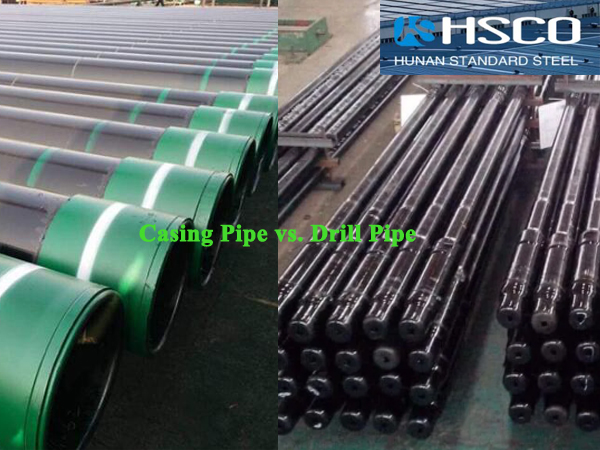
Casing pipe and drill pipe are both essential to oil and gas drilling, but they serve completely different functions.
Casing pipe: It is a large-diameter steel pipe lowered into the wellbore and cemented in place. Its job is to stabilize the wellbore, prevent collapse, and isolate different underground formations to keep oil, gas, and water where they belong.
Drill pipe: It is a smaller, thicker-walled steel tube that connects the surface rig to the drill bit. It transmits rotation and torque to the bit, circulates drilling fluid down the hole, and is repeatedly added or removed as drilling progresses.
Here’s a quick overview of the key differences:
|
Comparative Dimensions |
Casing Pipe |
Drill Pipe |
|
Primary Function |
Support wellbore, isolate formations |
Transmit torque, circulate drilling fluid |
|
Installed |
Permanently cemented in the well |
Temporarily used, pulled out after drilling |
|
Load Type |
External collapse, internal pressure |
Tension, torsion, bending, fatigue |
|
Connection |
Coupling (threaded) |
Tool joint (male/female pin and box) |
|
Manufacturing Standard |
API 5CT |
API 5DP |
|
Common Steel Grades |
J55, K55, N80, L80, P110 |
E75, X95, G105, S135 |
Oil casing and drill pipe play different roles in the drilling process.
Casing is used during and after drilling to:
● Support the wellbore walls and prevent collapse
● Isolate freshwater zones and prevent contamination
● Seal off high-pressure zones to prevent blowouts
● Provide a permanent flow path for oil and gas production
Drill pipe is used only during the drilling phase to:
● Transmit rotational power from the surface to the drill bit
● Circulate drilling fluid to cool the bit and carry cuttings to the surface
● Allow the drill string to be extended as the hole gets deeper
We’ll break down each of these points in more detail below.
The materials of oil casing pipe and drill pipe also vary.
Most casing pipes are made from carbon steel or low-alloy steel (grades like J55, N80, P110), which offers the best balance of strength and cost. Stainless steel or corrosion-resistant alloys (such as 13Cr) are used only in wells with high H₂S or CO₂ corrosion, where added resistance justifies the higher cost.
Drill pipe is made from higher-strength alloy steels (grades like E75, G105, S135). Aluminum alloy drill pipe exists but is a niche product used only where weight reduction is critical, such as in some horizontal or extended-reach drilling.
Casing is a uniform-diameter steel tube with threaded connections at each end. It is run into the hole in sections and cemented in place. Casing strings come in different diameters (e.g., 20″, 13-3/8″, 9-5/8″), with larger sizes run first and smaller sizes run deeper.
Drill pipe is also uniform in diameter but has thicker, heavier “tool joints” at each end. The pipe body is relatively thin-walled to reduce weight, while the joints are thick and strong to handle high torque and repeated make-and-break operations. Drill pipe is designed to be repeatedly connected and disconnected as the drill string is tripped in and out of the hole.
Performance and Design Focus Comparison:
|
Characteristics |
Casing Pipe |
Drill Pipe |
|
Main Materials |
Carbon steel, low alloy steel (stainless steel or corrosion-resistant alloy for corrosive environments) |
High-strength alloy steel (such as chromium-molybdenum steel) |
|
Key Performance Requirements |
Crushing resistance, internal pressure resistance, corrosion resistance |
Tensile strength, torsional strength, fatigue resistance, wear resistance |
|
Wall Thickness Characteristics |
Uniform wall thickness, determined by outer diameter and steel grade |
Relatively thin wall thickness, but thickened at tool joints |
|
Length Specifications |
Single length is mostly R-2 (approximately 9-10 meters) |
Single length is mostly R-2 |
|
Special Structures |
Bottom end with float shoe/float collar, some with centralizer |
High-strength tool joints welded to both ends |
There are different standards for oil casing pipe and drill pipe. The American Petroleum Institute (API) sets manufacturing standards for oil and gas well drill pipe and casing to ensure the safety and reliability of drilling operations.
Although drilling casing and drill pipe are different in structure and purpose, they are related to each other. That is, during the drilling process, the casing is fed into the wellbore layer by layer through the drill pipe, and penetrates the drill pipe. It serves as a bridge between surface equipment and bottom-hole work, and the two are closely related to each other.
Collaborative Working Relationship:
|
Operation Stage |
Main Pipe Material |
Brief Description of Function |
|
Drilling Stage |
Drill Pipe (+Drill Collar, Drill Bit) |
Continuously extended, driving the drill bit to break rocks and establish the wellbore |
|
Completion Stage |
Casing (+Cement) |
Run to the predetermined depth, cement the well, and isolate the formation. |
|
Production Stage |
Tubing |
Run into the casing to serve as a dedicated channel for oil and gas production. |
Casing and drill pipe are not interchangeable. Casing stays in the well to support and seal it; drill pipe is the temporary tool that makes the hole. Both are essential, and selecting the right grade, size, and connection type for each is critical to drilling success.
A: No. Casing is a permanent structural component, while drill pipe is a temporary tool. They have different mechanical properties and thread types.
A: It depends on the steel grade. Drill pipe uses higher-strength alloys like S135 steel to handle torque and tension, while casing like P110 is designed for collapse and internal pressure resistance.
A: Casing uses API threaded couplings, while drill pipe uses tool joints – male and female threaded connections that are designed for frequent make-up and break-out.
A: Casing is cemented to seal off formations and prevent fluid migration. Drill pipe is temporary and must be removed after drilling is complete.
A: Not typically. Casing follows API 5CT grades (J55, N80, P110), while drill pipe follows API 5DP grades (E75, X95, G105, S135), even when the number is similar.
Related technical articles you might be interested in:
● Drilling Casing Specifications and Dimensions
● Types of Drilling Casing Pipe
● Drill Pipe Structure and Common Specifications
Related information
Copyright @2017 Hunan Standard Steel Co.,Ltd and Husteel Industry Group All Rights Reserved