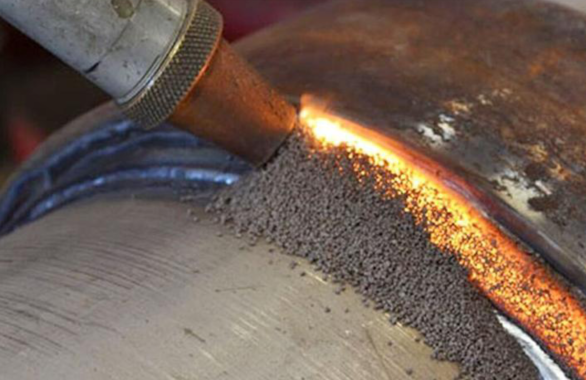
Submerged arc welding (SAW), also known as submerged arc automatic welding, is a fusion welding method where an electric arc burns under a layer of granular flux. As one of the most efficient mechanized welding methods available today, its welding process is completed under the protection of flux, achieving automation and high efficiency.
Its advantages, such as high deposition rate, excellent weld quality, high production efficiency, and minimal arc light and fumes, make it the preferred process for long straight welds or large-diameter circumferential welds. It is the primary welding method in the manufacture of heavy pressure vessels, large-diameter pipes (such as LSAW Pipe/SSAW Pipe), ships, bridges, and other important steel structures.
In recent years, despite the emergence of various new, highly efficient, and high-quality welding methods, submerged arc welding remains firmly established in its advantageous application areas (large-volume, long, flat welds). In terms of the weight share of deposited metal in industrial manufacturing, submerged arc welding has consistently maintained a stable proportion of approximately 10%, fully demonstrating its irreplaceable core role in the manufacture of heavy and critical structures.
Submerged Arc Welding Process Principle:
During welding, an electric arc is generated between the continuously fed welding wire and the base metal under a flux layer. The arc heat melts the welding wire, part of the flux, and the base metal, forming a molten pool. After the molten pool solidifies, a weld is formed, and the surface is covered with easily removable slag. The entire process is automated, with stable parameters and good reproducibility.
Submerged Arc Automatic Welding Process:
Submerged arc automatic welding is a welding method in which the electric arc burns under a flux layer, and the entire process is completed automatically by machinery.
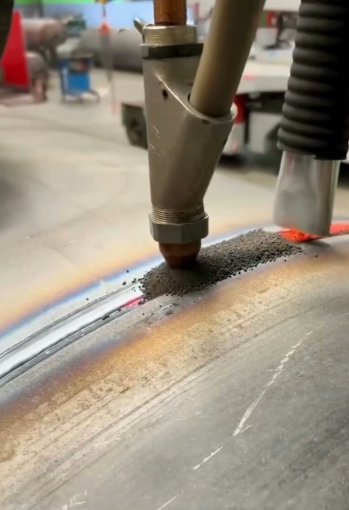
1. Preparation: Granular flux is evenly applied to the joint of the workpiece through a funnel. The bare welding wire is fed into the welding area through a contact tip by a wire feeding mechanism.
2. Arc Ignition and Welding: After energizing, the welding wire and the workpiece ignite the electric arc under the flux layer. The arc heat melts the local flux, welding wire, and base metal, forming a molten metal pool protected by slag.
3. Automatic Movement: The welding carriage (integrating wire feeding mechanism, flux funnel, and control panel) carries the electric arc and moves at a constant speed along the weld seam. The metal in front continuously melts, while the molten pool behind cools and solidifies to form the weld seam, and the slag solidifies into a slag shell.
4. Material Roles: The welding wire serves as both filler metal and electrode, while the flux plays a role in protection, metallurgical treatment, and improving weld formation. This separate design allows for independent optimization; for example, H08A welding wire combined with HJ431 flux is often used for welding low-carbon steel. High-capacity DC or AC arc welding power supplies are commonly used.
Advantages and Limitations of Submerged Arc Welding:
 Advantages:
1. High Weld Quality: The molten pool is well protected, resulting in fewer impurities in the weld metal. With appropriate welding process selection, stable, high-quality welds are more easily obtained.
2. Extremely high production efficiency: The wire extension length (from the tip of the contact nozzle to the arc tip) of submerged arc welding is much shorter than that of manual arc welding, generally around 50mm. Moreover, it uses bare wire, avoiding the problem of the electrode coating turning red-hot when the current is increased. This allows for the use of a larger current (5-10 times greater than manual welding), resulting in greater penetration and higher productivity. For butt welds under 20mm, beveling and gaps are unnecessary, reducing the amount of filler metal.
3. Good working conditions: In addition to reducing the labor intensity of manual operation, the arc light is embedded under the flux layer, eliminating arc radiation, reducing fumes, and increasing automation while lowering labor intensity.
4. Material and energy savings: No electrode head loss, reducing beveling filler metal for medium and thick plates; high thermal efficiency.
Limitations:
a. Limited location: Typically only suitable for horizontal or small-angle (<15°) welds.
b. Poor flexibility: The equipment is bulky and unsuitable for short welds, irregular welds, and operations in confined spaces.
c. High preparation requirements: Strict requirements are placed on workpiece assembly accuracy, beveling, and pre-weld cleaning.
d. Invisible process: Welding parameters must be strictly monitored and consistently controlled to ensure quality.
e. High initial investment: Requires specialized equipment and flux recovery systems.
Strong Thickness Adaptability and Process Options:
Submerged arc welding is particularly suitable for welding medium to thick plates (typically 6mm to over 300mm). Its process options are flexible:
a. Single-wire welding: The most basic and widely used method.
b. Multi-wire welding: Using parallel twin wires, tandem twin wires, or multiple wires, it can significantly increase deposition efficiency and welding speed, used for ultra-thick plates or applications with extremely high productivity requirements. For thick plates, the standard practice is to use multi-pass welding with beveling to precisely control heat input and microstructure.
Semi-automatic Submerged Arc Welding:
Semi-automatic submerged arc welding primarily involves flexible hose welding. Its characteristic feature is the use of a relatively fine diameter welding wire (2mm or less), which is fed into the molten pool through a curved hose. Arc movement is done manually, while wire feeding is automatic. Semi-automatic welding can replace automatic welding for welding some curved and shorter welds, mainly used for fillet welds, but also for butt welds.
Fluoride and Wire Selection:
Matching the flux and welding wire is key to maximizing the potential of submerged arc welding. Selecting the appropriate flux and welding wire for a specific submerged arc welding process is crucial for achieving optimal results. While submerged arc welding alone is highly efficient, productivity and efficiency can be further improved based on the welding wire and flux used. The flux not only protects the weld pool but also contributes to the mechanical properties of the weld and increases productivity. The flux formulation has a significant impact on these factors, affecting current carrying capacity and slag release. Current carrying capacity refers to the ability to achieve the highest possible deposition efficiency and a high-quality weld profile. Slag release from specific fluxes influences flux selection, as some fluxes are better suited to certain welding designs than others.
Once the welding wire for submerged arc welding is selected based on the base steel grade, the choice of matching flux becomes crucial in determining the overall performance of the weld. Flux not only provides protection but also directly affects the mechanical properties of the weld metal (especially impact toughness), crack resistance, defect rate, and welding productivity through metallurgical reactions.
Fluoride consumption is typically measured as the ratio of flux to the amount of wire deposited. For conventional fused fluxes, the consumption coefficient is approximately 1.0 to 1.2 (i.e., the weight of flux consumed is approximately 1.0 to 1.2 times the weight of the deposited wire). Sintered fluxes (especially ceramic fluxes), due to their lower bulk density and better process adaptability, typically consume 10%-30% less per unit weight than fused fluxes under the same process effect, and further reduce process losses due to their excellent slag removal properties.
Fluoride Types:
Submerged arc welding flux selection options include active and neutral types. A fundamental difference is that active fluxes alter the chemical properties of the weld, while neutral fluxes do not. Active fluxes are characterized by the presence of silicon and manganese. These elements help maintain weld tensile strength at high heat inputs, help keep the weld smooth at high travel speeds, and provide good slag release.
a. Neutral fluxes: Do not significantly alter the weld chemical composition, suitable for multi-pass welding, and avoid the accumulation of harmful elements.
b. Active fluxes: Contain deoxidizing elements such as silicon and manganese, which stabilize the arc, improve weld formation and slag removal, especially beneficial for single-pass or double-pass welding, but may not be suitable for multi-pass welding.
In general, active fluxes can help reduce the risk of poor weld quality and costly post-weld cleaning and rework. However, remember that active fluxes are generally best suited for single-pass or double-pass welding. Neutral fluxes are better for large multi-pass welding because they help avoid forming brittle, crack-sensitive welds.
Wire selection:
Solid wire: The most widely used, combined with flux to provide the required weld properties. Metal-cored welding wire: Can improve deposition efficiency by 15%-30% while reducing heat input and deformation risk, making it the preferred choice for high-efficiency welding.
When Should Submerged Arc Welding be Chosen?
Submerged arc welding is ideal when your product meets the following characteristics:
1. Structural form: Features long straight weld seams or large-diameter circumferential seams (such as longitudinal seams in pipes and circumferential seams in cylinders) to fully leverage its automation and high efficiency advantages.
2. Material and thickness: Primarily used for carbon steel or low-alloy high-strength steel, especially suitable for welding medium-thick to ultra-thick plates, typically thicker than 6mm.
3. Production scale: Suitable for mass production or large-scale manufacturing of single pieces.
4. Welding position: Mostly flat welding positions or welding with very small angles.
Typical Successful Applications:
a. Pipelines: Long-distance oil and gas pipelines (LSAW straight seam submerged arc
welded pipes, SAWH spiral submerged arc welded pipes), large-diameter municipal and water conservancy pipelines.
b. Pressure Vessels and Boilers: Longitudinal and circumferential seams of boiler drums, chemical containers, and storage tanks.
c. Heavy Steel Structures: Box columns, H-beams, box-type bridges, port machinery, and wind turbine towers for high-rise buildings.
d. Shipbuilding and Marine Engineering: Flat, large-scale splicing plates for ship decks, bulkheads, and bottom plates; jackets and modules for offshore platforms.
e. Machinery Manufacturing and Welding: Bases and frames for large machinery; wear-resistant and corrosion-resistant layer repair for large rolls and turbine blades.
When to Consider Other Welding Methods?
MAG/MIG, manual welding, or narrow-gap welding should be chosen in the following situations:
Welding Position: Requires welding in all positions, including vertical, horizontal, and overhead welding.
Workpiece Characteristics: Short, irregular welds, or structural space constraints.
Materials and Thickness: Thin plates (<3mm), stainless steel (commonly MAG), or aluminum (commonly MIG).
Production Flexibility: Small-batch, multi-variety customized production.
Development Trends:
With technological advancements, the application of submerged arc welding (SAW) is expanding its boundaries in the following ways:
1) Multi-wire SAW: Using two, three, or even four wires, deposition efficiency can be increased by 2-4 times, suitable for welding ultra-thick plates or applications requiring extremely high productivity.
2) Narrow-gap SAW: Used for welding extremely thick plates (such as nuclear power and pressure vessels), significantly reducing filler metal requirements and welding deformation.
3) Integration with automation/robotics: Enhancing the flexibility and precision of welding on complex workpieces (such as large curved surfaces).
Conclusion:
Submerged arc welding remains the benchmark process for achieving both efficiency and quality in the mass production of long straight welds and large-diameter circumferential welds, widely used in pressure vessels, pipelines, heavy steel structures, and shipbuilding. Its value is most prominent in high-volume, regular, flat-position thick plate welding.
Read more:
● SAW vs ERW and EFW Welded Steel Pipe
● Advantages and Disadvantages of Pipeline Transportation
 sales@hu-steel.com
 English
 Español