sales@hu-steel.com
 English
 Español
Hot rolled seamless steel tube (HRS) is manufactured by heating a solid billet above its recrystallization temperature and then piercing and rolling it into a hollow shape. Unlike cold drawn tubes, hot rolling produces larger diameters and thicker walls at a lower cost, making it the preferred choice for heavy-duty industrial applications.
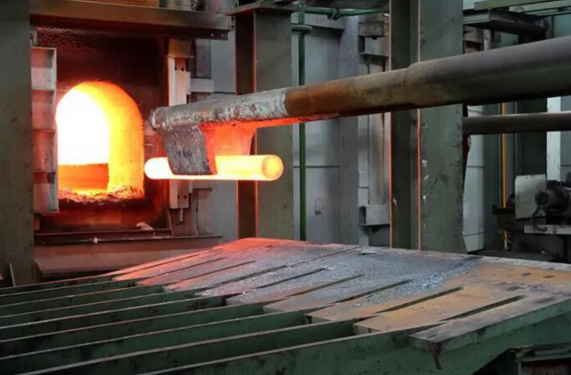
More specifically, the process begins with heating solid round billets in a rotary hearth furnace to approximately 1,200°C, followed by piercing to form a hollow shell, then elongation, plug rolling, sizing, and cooling. The absence of any weld seam gives the tube uniform strength and consistent performance across its entire structure.
1. Uniform strength throughout
With no weld seam or heat-affected zones, hot rolled seamless tubes offer consistent mechanical properties across the entire pipe body. This eliminates the weak points commonly found in welded pipes, making them reliable for critical applications.
2. Excellent formability and workability
The hot rolling process refines the grain structure of the steel, improving its ductility and making it easier to bend, flange, and form during subsequent fabrication.
Hot rolling is the most economical method for producing seamless tubes in larger diameters (typically above 2″) with thicker wall sections. The high production efficiency makes it suitable for bulk orders and standard industrial applications.
4. Wide range of available sizes and materials
Hot rolled seamless tubes are available in a broad spectrum of diameters, wall thicknesses, and material grades.
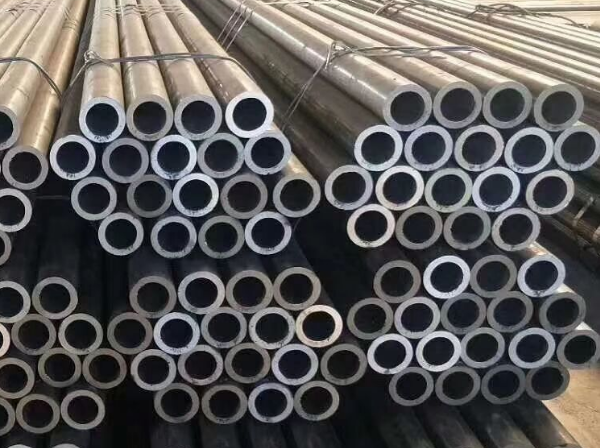
● Various Materials: Hot rolling can produce a variety of materials, including carbon steel (ASTM A106, API 5L), alloy steel, and stainless steel (ASTM A312).
● Wide Diameter Range: OD typically starts at 32mm and can reach over 1000mm, a range difficult to achieve with cold-drawn pipes.
● Wide Wall Thickness Range: Thick and ultra-thick wall seamless steel pipes can be produced, reaching thicknesses of tens or even hundreds of millimeters. They are commonly used in large mechanical structures, nuclear power plant main piping, and other applications.
5. Reliable performance in demanding conditions
The seamless structure provides superior resistance to internal pressure, thermal cycling, and mechanical stress, making hot rolled tubes the preferred choice for oil and gas transmission, power generation, boiler tubes, and chemical plant piping.
1. Internal inclusion and delamination risk
Non-metallic inclusions (such as sulfides, oxides, and silicates) present in the steel may be pressed into the material during hot rolling, potentially causing delamination (layering). This can reduce tensile strength in the thickness direction and may lead to interlayer tearing during welding. However, modern steelmaking practices and ultrasonic inspection effectively minimize this risk.
2. Residual stresses from uneven cooling
The uneven cooling that occurs after hot rolling generates internal residual stresses. These stresses are self-balanced but can negatively affect deformation behavior, structural stability, and fatigue resistance—particularly in larger cross-section products. Stress-relieving heat treatment can be applied when required.
3. Looser dimensional tolerances
Due to thermal expansion and contraction during cooling, hot rolled tubes have less precise control over thickness, width, and edge dimensions compared to cold drawn products. The deviation is more pronounced in larger sizes, making hot rolled tubes less suitable for applications requiring extremely tight tolerances.
Due to the hot-rolling process, the length of a single steel pipe is generally not as long as that of continuously produced welded pipe.
4. Limited Minimum Diameter and Wall Thickness
It cannot produce small diameters (e.g., < Φ25mm) and thin-walled pipes like cold-drawn pipe. The minimum diameter and wall thickness limits for production are relatively high.
5. Subsequent processing may require oxide scale removal.
The oxide scale formed on the surface after hot rolling requires removal through processes such as sandblasting and pickling, increasing the cost and steps of subsequent processing.
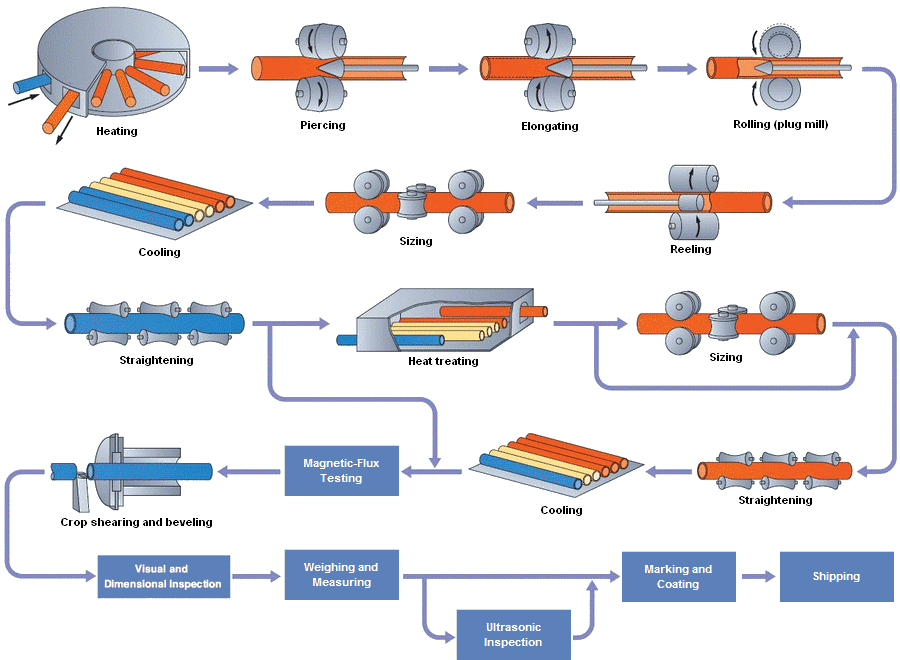
The main process sequence is:
Round tube perforation → Heating → Piercing → Elongating → Rolling (plug mill) → Sizing → Cooling → Reeling → Straightening → Heat treating → Sizing → Magnetic‑Flux Testing → Straightening → Cooling → Cropshearing & Beveling → Visual & Dimensional Inspection → Weighing & Measuring → Marking & Coating → Shipping.
Ultrasonic inspection is also applied as an additional non‑destructive test.
1. Petroleum field: Hot-rolled seamless steel tubes can be used as oil well riser pipes, oil pipes, oil casings and casings, etc. They can withstand greater oil pressure and the high-temperature and high-pressure environment in the oil circuit.
2. Chemical industry: Hot-rolled seamless steel tubes can also be used in chemical pipelines, furnace tubes, containers and storage tanks, etc. Has good corrosion resistance.
3. Aviation and aerospace fields: Hot-rolled seamless steel tubes are commonly used in the aviation and aerospace fields to manufacture components such as engines and tires.
4. Machinery manufacturing field: Hot-rolled seamless steel tubes can also be used as hydraulic pipes, transmission shafts and other components of machines. Due to its high strength, high precision and high pressure resistance, it can effectively improve the working efficiency and service life of machinery and equipment.
Hot-rolled seamless pipes are widely used in oil and gas transportation, chemical industry, aerospace, machinery and equipment manufacturing, building decoration and other fields. When choosing steel pipes, you should choose according to its use environment and characteristics: in areas where higher strength is required, hot-rolled seamless tubes are a good choice. If a higher surface finish is required, you can choose cold-drawn seamless tubes or cold-drawn welded pipes.
| Factor | Hot Rolled Tube | Cold Drawn Tube |
|---|---|---|
| Diameter Range | Larger (typically > 2″) | Smaller (typically ≤ 2″) |
| Wall Thickness | Thicker walls | Thinner walls, tighter tolerances |
| Surface Finish | Mill scale, standard | Smooth, bright finish |
| Dimensional Accuracy | Good, less precise | High precision |
| Cost | More cost-effective | Higher cost |
| Best For | Oil/gas pipelines, general industrial | Hydraulic cylinders, precision machinery |
Note: These are general ranges; actual capabilities vary by mill equipment. For a complete understanding of both manufacturing routes—from billet heating to final inspection—▶ refer to our detailed: [Seamless Steel Pipe Manufacturing Process Guide], which also covers cold drawn production in depth.
Q1. What is the difference between hot rolled and cold drawn seamless steel tubes?
Hot rolling is performed above the recrystallization temperature (approximately 1,200°C) and produces larger diameters with thicker walls at a lower cost. Cold drawing is performed at room temperature and produces smaller diameters with tighter tolerances and a smoother surface finish, but at a higher cost due to the additional processing steps.
Q2. What are the main disadvantages of hot rolled seamless steel tubes?
The main limitations are: (1) looser dimensional tolerances compared to cold drawn products, (2) a mill scale surface that may require removal for certain applications, and (3) the potential risk of internal inclusions that can cause delamination, though modern steelmaking and ultrasonic testing effectively minimize this risk.
Q3. Can surface scale on hot rolled tubes be removed?
Yes. Mill scale can be removed through shot blasting or pickling (acid cleaning). However, these additional processing steps add cost and time, so they are typically applied only when a smooth surface finish is required for the end use.
Q4. What diameter range can hot rolled seamless tubes achieve?
Hot rolled seamless tubes are available in outer diameters ranging from 32mm to over 1000mm, with wall thicknesses reaching up to several hundred millimeters. This makes them suitable for large-scale industrial applications such as heavy machinery and nuclear power plant piping.
Q5. Which industries commonly use hot rolled seamless steel tubes?
Hot rolled seamless tubes are widely used in oil and gas transmission, power generation (boiler tubes), chemical plant piping, large mechanical structures, and nuclear power facilities—any application that requires high strength, pressure resistance, and reliable performance under demanding conditions.
Read more:
● Carbon Steel Tube Material Selection Guide
● Cold rolled vs. Hot rolled: How to Choose?
● Cold Drawn Seamless Tubing
● Seamless Steel Pipe Sizes and Weights Chart
Related information
Copyright @2017 Hunan Standard Steel Co.,Ltd and Husteel Industry Group All Rights Reserved