sales@hu-steel.com
 English
 Español
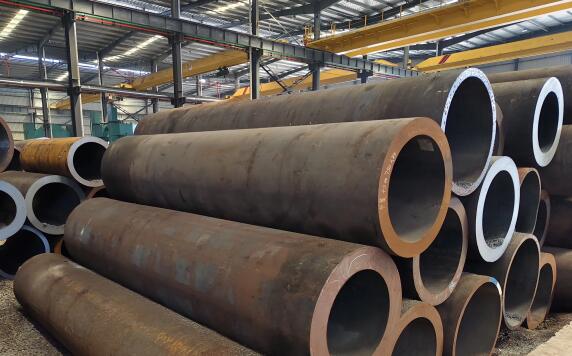
Wrought steel pipe is a versatile tubular product manufactured through hot or cold working processes, such as rolling, forging, or extrusion. Unlike cast steel, which is poured into a mold, wrought steel is mechanically shaped while solid, giving it superior strength, toughness, and uniform grain structure. Wrought steel pipe is available in two primary forms: seamless pipe and welded pipe, and is widely used in plumbing, heating, pipeline systems, and structural applications.
● Higher strength and impact resistance compared to cast alternatives
● More reliable grain structure, reducing the risk of cracking
● Available in both seamless and welded forms
● Meets strict engineering standards (such as ASTM A53 and A106)
Wrought steel is a product form created through mechanical working of heated or cold metal. Common wrought product forms include forgings, rolled shapes, extrusions, and drawn bars. The key point is that wrought steel is defined by the process, not the chemical composition—it can be made from carbon steel, alloy steel, or stainless steel.
A common point of confusion is the difference between wrought steel pipe and wrought iron pipe.
| Comparison | Wrought Steel Pipe | Wrought Iron Pipe |
|---|---|---|
| Material | Steel (iron + carbon, with controlled alloys) | Iron with slag inclusions (low carbon) |
| Strength | Higher strength and uniformity | Lower strength, more ductile |
| Corrosion Resistance | Can be galvanized or coated | Historically more corrosion-resistant |
| Current Use | Widely used in modern piping systems | Largely obsolete, used in restoration or decorative applications |
Wrought steel pipe is manufactured using two primary methods: seamless and welded. The choice between them depends on the application requirements.
Seamless wrought steel pipe is produced from a solid round steel billet, which is heated and then pierced through a form to create a hollow tube. The pipe is then rolled and drawn to the required dimensions. This process results in a uniform, continuous structure with no weld seam.
Typical Standards: ASTM A106 (high-temperature service), API 5L (line pipe)
Welded wrought steel pipe is manufactured by passing steel strips through rollers that form them into a tubular shape. The edges are then fused together using electric resistance welding (ERW) or another welding process. This method is more cost-effective for large-diameter and thin-wall applications.
Features:
● High dimensional accuracy and excellent surface finish
● More economical than seamless pipe for large diameters
● Suitable for moderate pressure and temperature applications
Typical Standards: ASTM A53 (general use), API 5L
Manufacturing variations:
ERW (Electric Resistance Welded): Most common for small to medium diameters.
LSAW (Longitudinal Submerged Arc Welded): Used for large diameter, thick-wall pipes.
SSAW (Spiral Submerged Arc Welded): Used for large diameter, moderate-pressure pipelines.
Wrought steel pipes are essential in a wide variety of industries:
1. Pipeline systems: Oil, gas, and water transmission
2. Power generation: Boiler tubes, steam lines, and heat exchangers
3. Structural applications: Scaffolding, building frames, and bridges
4. Mechanical equipment: Hydraulic cylinders, drive shafts, and precision components
5. HVAC systems: Heating, ventilation, and air conditioning piping
Although sometimes confused, wrought steel and forged steel are related but not identical.
| Aspect | Wrought Steel | Forged Steel |
|---|---|---|
| Process | Hot or cold working (rolling, drawing, extruding) | Shaped by hammering or pressing heated metal into shape |
| Grain Structure | Aligned in the direction of working | Dense and refined; directional alignment |
| Applications | Pipe, sheet, structural shapes | Highly stressed components such as valves, fittings, engine crankshafts |
| Strength | Strong and ductile | Generally stronger and more impact-resistant |
Wrought steel pipe is a foundational material in modern industry, offering a combination of strength, formability, and reliability that makes it indispensable for pipeline systems, mechanical applications, and structural projects. Whether you choose seamless pipe for high-pressure applications or welded pipe for cost-effective large-diameter systems, understanding the differences is key to making the right choice.
Read more:
● Schedule 40 vs Schedule 80 Pipe
Related information
Copyright @2017 Hunan Standard Steel Co.,Ltd and Husteel Industry Group All Rights Reserved