sales@hu-steel.com
 English
 Español
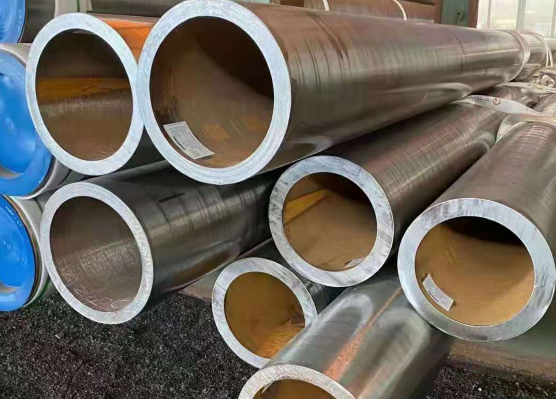
Round tube, also known as circular steel pipe, is a long steel bar with a circular (hollow) cross-section. Its core characteristics are a constant outer diameter and wall thickness, with a hollow center. Simply put, it's a hollow round bar.
Round tubes are used in pipelines, thermal equipment, machinery, petroleum and geological drilling, containers, the chemical industry, and specialized applications. Compared to solid round steel, round tubes are lighter, significantly saving material while maintaining the same strength and load-bearing capacity, making them a cost-effective material.
According to production methods can be divided into seamless round steel tube and welded round steel tube.
| Attribute | Seamless round steel tube | Welded round steel tube |
|---|---|---|
| Manufacturing Method | Pierced and rolled from solid billet, no weld seam | Rolled from strip steel and welded (ERW / Laser) |
| Advantages | High pressure resistance, uniform tube body | High efficiency, low cost, high dimensional accuracy |
| Disadvantages | Higher cost, heavier weight | Weld seam is a potential weak point |
| Typical Applications | High-pressure boilers, hydraulic systems, oil drilling, critical structures | Building structures, low-pressure fluid transport, guardrails, furniture |
Strip - Inspection - Shear - Length - Qualitative - Welding - Smoothing - Length - Inspection
| Material Type | Key Characteristics | Common Material Grades |
|---|---|---|
| Carbon Steel (CS) Round Tube | Low cost, moderate strength, prone to rust |
GB: Q195, Q215, Q235, Q275, 10#, 20#, 35#, 45# ASTM: ASTM A36, A53 Gr.B, A106 Gr.B, AISI 1018/1045 |
| Low-Alloy High-Strength Steel Round Tube | High strength, good toughness, lighter weight |
GB: Q355 (formerly Q345/16Mn), Q390, Q420, Q460 ASTM: A572 Gr.50, A572 Gr.65, A242 EN: S355JR, S355J2, S420MC JIS: SM490A |
| Stainless Steel (SS) Round Tube | Corrosion-resistant, aesthetically pleasing, high cost |
ASTM: 304/304L, 316/316L, 321, 347, 309S, 310S EN: 1.4301, 1.4307, 1.4401, 1.4404, 1.4541, 1.4550 JIS: SUS304, SUS304L, SUS316, SUS316L |
| Alloy Steel Round Tube | Specialized properties: wear resistance, heat resistance |
GB: 20Cr, 40Cr, 20CrMnTi, 30CrMo, 35CrMo, 42CrMo, 38CrMoAl, 12Cr1MoV, 15CrMo ASTM/AISI: 4130, 4140, 4340 EN: 41Cr4, 34CrMo4, 42CrMo4, 18CrNiMo7-6 DIN: 13CrMo44, 10CrMo910 |
| Application Category | Core Requirements | Common Standards |
|---|---|---|
| Structural Tubes | Strength, stiffness, load-bearing capacity | ASTM A500 |
| Fluid Transport Tubes | Sealing, pressure-bearing capacity | ASTM A106, ASTM A53 |
| Machining Tubes | Dimensional accuracy, surface quality | ASTM A519, DIN 2391, EN 10305 |
| Special Purpose Tubes | High/low temperature resistance, corrosion resistance | API 5L(line pipe), ASTM A213 (boiler tube) |
Daily Equipment: Fitness equipment, flagpoles, and lamps.
Q1: What is the difference between round tube and square/rectangular tube?
A: Round tubes offer higher torsional strength and better pressure resistance, making them ideal for fluid transport and rotating applications. Square and rectangular tubes provide higher bending strength in specific directions, making them more suitable for structural frames and load-bearing beams. The choice depends on your specific application.
Q2: Seamless vs. welded round tube – which one should I choose?
A: Choose seamless tubes for high-pressure applications, critical structures, and where weld integrity is a concern (e.g., hydraulic systems, boiler tubes). Choose welded tubes for general structural use, low-pressure fluid transport, and cost-sensitive projects, as they offer excellent value and are available in a wider range of sizes.
Q3: What are the most common materials for round tubes?
A: The most common materials are:
● Carbon steel (e.g., Q235, A36, A106 Gr.B) – general purpose
● Stainless steel (e.g., 304/304L, 316/316L) – corrosion-resistant applications
● Low-alloy high-strength steel (e.g., Q355, A572 Gr.50, S355) – structural applications
● Alloy steel (e.g., 35CrMo, 42CrMo, 4130) – high-strength and specialized applications
Q4: What size ranges are typically available for round tubes?
A: Round tubes are available in a wide range of sizes. Outer diameters typically range from 10.3 mm to over 660 mm (seamless), and up to 2500 mm or more (welded), with wall thicknesses from 0.5 mm to over 50 mm. Custom sizes are also available upon request.
Q5: Can round tubes be galvanized or coated?
A: Yes. Round tubes can be hot-dip galvanized, electro-galvanized, painted, or powder-coated to improve corrosion resistance. Hot-dip galvanizing is the most common method for outdoor and high-corrosion environments, providing long-term protection typically lasting 20–50 years.
Read more:
● Carbon Steel Pipe Material and Classification
● Square Tube vs. Round Tube: Which is Better?
Related information
Copyright @2017 Hunan Standard Steel Co.,Ltd and Husteel Industry Group All Rights Reserved