sales@hu-steel.com
 English
 Español

MS (Mild Steel) ERW pipe weights are listed below for two standards: IS 1239 (Light/Medium/Heavy class, widely used in India and the Middle East) and ASME B36.10M (SCH 5–SCH 80). Weight tolerances and a calculation formula are included for sizes not listed.
▶ For complete wall thickness data, see our [ERW Pipe Thickness Chart & Sizing Guide].
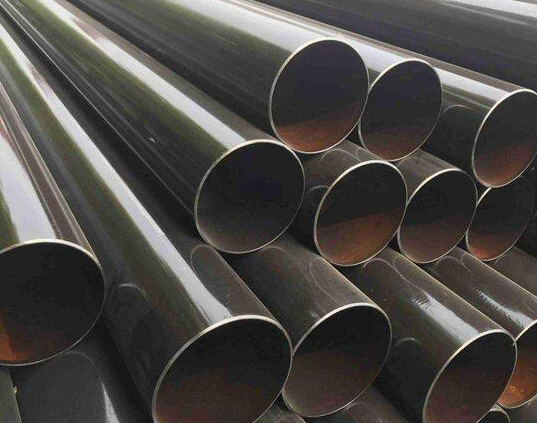
IS 1239 is the Indian standard for MS ERW pipes, widely used in India, the Middle East, and other BS 1387 markets. It divides pipes into three classes: Light (A Class) , Medium (B Class) , and Heavy (C Class). The table below shows the weights for all three classes.
| Nominal Bore (NB) | Outer Diameter (mm) | Light (A Class) | Medium (B Class) | Heavy (C Class) | |||
|---|---|---|---|---|---|---|---|
| WT (mm) | Wt (kg/m) | WT (mm) | Wt (kg/m) | WT (mm) | Wt (kg/m) | ||
| 15mm (½") | 21.3 | 2.00 | 0.95 | 2.60 | 1.21 | 3.20 | 1.44 |
| 20mm (¾") | 26.7 | 2.30 | 1.38 | 2.60 | 1.56 | 3.20 | 1.87 |
| 25mm (1") | 33.4 | 2.65 | 2.01 | 3.20 | 2.41 | 4.00 | 2.94 |
| 32mm (1¼") | 42.4 | 2.45 | 2.58 | 3.20 | 3.10 | 4.00 | 3.80 |
| 40mm (1½") | 48.3 | 2.90 | 3.23 | 3.20 | 3.57 | 4.00 | 4.38 |
| 50mm (2") | 60.3 | 2.90 | 4.08 | 3.60 | 5.03 | 4.50 | 6.19 |
| 65mm (2½") | 76.1 | 3.25 | 5.71 | 3.60 | 6.43 | 4.50 | 7.93 |
| 80mm (3") | 88.9 | 3.25 | 6.72 | 4.00 | 8.37 | 5.00 | 10.30 |
| 100mm (4") | 114.3 | 3.65 | 9.75 | 4.50 | 12.20 | 5.40 | 14.50 |
| 150mm (6") | 168.3 | — | — | 5.00 | 19.70 | 5.40 | 21.30 |
Weight tolerance is critical for procurement and acceptance. IS 1239 specifies the following permissible deviations:
| Class | Weight Tolerance | Wall Thickness Tolerance |
|---|---|---|
| Light (A Class) | +10% / -8% | ±10% |
| Medium (B Class) | +10% / -8% | ±10% |
| Heavy (C Class) | +10% / -8% | ±10% |
Theoretical weight per meter based on ASME B36.10M. For MS ERW (IS 1239) weights, see the IS 1239 table above.
| NPS (inch) | Outer Diameter (mm) | SCH 5 | SCH 10 | SCH 40 / STD | SCH 80 / XS | ||||
|---|---|---|---|---|---|---|---|---|---|
| WT (mm) | Wt (kg/m) | WT (mm) | Wt (kg/m) | WT (mm) | Wt (kg/m) | WT (mm) | Wt (kg/m) | ||
| 1/2" | 21.3 | 1.65 | 0.81 | 2.11 | 1.01 | 2.77 | 1.29 | 3.73 | 1.62 |
| 3/4" | 26.7 | 1.65 | 1.03 | 2.11 | 1.30 | 2.87 | 1.71 | 3.91 | 2.20 |
| 1" | 33.4 | 1.65 | 1.31 | 2.77 | 2.12 | 3.38 | 2.54 | 4.55 | 3.29 |
| 1¼" | 42.2 | 1.65 | 1.93 | 2.77 | 3.15 | 3.68 | 3.48 | 4.85 | 4.47 |
| 1½" | 48.3 | 1.65 | 1.93 | 2.77 | 3.15 | 3.68 | 4.05 | 5.08 | 5.41 |
| 2" | 60.3 | 1.65 | 2.42 | 2.77 | 3.98 | 3.91 | 5.44 | 5.54 | 7.48 |
| 2½" | 73.0 | — | — | — | — | 5.16 | 8.63 | 7.01 | 11.41 |
| 3" | 88.9 | 2.11 | 4.58 | 3.05 | 6.54 | 5.49 | 11.29 | 7.62 | 15.27 |
| 3½" | 101.6 | 2.11 | 5.25 | 3.05 | 7.52 | 5.74 | 13.77 | — | — |
| 4" | 114.3 | 2.11 | 5.25 | 3.05 | 7.52 | 6.02 | 16.07 | 8.56 | 22.32 |
| 5" | 141.3 | 2.77 | 9.50 | 3.40 | 11.74 | 6.55 | 21.77 | 9.53 | 30.97 |
| 6" | 168.3 | 2.77 | 11.47 | 3.40 | 14.04 | 7.11 | 28.25 | 10.97 | 42.56 |
| 8" | 219.1 | 2.77 | 14.99 | 3.76 | 20.25 | 8.18 | 42.55 | 12.70 | 64.64 |
Wall Thickness Series Description:
● SCH 5 / SCH 10: Thin-walled pipe, suitable for low-pressure fluid transport and lightweight structures.
● SCH 40 / STD: Standard wall thickness pipe, most widely used, suitable for water and gas transport.
● SCH 80 / XS: Thick-walled pipe, suitable for high pressure and more demanding conditions.
| NPS (inch) | Outer Diameter (mm) | SCH 40 / STD | SCH 80 / XS | ||
|---|---|---|---|---|---|
| WT (mm) | Wt (kg/m) | WT (mm) | Wt (kg/m) | ||
| 10" | 273.0 | 9.27 | 60.29 | 15.09 | 94.79 |
| 12" | 323.8 | 10.31 | 79.62 | 17.48 | 128.07 |
| 14" | 355.6 | 11.13 | 94.26 | — | — |
| 16" | 406.4 | 12.70 | 122.00 | — | — |
| 18" | 457.2 | 14.27 | 153.00 | — | — |
| 20" | 508.0 | 15.09 | 183.00 | — | — |
| 24" | 609.6 | 17.48 | 248.00 | — | — |
The following ERW pipe weight table data is based on ASME B36.10M and carbon steel density of 7.85 g/cm³. ▶ Learn more about [Pipe Sizing: NB vs OD vs ID vs WT].
|
OD (mm) |
NB (inch) |
DN (mm) |
WT (mm) |
Theoretical Weight (kg/m) |
Wall Thickness Series |
|---|---|---|---|---|---|
| 21.3 | 1/2″ | 15 | 2.8 | 1.27 | Sch 40 |
| 21.3 | 1/2″ | 15 | 3.7 | 1.62 | Sch 80 |
| 26.7 | 3/4″ | 20 | 2.9 | 1.68 | Sch 40 |
| 26.7 | 3/4″ | 20 | 3.9 | 2.20 | Sch 80 |
| 33.4 | 1″ | 25 | 3.4 | 2.50 | Sch 40 |
| 33.4 | 1″ | 25 | 4.6 | 3.24 | Sch 80 |
| 42.2 | 1¼″ | 32 | 3.6 | 3.39 | Sch 40 |
| 42.2 | 1¼″ | 32 | 4.9 | 4.47 | Sch 80 |
| 48.3 | 1½″ | 40 | 3.7 | 4.05 | Sch 40 |
| 48.3 | 1½″ | 40 | 5.1 | 5.41 | Sch 80 |
| 60.3 | 2″ | 50 | 3.9 | 5.44 | Sch 40 |
| 60.3 | 2″ | 50 | 5.5 | 7.48 | Sch 80 |
| 73.0 | 2½″ | 65 | 5.2 | 8.63 | Sch 40 |
| 73.0 | 2½″ | 65 | 7.0 | 11.41 | Sch 80 |
| 88.9 | 3″ | 80 | 5.5 | 11.29 | Sch 40 |
| 88.9 | 3″ | 80 | 7.6 | 15.27 | Sch 80 |
| 114.3 | 4″ | 100 | 6.0 | 16.07 | Sch 40 |
| 114.3 | 4″ | 100 | 8.6 | 22.32 | Sch 80 |
| 141.3 | 5″ | 125 | 6.6 | 21.77 | Sch 40 |
| 141.3 | 5″ | 125 | 9.5 | 30.97 | Sch 80 |
| 168.3 | 6″ | 150 | 7.1 | 28.25 | Sch 40 |
| 168.3 | 6″ | 150 | 11.0 | 42.56 | Sch 80 |
| 219.1 | 8″ | 200 | 8.2 | 42.55 | Sch 40 |
| 219.1 | 8″ | 200 | 12.7 | 64.64 | Sch 80 |
| 273.0 | 10″ | 250 | 9.3 | 60.29 | Sch 40 |
| 273.0 | 10″ | 250 | 12.7 | 81.43 | Sch 80 |
| 323.8 | 12″ | 300 | 10.3 | 79.62 | Sch 40 |
| 355.6 | 14″ | 350 | 11.1 | 94.26 | Sch 40 |
| 406.4 | 16″ | 400 | 12.7 | 123.30 | Sch 40 近似 |
| 457.2 | 18″ | 450 | 14.3 | 156.00 | Sch 40 近似 |
| 508.0 | 20″ | 500 | 15.1 | 183.00 | Sch 40 近似 |
| 609.6 | 24″ | 600 | 17.5 | 255.00 | Sch 40 近似 |
For specifications not listed in the tables, use the following formula:
W = 0.02466 × 3.60 × (60.3 – 3.60) = 5.03 kg/m
Q1: How is the theoretical weight of MS ERW pipe calculated?
A:
W (kg/m) = 0.02466 × T × (D – T)
W = Theoretical weight per meter (kg/m), T = Wall thickness (mm), D = Outer diameter (mm)
For stainless steel pipe (density 7.93 g/cm³), the coefficient is changed to 0.02491.
Q2: What is the difference between IS 1239 Light, Medium, and Heavy Class?
A:● Light (A Class) has the thinnest wall, used for electrical conduits and light structural frames.
● Medium (B Class) is the standard choice for water, gas, and general low-pressure applications.
● Heavy (C Class) has the thickest wall, suitable for higher pressure and more demanding conditions.
Q3: Are the weight coefficients the same for ERW pipes made of materials such as Q235B, ASTM A53 Gr.B, API 5L Gr.B, and S355J2H?
A: The coefficients are the same, but there are slight differences in material density.
The coefficient 0.02466 (metric) in the theoretical weight calculation formula for steel pipes is based on the carbon steel density of 7.85 g/cm³ and is applicable to common materials conforming to standards such as ASTM A53, ASTM A500, EN 10219, and API 5L. For stainless steel (304/316L, density ~7.93 g/cm³), change the coefficient to 0.02491. For high-alloy materials, use the actual density from the MTC.
Q4: Does galvanizing affect the weight of MS ERW pipe?
A: Yes. Hot-dip galvanizing adds approximately 3%–6% to the weight, depending on zinc coating thickness (typically 50–100 μm). For precise procurement, request the actual weight after galvanizing.
Q5: Are ASME B36.10M and IS 1239 weight data the same?
A: No. They are based on different standards. For the same nominal size (e.g., 2"), ASME SCH 40 pipe weighs 5.44 kg/m, while IS 1239 Medium weighs 5.03 kg/m. Always confirm which standard your project requires.
Q6: How to determine the reliability of the weight sheet provided by the supplier?
A: During procurement/project acceptance, check the following:
a. Verify the applicable standard (IS 1239, BS 1387, ASTM A53, etc.)
b. Request a Material Certificate (MTC)
c. Confirm wall thickness tolerance range
d. Independently verify using the formula above
Further Reading
● ERW Pipe Wall Thickness in mm
● BS 1387 Hot-Dip Galvanized Steel Pipe
● SCH 40 vs. SCH 80 Pressure Rating
● Carbon Steel ERW Pipe SpecificationRelated information
Copyright @2017 Hunan Standard Steel Co.,Ltd and Husteel Industry Group All Rights Reserved