sales@hu-steel.com
 English
 Español

Every ERW pipe goes through a welded pipe hydrostatic test before shipping. The factory fills it with water, pumps up the pressure, and holds it. If it doesn't leak, it gets a "Pass" stamp.
But here’s the thing most buyers don't realize: Water under pressure is not an X-ray.
Passing a hydrostatic test doesn't mean your pipe is flawless. If you want to protect your project, you need to know exactly what this test is doing.
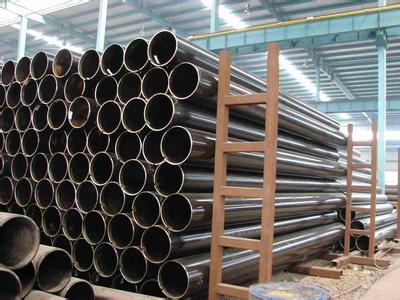
Water pressure pushes outward (hoop stress). So, it is really good at finding things that go all the way through the wall.
● Through-wall leaks: Obvious holes or tears in the steel.
● Weak walls: If a section of the pipe is way too thin, it will simply balloon out and burst.
● Bad threads: It'll catch leaking connections or couplings at the ends.
If the pipe holds the pressure without spraying water, it passes.
This is where buyers get burned. Water pressure pushes straight out, but a lot of ERW weld defects are flat and run parallel to the pipe wall.
1. Lack of Fusion (The Hidden Killer)
This is a cold weld. The edges didn't melt and fuse properly. It’s basically a flat, microscopic crack hiding inside the seam. Because the water pushes perpendicular to it, the crack doesn't get forced open. A pipe can pass the water test easily, get shipped, and then split right down the weld the first time the pressure spikes in the field.
2. Sub-surface Junk
Tiny inclusions or porosity trapped inside the weld don't affect immediate water tightness. They just sit there and weaken the structure over time.
(Because water pressure misses these flat defects, API 5L strictly forces factories to run 100% Ultrasonic Testing (UT) alongside the water test. To see how UT catches what water misses, read our [NDT Guide for ERW Pipe Welds].)
You might wonder: If the pipe passed the water test, why did it snap during a tensile test or fail later?
There are usually two reasons:
1. Insufficient Strength of the Weld Seam Itself
If the welding heat or squeeze force isn't dialed in right, the weld joint itself is literally weaker than the steel plate it was made from.
2. The "Burr Scraping" Problem
When the factory cuts off the inner burr (the excess weld flashing inside the pipe), the cutting tool can scrape a shallow groove into the pipe wall. Now you have a sharp notch right next to the weld. Under high pressure, all the stress concentrates on that scratch. It becomes a starting point for a crack. So, getting the inner burr removal right is not just about looks—it's about preventing stress points.
It's not just filling a pipe with water and looking at it. A proper procedure looks like this:
1. Filling and Venting: The pipe is filled with water. All air must be bled out. Trapped air acts like a spring and can cause a false failure (or a very dangerous burst).
2. Pressurizing: The pump slowly raises the pressure. It’s done slowly so the steel has time to adjust.
3. Holding: The pressure is held for a set time.
4. Inspection: An inspector walks the length of the pipe, checking the weld seam and ends for any weeping or spraying water.
5. Draining: If it passes, the water is drained out.
Buyers often ask, "What pressure are we testing to?" It’s not a random number. According to API 5L, the test pressure is calculated using a specific formula based on the pipe's outside diameter (OD), wall thickness, and specified yield strength.
However, the standard puts a cap on the pressure so you don't damage the pipe. For ASTM A53:
● NPS 3 and smaller: Minimum test pressure doesn't need to exceed 2500 psi.
● Larger than NPS 3: The cap is 2800 psi.
● The Hold Time: At least 5 seconds for NPS 3 and smaller, and at least 10 seconds for larger pipes.
They do completely different jobs. Here is the quick comparison:
| Feature | Hydrostatic Test | NDT (Ultrasonic / Eddy Current) |
|---|---|---|
| What it finds | Through-wall leaks, gross weak spots. | Internal cracks, lack of fusion, inclusions. |
| How it works | Applies hoop stress (water pressure). | Uses sound waves or electromagnetism. |
| Coverage | 100% of the pipe body. | 100% of the weld seam length. |
| Best for | Proving pressure containment. | Proving weld integrity and material soundness. |
| Finds cold welds? | No. (Water doesn't open flat cracks). | Yes. (UT is highly sensitive to them). |
When buying seamless pipe, the hydrostatic test tells a different story. Because seamless pipes are pierced from a solid billet, they don't have a weld seam.
This changes the game for buyers:
1. No Welds to Worry About
With a seamless pipe, you don't have to worry about "lack of fusion" at a seam. The main risks are issues within the steel itself (like laminations or cracks from the piercing process). A hydrostatic test is much more effective here because if the steel body has a weak spot, the water pressure will find it and blow it out.
2. The NDT Requirement is Different
For ERW pipe, API 5L forces you to do 100% Ultrasonic Testing (UT) on the weld in addition to the water test. For seamless pipe, the water test plus proper heat treatment and material certification (MTC) often carry more weight, because there is no structural discontinuity (the weld) to fail.
What this means for buyers:
A hydrostatic test on seamless pipe is a solid test of the pipe-body's strength. But for ERW pipe, the water test alone is simply not enough—it can't protect you from hidden weld defects. (If you are deciding between the two, see [ERW vs Seamless Pipe: Cost & Selection Guide].)
Q1: If it passed the hydrostatic test, can I skip the UT test?
A: No. Not for high-pressure lines. A water test only proves the pipe holds water right now. It cannot find a tight, flat crack that will blow open next year.
Q2: Can we test at a higher pressure to be safer?
A: No. Testing too high can actually damage the pipe by over-stressing the steel, causing micro-cracks. Stick to the standard's calculated limits.
Q3: Why does my supplier use 2800 psi for a 2-inch pipe?
A: Under ASTM A53, the required test pressure need not exceed 2500 psi for NPS 3 and smaller. If they are testing at 2800 psi, they are going above the minimum requirement, which is generally fine as long as it doesn't yield the pipe.
Related Topics:
● NDT for ERW Pipe Welds: What Buyers Need to Check
Related information
Copyright @2017 Hunan Standard Steel Co.,Ltd and Husteel Industry Group All Rights Reserved