sales@hu-steel.com
 English
 Español
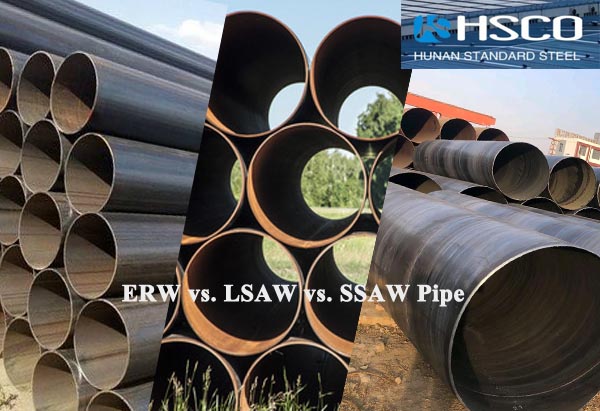
In the fields of oil and gas transportation and structural piping, ERW, LSAW, and SSAW are the three most widely used welded steel pipes. ERW stands for Electric Resistance Welding, LSAW for Straight Seam Submerged Arc Welding, and SSAW for Spiral Submerged Arc Welding. Behind these three abbreviations lie completely different process routes, quality levels, and cost logics. Choosing the wrong one can either waste money or create safety hazards.
ERW is a straight seam high-frequency weld, relying on resistance heat to fuse the two sides of the steel strip together without adding any filler. LSAW is also a straight seam, but it uses submerged arc welding, requiring the addition of welding wire and flux, and is a double-sided weld. SSAW is a spiral seam, also submerged arc welding, but the weld seam runs around the pipe.
|
Comparison Items |
ERW | LSAW | SSAW |
|
Weld Seam |
Straight seam, no filler metal |
Straight seam, double-sided submerged arc welding |
Spiral seam, double-sided submerged arc welding |
|
Diameter Range |
Maximum 24 inches (610mm) |
16~60 inches (and above) |
Up to 120 inches (3048mm) and above |
|
Wall Thickness |
≤25mm (mainly thin-walled) |
Thicker, up to approximately 175mm |
Medium, usually ≤25mm |
|
Geometric Accuracy |
Highest (uniform wall thickness, low ellipticity) |
Good |
Relatively weaker than straight seam pipes (higher ellipticity) |
|
Quality Grade |
Medium (depends on factory testing capabilities) |
Highest (can be 100% RT tested) |
Medium (long weld seam, high defect probability) |
|
Applicable Regions |
Unlimited (non-high-voltage trunk lines) |
Applicable to Class 1/2/3/4 regions |
Only applicable to Class 3/4 regions |
|
Cost |
Lowest |
Highest |
Relatively Low |
|
Typical Scenarios |
Gas, water transmission, building structures |
Long-distance oil and gas trunk lines, submarine pipelines |
Large-diameter water transmission, low-pressure gas transmission, pile foundations |
The data in the table presents the conclusions; below, we'll discuss the reasons. The reason for such significant differences in diameter, precision, and applicable regions among the three types of pipes lies in their completely different forming and welding processes. Below, we'll break down how ERW, LSAW, and SSAW are manufactured, their advantages, and their disadvantages.
△ When to choose ERW pipe?
For medium- and low-pressure scenarios such as city gas, water supply, and building structures, ERW is perfectly adequate and offers the best cost-performance ratio. If someone on a project says, "ERW pipes are fine," they usually mean this type of application.
△ When to choose LSAW pipe?
Large-diameter, high-pressure, long-distance trunk lines, submarine pipelines, high-altitude and cold regions, and densely populated Class I and Class II areas. In these places, it's not a question of whether you want to use LSAW; the design specifications require you to use it.
First, geometric dimensional control is not as good as with straight seam pipes, resulting in greater ovality. This makes on-site butt welding more challenging, requiring welders to spend considerable time adjusting.
Second, the weld length is 1.2 to 1.5 times the pipe length, naturally increasing the probability of defects.
Third, the stress on the weld is more complex, making stress concentration issues more pronounced than with straight seam pipes.
△ When to choose SSAW pipe?
For large-diameter water transmission, low-pressure natural gas, pile foundation engineering, and structural support—in these non-critical scenarios—SSAW is the most cost-effective choice.
There is no absolutely better option among the three types of welded pipes, only the most suitable one. The core logic of selection is: choosing the solution with the lowest overall cost while meeting design specifications and operational safety requirements.
|
Selection Criteria |
Recommended Pipe Type |
Key Reasons |
|
Diameter ≤ 24 inches, medium to low pressure, conventional media, cost-sensitive |
ERW |
High dimensional accuracy, lowest overall cost |
|
Diameter ≥ 16 inches, high pressure, Class 1/2 areas, main lines |
LSAW |
Welds can be 100% RT inspected, highest quality reliability |
|
Diameter ≥ 24 inches, medium to low pressure, Class 3/4 areas, non-critical scenarios |
SSAW |
Strong material adaptability, significant cost advantage for large diameters |
Further Reading:
● Seamless vs Welded Steel Pipe: Process, Performance, Cost & Selection Guide
● ERW Pipe vs Seamless Pipe: Cost & Selection Guide
● SCH 40 and SCH 80 Pipe Pressure Rating
● Pipeline Transportation: Advantages, Disadvantages & Pipe Selection
Related information
Copyright @2017 Hunan Standard Steel Co.,Ltd and Husteel Industry Group All Rights Reserved