sales@hu-steel.com
 English
 Español
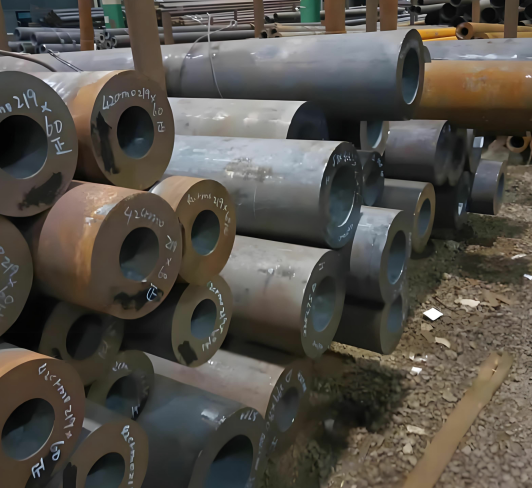
Schedule 160 (abbreviated as SCH 160) steel pipe is a grade of extra-thick-walled steel pipe defined in the ANSI/ASME B36.10 standard, belonging to the higher grades in the pipe wall thickness series. In the commonly used Schedule series, the wall thickness grades from lowest to highest are: SCH 10/20/30/40/STD → SCH 60 → SCH 80/XS → SCH 100 → SCH 120 → SCH 140 → SCH 160 → XXS (thickest).
Wall Thickness Rating: Very Heavy Wall, second only to XXS;
Typical Pressure Rating: Suitable for ultra-high pressure applications, up to 1500-2500 psi;
Manufacturing Process: Typically seamless steel pipe, ensuring no weak points in the welds;
Applicable Standards: ASTM A106 (carbon steel) / ASTM A53 / ASME B36.10;
Typical Materials: Carbon steel (Gr.B), stainless steel 316, etc.
● The actual wall thickness depends on the nominal pipe diameter (NPS). For example, a SCH 160 with an NPS of 2" (DN50) has a wall thickness of approximately 11.13 mm, and an NPS of 4" is approximately 13.49 mm. Refer to the ASME B36.10 standard table for specific details.
● Schedule 160 steel pipes are indeed widely used in high-pressure environments such as oil and gas, chemical, and power steam systems. The materials are mostly carbon steel (such as ASTM A106 Gr.B) or stainless steel (such as ASTM A312 TP304). However, the actual allowable pressure must be carefully evaluated in conjunction with the allowable stress of the material at the design temperature; it cannot be determined solely by the wall thickness rating.
Schedule 160 Steel Pipe Dimensions:
Pipes schedule 160 chart gives dimensions of steel pipes schedule 160. Chart includes sizes in inches and in millimeters.
|
Nominal size [inches] |
Outside diameter [inches] | Outside diameter [mm] | Wall thickness [inches] | Wall thickness [mm] | Weight [lb/ft] | Weight [kg/m] |
| 1/2 | 0.84 | 21.3 | 0.188 | 4.78 | 1.31 | 1.95 |
| 3/4 | 1.05 | 26.7 | 0.219 | 5.56 | 1.94 | 2.9 |
| 1 | 1.32 | 33.4 | 0.25 | 6.35 | 2.84 | 4.24 |
| 1 1/4 | 1.66 | 42.2 | 0.25 | 6.35 | 3.76 | 5.61 |
| 1 1/2 | 1.9 | 48.3 | 0.281 | 7.14 | 4.86 | 7.25 |
| 2 | 2.375 | 60.3 | 0.344 | 8.74 | 7.46 | 11.11 |
| 2 1/2 | 2.875 | 73 | 0.375 | 9.53 | 10.01 | 14.92 |
| 3 | 3.5 | 88.9 | 0.438 | 11.13 | 14.32 | 21.35 |
| 4 | 4.5 | 114.3 | 0.531 | 13.49 | 22.51 | 33.54 |
| 5 | 5.563 | 141.3 | 0.625 | 15.88 | 32.96 | 49.11 |
| 6 | 6.625 | 168.3 | 0.719 | 18.26 | 45.35 | 67.56 |
| 8 | 8.625 | 219.1 | 0.906 | 23.01 | 74.69 | 111.27 |
| 10 | 10.75 | 273 | 1.125 | 28.58 | 115.64 | 172.33 |
| 12 | 12.75 | 323.8 | 1.312 | 33.32 | 160.27 | 238.76 |
| 14 | 14 | 355.6 | 1.406 | 35.71 | 189.11 | 281.7 |
| 16 | 16 | 406.4 | 1.594 | 40.49 | 245.25 | 365.35 |
| 18 | 18 | 457 | 1.781 | 45.24 | 308.5 | 459.37 |
| 20 | 20 | 508 | 1.969 | 50.01 | 379.17 | 564.81 |
| 22 | 22 | 559 | 2.125 | 53.98 | 451.06 | 672.26 |
| 24 | 24 | 610 | 2.344 | 59.54 | 542.13 | 808.22 |
Understanding NPS, OD, and Pipe Schedules: A Guide to ASME B36.10M and B36.19M Standards
When selecting seamless steel pipes or welded steel pipes, understanding the relationship between Nominal Pipe Size (NPS), outside diameter (OD), and wall thickness is crucial. According to ASME B36.10M (Carbon Steel Pipe) and ASME B36.19M (Stainless Steel Pipe), the OD and NPS do not always match for pipes between NPS 1/8 to 12. For instance, an NPS 12 pipe has an actual OD of 12.75 inches (323.9 mm), whereas for NPS 14 and above, the OD equals the NPS (e.g., NPS 14 pipe = 14 inches OD).
Originally, NPS values were based on maintaining a consistent inside diameter (ID) with older wall thickness standards. However, as wall thicknesses evolved, the relationship between NPS, OD, and ID changed. Today, the OD of a pipe remains constant for a given NPS, while wall thickness varies by schedule (SCH). This impacts pressure ratings, as per ASME B31.3 Process Piping—a pipe’s pressure resistance decreases when its NPS increases while maintaining the same schedule.
Pipe Schedules and IPS System
Older designations like Standard Wall (STD), Extra Strong (XS), and Double Extra Strong (XXS) are still in use but belong to the Iron Pipe Size (IPS) system, which aligns with NPS. In this system:
● STD = SCH 40 (for NPS 1/8 to 10). For NPS 12 and above, STD is a fixed wall thickness of 9.53 mm.
● XS = SCH 80 (for NPS 1/8 to 8). For NPS 8 and above, XS is a fixed wall thickness of 12.70 mm.
XXS is thicker than SCH 160 for NPS 1/8 to 6, but for NPS 8 and above, SCH 160 is thicker than XXS
For accurate pipe size selection, always refer to ASME B36.10M or B36.19M tables. Whether choosing carbon steel pipes, stainless steel pipes, or seamless pipes for high-pressure applications, understanding these standards helps ensure the right fit for industrial pipelines, oil and gas pipelines, and structural applications.
Application Areas:
Sch 160 steel pipes, due to their extra-thick walls, are specifically designed for extremely high pressure and harsh operating conditions:
● Oil and Gas: High-pressure wellhead equipment, choke and kill lines, high-pressure oilfield transmission lines (pressures up to 1000-3000 psi);
● Chemical and Power Industries: High-temperature, high-pressure steam pipelines (operating temperatures up to 650°F), high-pressure reactor connection pipes;
● Hydraulic Systems: Main oil lines in heavy-duty hydraulic equipment;
● General High-Pressure Fluids: Transporting water, oil, natural gas, air, steam, etc., maintaining stability in high-temperature environments above 350°C.
Procurement and Usage Precautions:
1. Flange Matching: SCH 160 pipes are typically used with Class 900 or Class 1500 flanges. Do not mix with lower-grade flanges.
2. Welding Requirements: Due to the thicker wall, preheating and post-weld heat treatment are required. It is recommended that qualified personnel perform the welding.
3. Threaded Connections: If threaded connections are used, Class 3000 or Class 6000 threaded or socket weld fittings are recommended to ensure the connection strength is not less than that of the pipe body itself.
4. Wall Thickness Tolerance: Actual wall thickness may have tolerances allowed by ASTM standards; this must be confirmed during procurement.
5. Material Certificates: For high-pressure applications, a material certificate of EN 10204 3.1 and a hydrostatic test report are required.
Related information
Copyright @2017 Hunan Standard Steel Co.,Ltd and Husteel Industry Group All Rights Reserved