sales@hu-steel.com
 English
 Español
The main differences between Schedule 40 and Schedule 80 pipes are wall thickness, inner diameter, and weight. For the same nominal size, Schedule 80 pipes have a thicker wall, smaller inner diameter, are heavier, and have higher pressure resistance and mechanical strength.
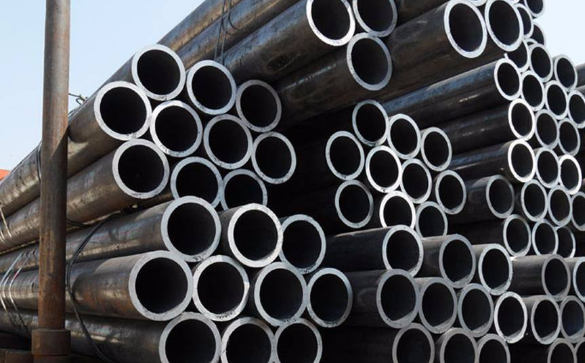
For the same material and size, a higher SCH number indicates a thicker, heavier, and more pressure-resistant pipe, but also a higher cost. When the SCH number has an "S" suffix (e.g., SCH 40S), it specifically indicates that the wall thickness series conforms to the stainless steel pipe standard ASME B36.19. For carbon steel pipes, numbers without "S" (e.g., SCH 40) are typically used, conforming to standard ASME B36.10.
The pressure ratings of SCH 40 and SCH 80 steel pipes are not fixed values; they depend on the pipe diameter, material, and temperature. The table below uses theoretical calculations of the most common ASTM A106 Gr.B seamless carbon steel pipe at room temperature (20°C/68°F) as an example to illustrate the core differences and trends between the two.
| NPS (inch) | OD (inch) | SCH 40 | SCH 80 | ||
|---|---|---|---|---|---|
| WT (in) | Pressure (psi) | WT (in) | Pressure (psi) | ||
| 1/8 | 0.405 | 0.068 | 1,380 | 0.095 | 2,220 |
| 1/4 | 0.540 | 0.088 | 1,310 | 0.119 | 2,110 |
| 3/8 | 0.675 | 0.091 | 1,160 | 0.126 | 1,880 |
| 1/2 | 0.840 | 0.109 | ~5,000 | 0.147 | ~7,100 |
| 3/4 | 1.050 | 0.113 | ~4,300 | 0.154 | ~6,100 |
| 1 | 1.315 | 0.133 | ~4,000 | 0.179 | ~5,400 |
| 2 | 2.375 | 0.154 | ~2,600 | 0.218 | ~3,700 |
| 3 | 3.500 | 0.216 | ~2,400 | 0.300 | ~3,400 |
| 4 | 4.500 | 0.237 | ~2,100 | 0.337 | ~3,000 |
| 6 | 6.625 | 0.280 | ~1,700 | 0.432 | ~2,600 |
| 8 | 8.625 | 0.322 | ~1,500 | 0.500 | ~2,300 |
| 10 | 10.750 | 0.365 | ~1,350 | 0.500 | ~2,200 |
| 12 | 12.750 | 0.406 | ~1,300 | 0.687 | ~2,200 |
| 14 | 14.000 | 0.438 | ~1,250 | 0.750 | ~2,100 |
| 16 | 16.000 | 0.500 | ~1,250 | 0.844 | ~2,100 |
| 18 | 18.000 | 0.562 | ~1,250 | 0.938 | ~2,100 |
| 20 | 20.000 | 0.594 | ~1,200 | 1.031 | ~2,100 |
| 24 | 24.000 | 0.688 | ~1,100 | 1.219 | ~1,900 |
4. Corrosion Allowance: If transporting corrosive media, an additional thickness must be added to the calculated wall thickness, which will affect the effective pressure-bearing capacity.
SCH 40 is the standard wall thickness with a lower pressure-bearing capacity, meeting most low-pressure requirements. SCH 80 is a thicker wall thickness, significantly improving pressure-bearing capacity and offering higher mechanical properties (high impact resistance, bending resistance, and vibration fatigue strength).
How to accurately select wall thickness for different operating conditions?
Choose SCH 40 wall thickness:
For general challenges, such as building water supply and drainage, HVAC, and conventional compressed air, where optimal cost-effectiveness is desired. It is a proven, universal standard solution.
Choose SCH 80 wall thickness:
For demanding challenges, such as systems involving medium to high pressure, pressure fluctuations, corrosive/abrasive environments, or requiring higher mechanical safety margins (e.g., process piping, high-pressure hydraulic systems, critical equipment connections). Its increased wall thickness is an insurance premium for safety and long-term operation.
SCH 80 steel pipe offers users greater pressure safety margin and mechanical strength through a significantly increased wall thickness. For clearly defined low-pressure systems, SCH 40 steel pipe is an economical choice; for medium- to high-pressure, critical, or harsh conditions, the SCH 80 wall thickness is a necessary investment. The right choice begins with accurate calculations. We recommend strictly adhering to design codes such as ASME for wall thickness calculations, letting the data guide you to choose the safest and most economical solution.
Read more:
● Seamless Pipe vs. Welded Pipe
Related information
Copyright @2017 Hunan Standard Steel Co.,Ltd and Husteel Industry Group All Rights Reserved