Stainless steel (SS) welded pipe is manufactured from stainless steel strips or coils using a continuous forming and welding process. It is widely used in industries such as construction, food processing, chemical transportation, and sanitary applications due to its cost-effectiveness, dimensional accuracy, and suitability for large-diameter, thin-wall pipes.
As a professional stainless steel welded pipe manufacturer, Hunan Standard Steel Co., Ltd (HSCO) maintains complete production lines and a strict quality control system, committed to providing customers with cost-effective, customized piping solutions.
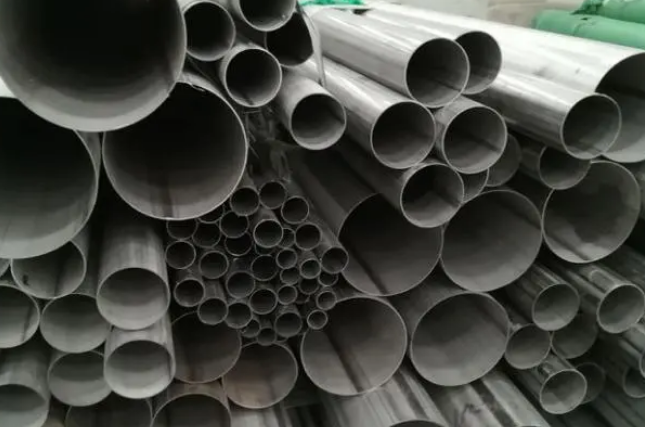
This guide provides a comprehensive overview of the entire production process, from raw material preparation to final packaging, helping you understand the quality control and technical advantages of stainless steel welded pipes.
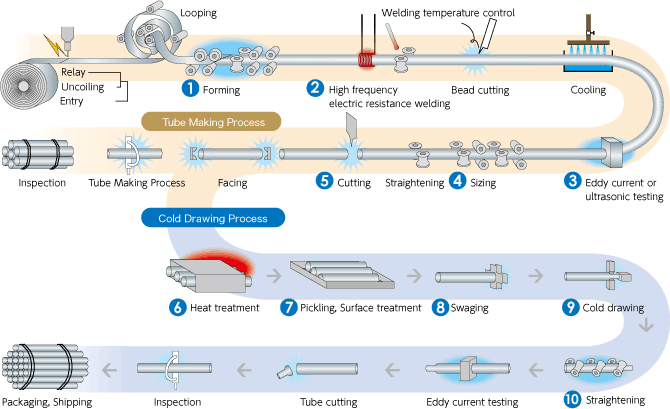
Manufacturing Process Flow Chart:
The production of stainless steel welded pipes is a continuous, automated process consisting of the following key stages:
Raw Material (Stainless Steel Coil/Strip) → Uncoiling → Leveling → Forming → Welding (TIG/HF) → Weld Seam Treatment → Sizing → Straightening → Cutting → Inspection → Surface Finishing → Packaging & Storage
I. Raw Material Preparation & Inspection
1. Material Selection
Select the appropriate stainless steel grade based on the application environment and performance requirements:
●
304 Stainless Steel: Contains 18% chromium and 8% nickel, offering excellent corrosion resistance and formability for most civil and general industrial applications.
●
316 Stainless Steel: Contains molybdenum, providing superior performance in harsh corrosive environments (e.g., marine, chemical).
● 304L/316L: Low-carbon versions, offering better resistance to intergranular corrosion after welding.
△ 304 and 316 stainless steels are commonly supplied according to ASTM A312 for general industrial applications, while ASTM A270 is specified for sanitary grades. For a detailed breakdown of when to choose 316 over 304, see our [304 vs. 316 Stainless Steel Guide].
2. Incoming Material Inspection
All stainless steel strips or coils must undergo strict inspection before production:
Visual Inspection: Verify surfaces are free from scratches, cracks, rust, and other defects.
Dimensional Measurement: Use gauges to check thickness and width against specifications.
Spectrochemical Analysis: Verify chemical composition using a spectrometer to ensure material compliance.
II. Forming Process
1. Uncoiling
The stainless steel coil is fed through an uncoiler to obtain a flat strip. Uncoiling speed and tension must be precisely controlled to prevent wrinkling or stretching deformation.
2. Leveling (Straightening)
The uncoiled strip, which may have curvature or unevenness, passes through a leveling machine. The leveler consists of multiple sets of rollers that bend and straighten the strip to achieve ideal flatness, ensuring subsequent forming accuracy.
3. Forming
The leveled strip enters a forming mill, where multiple roller stations gradually bend it into a tubular shape. Key aspects of the forming process include:
Selecting appropriate roller tooling based on pipe diameter and wall thickness.
Ensuring pipe roundness, uniform wall thickness, and proper weld gap.
The forming process directly affects subsequent weld quality and final dimensional accuracy.
III. Welding Process
Welding Preparation
The formed tube edges must be cleaned before welding to remove oil, impurities, and oxide layers. Common cleaning methods include mechanical grinding and chemical cleaning.
Welding Method Selection
Stainless steel welded pipes primarily use the following two welding processes:
1. Tungsten Inert Gas (TIG) Welding
Principle: Uses a non-consumable tungsten electrode and argon shielding gas to protect the weld from oxidation.
Characteristics: High weld quality, aesthetically pleasing welds, no spatter. Suitable for applications requiring high weld appearance and performance.
Applications: Thin-wall pipes, sanitary grade pipes, food-grade pipelines.
2. High-Frequency (HF) Welding
Principle: Utilizes the skin effect and proximity effect of high-frequency current to rapidly heat strip edges to welding temperature, then completes welding under squeeze rolls.
Characteristics: Fast welding speed, high production efficiency, ideal for large-scale continuous production.
Applications: General industrial fluid pipes, structural pipes, thick-wall pipes.
IV. Weld Seam Treatment & Heat Treatment
1. Weld Seam Finishing
After welding, weld seams may have protrusions or burrs. Grinding machines are used for internal and external weld finishing to make the seam flush with the pipe surface. Grinding force and angle must be controlled to avoid damaging the base material.
2. Weld Heat Treatment
For welded pipes with high performance requirements, solution heat treatment is essential:
Purpose: To eliminate welding stress, improve weld microstructure, and restore corrosion resistance.
Process: Heat the weld zone to 1050-1100°C, hold for a specified time, then rapidly cool (water or air quenching).
Key Benefit: After solution treatment, the weld zone's resistance to intergranular corrosion can reach the same level as the base material.
V. Sizing & Straightening
Sizing
The welded pipe passes through a sizing mill for precise dimensional adjustment. The sizing mill uses multiple passes to gradually reduce outer diameter deviations, meeting product standard requirements.
Straightening
Bending deformations that may occur during welding and processing are corrected by a straightening machine. The straightener consists of multiple roller sets that ensure pipe straightness meets standards through precise roller adjustments.
VI. Cutting
Continuous welded pipes are cut to specified lengths according to customer requirements. Common cutting methods include:
Saw Cutting: High cutting accuracy, smooth ends, suitable for applications with high precision requirements.
Plasma Cutting: Fast speed, suitable for large-diameter pipes, but ends may be rougher and require additional finishing.
VII. Inspection & Quality Control
Stainless steel welded pipes must undergo rigorous quality inspection before shipment to ensure compliance with standards and customer requirements.
1. Visual Inspection
Check pipe surfaces for defects such as cracks, porosity, scratches, and rust; verify weld seam is smooth, continuous, and free from undercut.
2. Dimensional Inspection
Use calipers, micrometers, and diameter gauges to verify outer diameter, wall thickness, length, and straightness are within specified tolerances.
3. Performance Testing
Mechanical Testing: Tensile, hardness, and flattening tests to verify pipe strength and ductility.
Corrosion Testing: Salt spray and intergranular corrosion tests to evaluate resistance in specific environments.
4. Non-Destructive Testing (NDT)
Eddy current or ultrasonic testing is performed on weld seams to detect internal defects (e.g., cracks, lack of fusion, inclusions).
VIII. Surface Finishing
Depending on application requirements, pipes may undergo the following surface treatments:
1. Polishing
Mechanical or chemical methods improve surface smoothness to achieve a mirror or satin finish. Polished pipes are aesthetically pleasing and less prone to dirt adhesion, commonly used in sanitary or decorative applications (food, pharmaceutical, architectural).
2. Passivation
Forms a dense oxide film on the pipe surface, significantly improving corrosion resistance. Passivation is typically performed by immersing pipes in a passivation solution for a specified time, followed by rinsing and drying.
IX. Packaging & Storage
Packaging
Qualified pipes are packaged according to customer requirements and shipping conditions:
Plastic Film Wrapping: For dust and moisture protection.
Wooden Crates / Steel Strapping: Suitable for long-distance transport or export.
End Protection: Plastic caps on pipe ends to prevent thread damage.
Storage
Packaged products are stored in a warehouse, categorized by specification, grade, and batch, with clear labeling for inventory management and fast dispatch.
Product Specifications & Applicable Standards
Available Range:
Outer Diameter: Φ6mm – Φ219mm
Wall Thickness: 0.5mm – 8.0mm
Length: Customized per customer requirements
Materials: 304, 304L, 316, 316L, etc.
Other specifications can be customized according to ASTM A312 and ASME B36.19 standards.
Applicable Standards:
● ASTM A312: Standard specification for seamless, welded, and heavily cold worked austenitic stainless steel pipes for high-temperature and general corrosive service.
● ASTM A270/A249: Sanitary stainless steel pipe standards
● ASME B36.19: Stainless steel pipe dimensions and wall thickness (referenced by ASTM A312)
● GB/T 12771: Chinese standard for welded stainless steel pipes for fluid transport
● Others: JIS, EN, and other standards available upon request
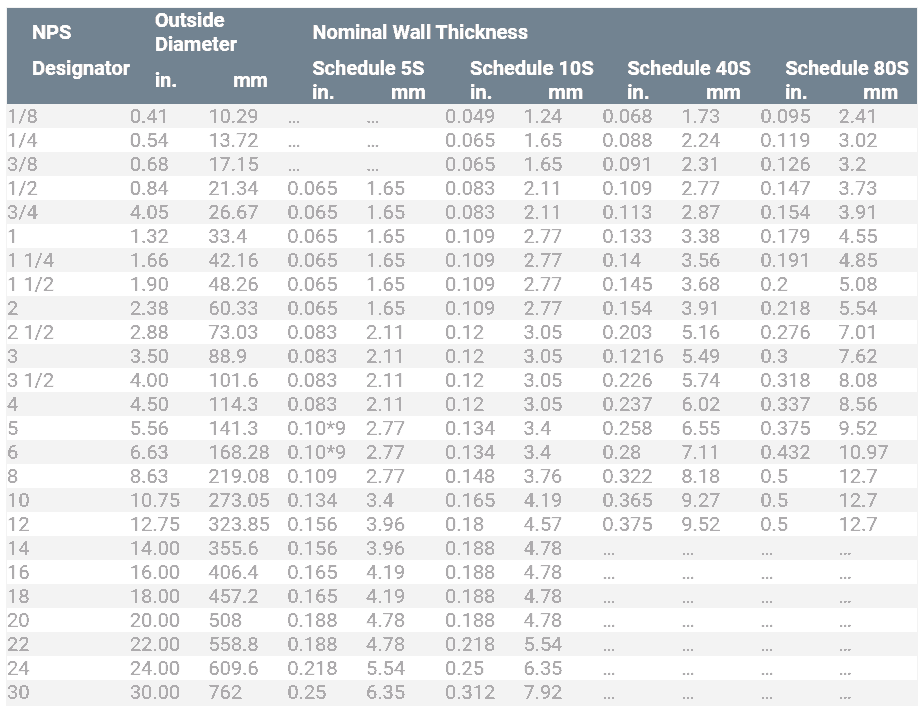
Stainless Steel Pipe Dimensions – ASME B36.19 Reference
The table below provides standard dimensions for stainless steel welded pipes per
ASME B36.19, covering
NPS 1/8 to NPS 30. Wall thicknesses are listed for
SCH 5S, 10S, 40S, and 80S series. These dimensions are applicable to common grades such as 304/316 and are referenced by ASTM A312 for general corrosive and high-temperature service.
Note: For NPS 10 and above, SCH 40S wall thickness is thinner than
carbon steel SCH 40. Always specify the "S" series when ordering stainless steel.
Common Applications & Industries
● Chemical & Petrochemical Processing: Corrosion-resistant fluid transmission pipelines
● Food & Beverage Industry: Sanitary process lines
● Pharmaceutical Manufacturing: High-purity, non-contaminating process lines
● Water & Wastewater Treatment: Corrosion-resistant piping systems
● Building & Decoration: Railings, structural components, architectural features
Frequently Asked Questions (FAQ)
Q1: What is the difference between stainless steel welded pipe and seamless pipe?
A: Welded pipe is formed from steel strip and welded (has a weld seam), offering lower cost, higher dimensional accuracy, and suitability for mass production.
Seamless pipe is pierced and rolled from solid round steel (no weld seam), offering higher pressure resistance but at a higher cost. The choice depends on working pressure, medium, and application environment.
Q2: Does welding reduce the corrosion resistance of welded pipes?
A: Untreated weld zones may suffer reduced corrosion resistance due to sensitization. However, through solution heat treatment and pickling & passivation, the weld zone's corrosion resistance can be restored to the same level as the base material.
Q3: Can stainless steel welded pipes be used in high-pressure or high-temperature environments?
A: Qualified welded pipes are fully suitable for high-pressure (typically ≤10MPa) and conventional temperature applications. For higher pressures or temperatures, seamless pipes or thicker-walled welded pipes should be evaluated.
Q4: How can I assess the quality of stainless steel welded pipes?
A: The key is documentation verification. Request a complete Material Test Certificate (MTC) from the supplier to confirm chemical composition. For welded pipes, also verify whether solution heat treatment and non-destructive testing have been performed. Actual wall thickness measurement is also important for identifying substandard products.
Q5: What specifications and materials can you produce?
A: We produce welded pipes with outer diameters from Φ6mm to Φ219mm and wall thicknesses from 0.5mm to 8.0mm. Common materials include 304, 304L, 316, 316L, etc., supplied according to standards such as ASTM A270/A249 and GB/T 12771.
Q6: What is the difference between ASTM A312 and ASTM A270 for stainless steel pipes?
A: ASTM A312 is the general specification for stainless steel seamless and welded pipes used in high-temperature and general corrosive service. ASTM A270 is a more specific standard for sanitary (food, dairy, pharmaceutical) tubing, with stricter requirements for surface finish and cleanliness.
Related Resources:
● How to Choose the Right Wall Thickness (Sch40 vs Sch80) for Your Application
● 304 vs. 316 Stainless Steel: What's the Difference?
● Stainless Steel Seamless Pipe Manufacturing Process
● ERW vs Seamless Stainless Steel Pipe: How to Choose?
Why Choose HSCO?
Full-Process Quality Control: Every step from raw material inspection to finished product dispatch is strictly controlled.
Flexible Customization: Capable of customizing non-standard specifications, special materials, and surface finishes.
Reliable Supply: Adequate stock inventory to meet bulk orders and urgent delivery requirements.
Contact Us
For more product information, technical specifications, or to
request a quote, please contact our sales team:
▶ Email: sales@hu-steel.com
Hunan Standard Steel Co., Ltd (HSCO) — Your Trusted Partner for Stainless Steel Welded Pipes
 sales@hu-steel.com
 English
 Español