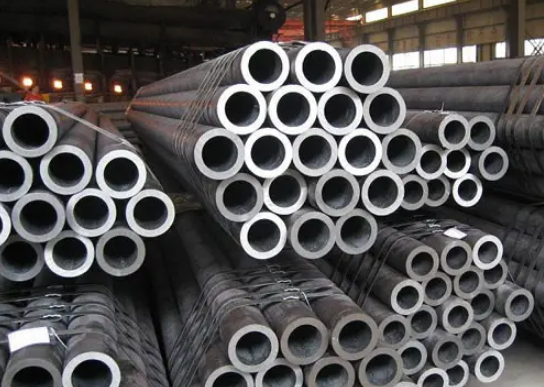
Seamless steel tubes for small-diameter high-pressure boilers refer to seamless steel tubes with a small outer diameter (usually ≤89mm) specifically used for manufacturing the heating surface tube systems of
high-pressure boilers (such as superheater tubes, reheater tubes, water-cooled walls, economizers, etc.). Their operating conditions are typically pressure ≥ 9.8 MPa and temperature 450℃~650℃. They are key materials in power plant boilers, industrial boilers, and petrochemical high-temperature equipment, serving for extended periods in high-temperature, high-pressure, and corrosive flue gas environments.
Manufacturing process:
Usually primarily cold-drawing, supplemented by hot rolling or cold rolling to ensure high dimensional accuracy.
Common Specification:
Hot-rolled tubes: Outer diameter 22~530 mm, wall thickness 20~70 mm;
Applications: Superheater, reheater, economizer tube bundles.
Cold-drawn (rolled) tubes: Outer diameter 10–108 mm, wall thickness 2.0–13.0 mm;
Applications: headers, main steam pipes, thick-walled pressure components.
In actual production and applications, common size combinations for small-diameter, high-pressure seamless boiler tubes (typically ≤89 mm) include:
Small-diameter cold-drawn tube series:
16×3mm, 25×3mm, 32×4mm, 38×4.5mm, 42×5mm, 48×5mm, 51×5mm, 57×5mm, 60×5mm, 76×6mm.
Other commonly used specifications:
14×2mm, 22×3mm, 28×4mm, 34×5mm, 44.5×7mm, 48×9mm, 60×8mm, 89×12mm.
Performance Requirements of Small-Diameter Seamless Boiler Tubes:
1. Adaptability to Harsh Operating Conditions: Working pressure ≥ 9.8 MPa, working temperature 450-650℃, requiring resistance to high temperature and pressure, as well as oxidation and corrosion from flue gas/water vapor.
2. High Dimensional Accuracy Requirements: Wall thickness deviation for small-diameter tubes is typically required to be ≤ ±10%, and the outer diameter tolerance for cold-drawn tubes can reach ±0.15-0.20 mm.
3. Strict Quality Control: Standards require each tube to undergo ultrasonic testing, eddy current testing, and hydrostatic testing.
4. Special Microstructure and Properties: Requires high creep strength, oxidation resistance, and good microstructural stability.
Advantages of Small-Diameter Seamless Boiler Tubes:
1. Excellent High-Temperature Performance: Possesses high creep strength and resistance to creep, maintaining stable mechanical properties even under long-term service at 450-650℃.
2. High Reliability: The seamless structure eliminates welding defects, and 100% non-destructive testing (ultrasonic + eddy current) ensures the absence of internal cracks, inclusions, and other defects. Each steel pipe undergoes a hydrostatic test to guarantee pressure-bearing and sealing performance.
3. Good Microstructural Stability: Precise heat treatment (normalizing, quenching + tempering, etc.) yields a uniform and fine grain structure, making it less prone to microstructural degradation such as pearlite spheroidization or graphitization during long-term high-temperature service.
4. Dimensional Accuracy Advantage: The cold-drawing process achieves high-precision dimensions, facilitating precise fit with tube sheets, flanges, and other components, making it particularly suitable for applications such as heat exchanger tube bundles.
5. Complete Range of Specifications: Covering a complete series from carbon steel and low-alloy steel to high-alloy steel, allowing for precise selection based on factors such as temperature, pressure, and media corrosivity.
Common Materials and Grades:
● High-quality carbon structural steel (≤450℃): 20G, 20MnG, 25MnG,
ASME SA-192/
SA-210A1;
● Alloy structural steel (450-650℃): 15CrMoG, 12CrMoG, 12Cr2MoG, 12CrMoVG,
ASME SA213 T11/T12, T91/P91, T92/P92, T22/P22, etc.;
● Heat-resistant stainless steel (high temperature + corrosive environment): 1Cr18Ni9, 1Cr18Ni11Nb, and high-end
austenitic stainless steels such as TP347H, HR3C, and Super304H for ultra-supercritical units.
How to Determine the Size you Need?
Choosing the correct seamless boiler tube size hinges on confirming the following three points:
1. Standard: Clearly define whether it adheres to ASME SA213 (US standard), GB/T 5310 (China standard), or
EN 10216-2 (European standard). Different standards have slight differences in their size series.
2. Design Parameters: Based on the boiler or piping's design pressure, temperature, and available space, determine the required wall thickness and outer diameter through strength calculations.
3. Procurement Specifications: When purchasing, use the precise format of "outer diameter × wall thickness" (e.g., Φ38 × 4.5), specifying the standard and material.
Conclusion:
The core advantage of seamless steel tubes for small-diameter high-pressure boilers lies in their high-temperature creep strength and reliability. Selection should primarily be based on the service temperature, combined with factors such as design pressure and media corrosivity, choosing an appropriate grade within the ASME SA213, GB/T 5310, or similar standard systems. For supercritical and higher-parameter units, high-alloy steels such as T91/P91 must be used to ensure long-term safe operation.
Related articles: Boiler Tube Size Chart or Classification of Boiler Tubes
 sales@hu-steel.com
 English
 Español