sales@hu-steel.com
 English
 Español
Need a structural steel pipe with 355 MPa yield strength + room temperature impact toughness + good weldability? EN 10219 S355JRH - Europe's most versatile cold-formed hollow section.
EN 10219 S355JRH refers to cold-formed welded hollow structural sections (HSS) manufactured according to the European standard EN 10219, with a material grade of S355JRH. S355JRH is an upgraded version of S235JRH, offering higher strength while maintaining good weldability, making it suitable for engineering scenarios with higher requirements for load-bearing capacity and safety.
△Related standards: This standard is also used in conjunction with EN 10210 (hot finished hollow profiles) and EN 1090 (CE certification implementation standard).
|
Symbol |
Meaning |
|
S |
Structural Steel |
|
355 |
Represents the minimum yield strength of this steel as 355 MPa (applicable to wall thickness ≤ 16 mm). |
|
JR |
Indicates that the steel has an impact energy ≥ 27 J when subjected to impact testing at room temperature (+20°C). This demonstrates its good toughness and ability to resist impact loads. |
| H |
Represents hollow section steel. |
△ A yield strength of 355 MPa ensures that the material can withstand medium to high loads and is one of the most widely used structural steel grades in European and international engineering.
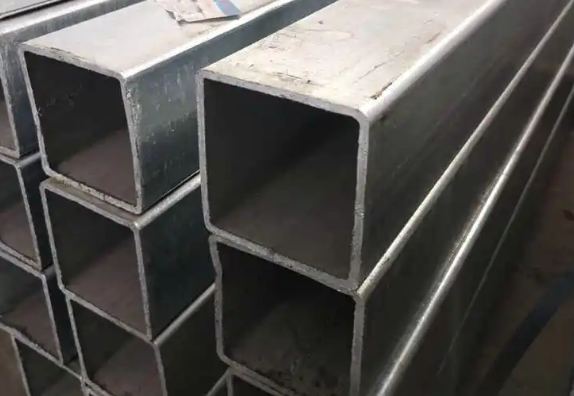
S355JRH steel pipes can be manufactured in circular (CHS), square (SHS), and rectangular (RHS) cross-sections.
|
Parameters |
Range |
Common Specifications Examples |
|
Outer Diameter |
φ21.3mm - 2500mm+ |
φ219, φ273, φ323.9, φ355.6, φ406.4, φ508mm |
|
Wall Thickness |
2mm - 50mm |
2.0, 2.6, 3.2, 4.0, 5.0, 6.3, 8.0, 10.0, 12.5, 16.0, 20.0 |
|
Type |
Side Length/Size Range |
Wall Thickness Range |
|
Square Tube |
20×20mm - 400×400mm |
1.5mm - 40mm |
|
Rectangular Tube |
50×30mm - 500×300mm |
1.5mm - 40mm |
△ Need specific specifications? Contact us for customized sizes and the latest quotes: info@hu-steel.com
Precision Forming: Utilizing high-precision cold bending forming technology, ensuring regular cross-sectional shapes, sharp edges, and uniform wall thickness for square and rectangular tubes.
Strict Tolerances: Outer diameter, side length, and straightness all adhere to the strict tolerance standards of EN 10219-2, guaranteeing high interchangeability and assembly efficiency of components on-site, reducing on-site adjustments and rework.
|
Comparison Items |
S235JRH |
S275JOH |
S355JRH |
|
Designation Meaning |
S = Structural steel, 235 = Yield strength, JR = Room temperature impact, H = Hollow profile |
S = Structural steel, 275 = Yield strength, J0 = 0°C impact, H = Hollow profile |
S = Structural steel, 355 = Yield strength, JR = Room temperature impact, H = Hollow profile |
|
Minimum Yield Strength (≤16mm) |
235MPa |
275MPa |
355MPa |
|
Tensile Strength Range |
340-470 MPa |
410-560 MPa |
490-630 MPa |
|
Elongation (≥) |
24% |
20% |
20% |
|
Impact Toughness Temperature |
+20°C |
0°C |
+20°C |
|
Impact Energy Requirement |
≥27J |
≥27J |
≥27J |
|
Carbon Equivalent (CEV) (≤16mm) |
≤0.37 |
≤0.41 |
≤0.45 |
|
Welding Performance |
Excellent |
Excellent |
Good (Higher Carbon Equivalent) |
|
Application |
Lightweight structures, decorative pipes |
General load-bearing structures |
Medium to high load-bearing structures |
|
Grade |
Impact Test Temperature |
Minimum Impact Energy |
Application |
|
S355JRH |
+20°C |
27J |
Normal temperature environment, indoor structure |
|
S355J0H |
0°C |
27J |
Temperate regions, general outdoor applications |
|
S355J2H |
-20°C |
27J |
Cold regions, winter construction, Nordic market |
|
S355K2H |
-20°C |
40J |
Extremely cold regions, critical safety structure |
|
Grade Type |
Representative Grade |
Characteristics |
Application |
|
Ordinary Structural Steel |
S235JRH, S275J0H, S355JRH |
Conventional strength, high cost-effectiveness |
General building structures |
|
Normalized/Normalized Rolled Steel (N) |
S355NH, S460NH |
Fine grain, excellent impact toughness |
High pressure vessels, low temperature environments -5°C |
|
Thermomechanically Rolled Steel (M) |
S355MH, S460MH |
High strength, good weldability |
Heavy machinery, marine engineering |
1. Clarify impact temperature requirements
If your project is located in a cold region or involves winter construction, be sure to confirm whether -20°C impact toughness is required and choose S355J2H instead of S355JRH accordingly.
2. Verify material certificates
Request the supplier to provide an EN 10204 Type 3.1 material certificate during procurement, verify the chemical composition and mechanical property data, and ensure that the material meets the standard requirements.
3. On-site inspection points
Randomly sample upon arrival, measure the wall thickness and side length with calipers, and check whether they are within the standard tolerance range. For important structures, a third party can be commissioned to conduct a re-inspection.
4. Corrosion protection
As a carbon steel, S355JRH is not inherently corrosion-resistant. For use outdoors or in humid environments, hot-dip galvanizing or coating protection is required.
A: The main difference between the two lies in the impact toughness testing temperature. S355JRH guarantees an impact energy ≥27J at room temperature (+20°C); S355J2H guarantees an impact energy ≥27J at -20°C. If your project is located in a cold region or involves winter construction, please choose S355J2H. For normal temperature environments, S355JRH is sufficient.
A: The price depends on specifications, wall thickness, quantity, surface treatment (black skin/galvanized/painted), and delivery terms (FOB/CIF/CFR). Please provide the above information, and we will provide a quote within 2 hours. Due to fluctuations in raw material prices, the quote is valid for 7 days.
● Epoxy powder coating (suitable for special environments)
A: Yes. We provide an EN 10204 3.1 type certificate for each batch of S355JRH structural pipe, including traceable data such as furnace number, chemical composition, and mechanical properties. We can also cooperate with third-party testing (such as SGS, BV) if needed.
A: Yes. When the wall thickness of S355JRH is >16mm, the minimum yield strength drops to 345 MPa. This is a standard requirement and does not affect compliance.
Read more: S235JRH and S355J2H Structural Steel or EN 10219 vs EN 10210
Related information
Copyright @2017 Hunan Standard Steel Co.,Ltd and Husteel Industry Group All Rights Reserved