What is ASTM A53 Grade B Sch 40 ERW Pipe?
ASTM A53 Grade B Sch 40 ERW pipe is a general-purpose carbon steel welded pipe manufactured using high-frequency resistance welding technology, conforming to the American Society for Testing and Materials (ASTM) A53/A53M standards. It is grade B, with a wall thickness conforming to the Schedule 40 standard series. It is primarily used for low-pressure fluid transportation (such as water, air, and low-pressure steam) and general structural applications. It is generally shipped as a black pipe (untreated surface), and painting, galvanizing, or other anti-corrosion treatments are available upon request.
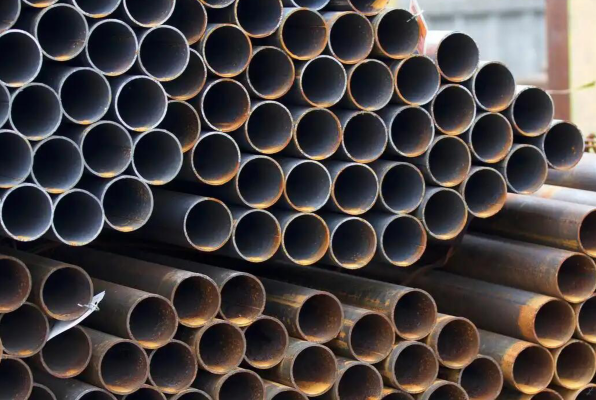
The ASTM A53 standard covers both seamless and welded processes, but welded pipe specifically refers to pipe formed by electric resistance welding (ERW) or submerged arc welding (SAW). Its chemical composition is primarily low-carbon steel (Mild Steel), typically Gr.B, exhibiting good weldability, plasticity, and strength, making it suitable for medium- and low-pressure environments. This standard clearly specifies dimensional tolerances, mechanical properties, hydrostatic testing, and non-destructive testing to ensure product consistency and reliability.
The key parameters of ASTM A53 Grade B Sch 40 ERW pipe are as follows:
Material: Carbon steel (Grade B), moderate strength, suitable for normal temperature and pressure systems.
Wall Thickness:
Sch 40 represents a standard, medium wall thickness grade, approximately 9.53 mm (when the outer diameter is 457.2 mm).
Outer Diameter Range: 1/2 inch to 24 inches (21.3 mm - 610 mm).
Length: Supports standard lengths of 5.8 meters, 6 meters, and 12 meters, or custom sizes.
Manufacturing Process: Electric Resistance Welding (ERW). The weld must pass the standard-specified hydrostatic test and non-destructive electrical testing to ensure its integrity.
Features: High production efficiency, low cost, wide size range, smooth weld surface quality. It is the mainstream production process for modern medium and low pressure fluid transportation pipes and structural pipes.
Common Markets: ASTM A53 Gr.B ERW pipes are widely used in North America, the Middle East, and global construction, municipal, and general industrial projects conforming to ASTM standards.
Limitations: The weld seam is a potential weak point (requiring quality control), and its pressure-bearing capacity is lower than that of
seamless pipes of the same specification. It is not suitable for ultra-high pressure, high temperature, or extreme fatigue load applications.
Production Technology Characteristics:
The core advantages of ASTM A53 welded pipes lie in their mature manufacturing process, controllable cost, and stable performance.
1. ERW welded pipes are formed by heating the edges with high-frequency current and extruding. Weld quality can be ensured through online ultrasonic testing.
2. SAW welded pipes are suitable for large-diameter, thick-walled pipes, with a high weld depth-to-width ratio and strong density.
The pipe's yield strength can reach 240–345 MPa, tensile strength is 415–520 MPa, and elongation is not less than 20%. Furthermore, the A53 standard allows for hot-dip galvanizing (such as A53 Type E, F, S), significantly improving its corrosion resistance and expanding its application scenarios in humid or industrial environments.
Application Areas:
In practical applications, ASTM A53 Grade B ERW welded pipe is widely used in building structures, municipal pipe networks, and industrial equipment piping systems.
For example, it is used as supporting columns or staircase components in buildings, for long-distance transportation in municipal water supply and drainage systems, and as low-pressure gathering and transmission auxiliary pipelines in the oil and gas industry. It has a high degree of standardization, is compatible with various connection methods and fittings, and facilitates on-site installation and maintenance. Furthermore, due to its excellent processing adaptability, A53 welded pipe can undergo secondary processing such as bending, flaring, and necking to meet customized needs in complex working conditions.
Typical Applications: Low-pressure fluid transportation (water, gas, oil, steam), building structures (railings, scaffolding, sheds), machinery frames, agricultural irrigation, electrical wiring conduits, etc.
Differences from other standards:
ASTM A53 Gr.B vs.
ASTM A106 Gr.B: A53 Gr.B is suitable for ambient temperature systems and has a lower cost; A106 Gr.B is suitable for high-temperature and high-pressure environments (such as steam and boilers) and has a higher cost.
Manufacturing process: A53 supports seamless, resistance welded, and furnace welded pipes, while A106 only allows seamless pipes.
ASTM A53 Gr.B vs. API 5L Gr.B (higher-grade welded pipe): API 5L is a standard specifically for oil and gas pipelines, with requirements for toughness, weldability, and non-destructive testing that are far higher than those of the general-purpose A53.
Quality Control Requirements:
ASTM A53 standard sets stringent requirements for the entire process, from raw materials and forming to welding, heat treatment, and testing. All pipes must pass a hydrostatic test, and weld areas must undergo 100% non-destructive testing (such as UT or RT) to ensure the absence of defects such as cracks, porosity, and inclusions.
Furthermore, the standard specifies test methods for tensile properties, flattening properties, and flexural properties to ensure the structural integrity of the product under extreme conditions. This systematic quality control system is a key reason for its widespread adoption in the engineering field.
Read more: Schedule 40 Carbon Steel Pipe Size Chart
 sales@hu-steel.com
 English
 Español