What is a Casing String?
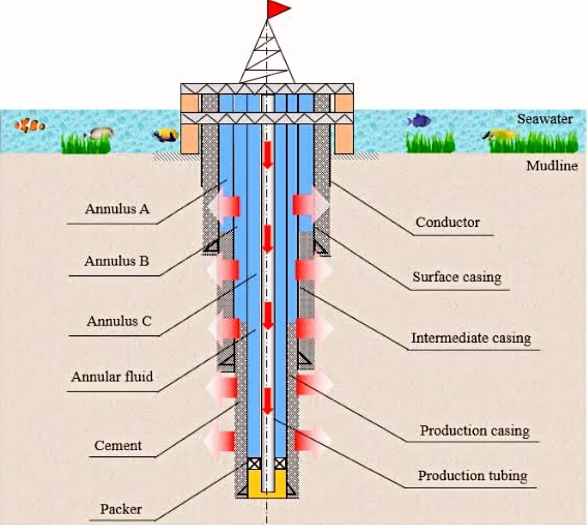
A casing string is a cylindrical structure formed by threading multiple sections of casing pipe together. It is primarily used in oil and gas well engineering and construction. In oil and gas wells, it consists of components such as the casing head, surface casing, intermediate casing, production casing, and liner. It is used to isolate complex formations, stabilize the wellbore, establish oil and gas production pathways, and install wellhead equipment.
The design of casing strings for oil and gas wells requires comprehensive consideration of formation pressure, collapse resistance, and connection strength, employing methods such as the safety factor method and the boundary load method. Causes of damage include drilling errors, cementing quality defects, corrosion, and geological activity, often manifesting as deformation, cracking, or dislocation.
Construction casing strings are primarily steel-cased concrete structures. The external steel tubes constrain concrete expansion to enhance compressive bearing capacity. Common types include slotted and welded construction. The bearing capacity of construction casing strings is verified through axial compression tests, and a formula for calculating the ultimate bearing capacity has been derived.
Main Functions of a Casing String are:
1. Isolating complex formations: By combining casing at different levels, different pressure systems, such as high-pressure zones, thief zones, and freshwater zones, are separated to prevent fluid cross-contamination.
2. Stabilizing the wellbore: Preventing wellbore collapse or deformation and maintaining wellbore integrity.
3. Establishing oil and gas production pathways: Providing access for oil and gas extraction and installing wellhead equipment.
4. Controlling blowouts: Providing a foundation for installing blowout preventers and playing a key role in well control safety.
5. Protective layer isolation: Used in construction projects to protect different functional areas, such as protective casing packers above the water injection zone.
6. Environmental protection: Particularly important is isolating freshwater zones to prevent contamination by drilling fluid or formation fluids.
Casing String Structure - By Function and Run Order
Casing is the most widely used type of tubing in the oil industry. It is threaded together to form a casing string. The casing string primarily consists of a
casing head, surface casing, intermediate casing, production casing, substructure, and liner, all connected by threaded connections to form a single structure. The details are as follows:
1. Casing Head
This is the device that suspends the casing at the wellhead. According to standard requirements, after each layer of casing is lowered and cemented, the top joint should be removed and a casing head connected to the top of the casing to seal the annular space between the two layers of casing, suspend the second layer of casing, and bear part of its weight.
For example, a standard wellhead assembly would include: a casing head connected to the surface casing, with a casing hanger connected to the technical casing; a reservoir casing head installed on the surface casing head, with the casing hanger connected to the reservoir casing; and a tubing head installed on the reservoir casing head, with the tubing connected to the tubing hanger. Casing heads are categorized into two types: threaded and flanged, depending on the connection method. In recent years, self-sealing casing heads have been developed overseas, suitable for high-pressure gas wells.
2. Surface Casing
Casing is installed to prevent the collapse of the unconsolidated formation above the wellbore, isolate the upper freshwater layer, protect it from drilling contamination, and install wellhead blowout preventers. The depth of the surface casing should be determined based on the depth of the unconsolidated formation and the fracture pressure gradient of the upper formation. The diameter of the surface casing is determined by the number of casing layers installed and the diameter of the production casing.
 3. Intermediate Casing
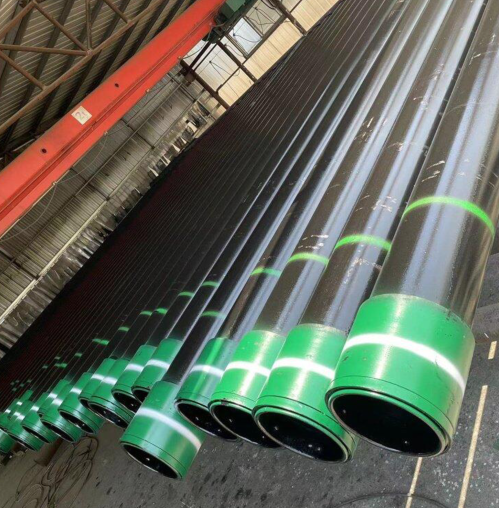
Also known as technical casing, this is the casing installed between the surface casing and the production casing due to drilling technology limitations. The
intermediate casing can be one or more layers. There are many reasons for necessitating the installation of intermediate casing, such as encountering a high-pressure oil or gas layer below the surface, and the fracture pressure gradient of the upper formation being insufficient to withstand the pressure gradient generated by the heavy drilling fluid, necessitating the installation of the intermediate casing to seal the upper formation. For example, when drilling into thick, loose sand layers or expansive shales, and when the drilling fluid properties cannot be controlled, technical casing may also be required. The size of the intermediate casing should be determined based on the diameter of the production casing and the number of casing layers.
4. Production Casing
Also known as reservoir casing or gas production casing, this is the final layer of casing lowered into an oil (or gas) well. It creates a secure pathway for oil and gas from the bottom of the well to the wellhead and prevents leakage into other, lower-pressure formations. The size of the
production casing is determined by the production rate of the production layer. Casing sizes are typically 5" (127mm) and 6" (152mm). In particularly high-yield oil and gas wells, 8" (203mm) casing may also be used as production casing.
5. Substructure
This refers to the general term for the accessories located below the casing string. The substructure varies depending on the type of casing. The substructure of both technical and production casing generally consists of the following components, from bottom to top: cement guide shoe (or cast iron guide shoe + casing shoe), float collar, support ring, casing centralizer, and mud cake scraper. Needle. The purpose of lower casing components is to facilitate smooth casing lowering into the well and improve cementing quality.
6. Liner Casing
Also known as the drilling liner, in a cased well, the casing string that is used for cementing only the openhole section, without the top of the casing extending to the wellhead, is called the casing liner. Liners are categorized as production liner, technical liner, protection liner, and tieback liner, depending on their purpose. Production liner serves as completion casing, replacing production casing; technical liner is used to deepen the technical casing. The protective liner is used to repair damaged or broken casing; the tieback liner is used to connect the lower liner back into the technical casing to cover the damaged casing.
Casing Pipe Material:
To withstand the harsh downhole conditions (high pressure, corrosion, and heavy loads), casing is made of high-quality steel with tapered threads at both ends, meeting API standards. The main material types are:
1. Carbon steel and alloy steel: These are the materials used for most casing. Different strength and hardness are achieved by adjusting the carbon content, adding alloying elements (such as manganese, chromium, molybdenum, and vanadium), and undergoing rigorous heat treatment processes. and toughness grade.
2. Corrosion-Resistant Alloys: Stainless steel or nickel-based alloys are used for extremely corrosive environments (such as wells with high hydrogen sulfide and carbon dioxide content), but are more expensive.
Casing Size and Steel Grade Selection:
Size Selection:
Casing OD ranges from 114.3 mm (4-1/2 inches) to 508 mm (20 inches), with wall thickness adjusted based on OD and steel grade. Thread types include
API threads or high-performance special threads. Casing size is primarily determined by the wellbore design and must ensure it fits within the ID of the upper casing. 9-5/8" and 13-3/8" are the most commonly used sizes.
Steel Grade Selection:
Oil casing pipe is constructed according to
API 5CT Standard manufacturing specifies the material grades, mechanical properties, and testing requirements for oilfield tubular goods. The choice of
casing steel grade is typically determined by downhole loads and environments. Common casing grades include:
J55/K55: Standard casing grades for shallow wells.
N80/L80: Medium-strength casing grades for deep wells, often used in sour environments.
P110: High-strength casing for deep and high-pressure wells.
Q125: Ultra-high-strength casing for extreme well conditions.
Casing of the same outer diameter can be manufactured in different steel grades and wall thicknesses. Engineers combine different outer diameters, wall thicknesses, and steel grades to design a casing string that can withstand external crushing, internal pressure, and tensile loads at specific depths.
Casing String Design:
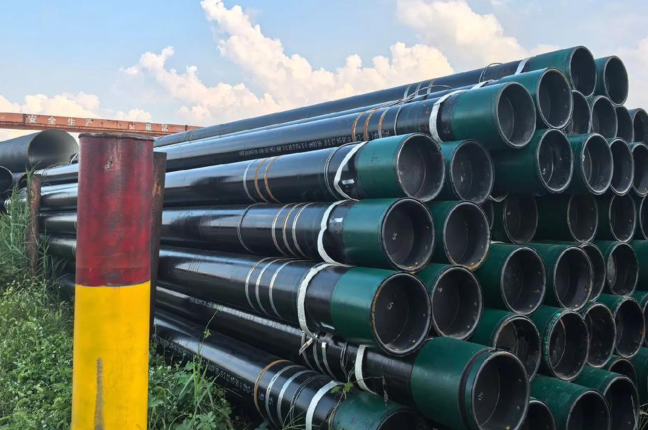
Casing string design is not arbitrary; it is a product of drilling engineering. This is one of the most complex calculations in drilling. Engineers need to consider:
Strength requirements: The casing string must be able to withstand the maximum external forces it may encounter during its service life, including:
a. External extrusion resistance: Resisting the inward squeezing force of the formation.
b. Internal pressure resistance: Resisting the expansion force of internal fluids (such as high-pressure oil and gas).
c. Tensile strength: Resisting the substantial weight of the casing string itself.
Safety factor: Adequate margin should be allowed within the above calculated strengths to ensure absolute safety.
Economy: While ensuring safety, the most economical materials and solutions should be selected.
Mechanical Properties of the Casing String:
The mechanical properties of the casing string are the core guarantee of its safe service underground. Engineers must ensure that the casing string can withstand all mechanical loads encountered during drilling and production. These strengths are categorized into the following three types:
1) Casing Collapse Strength
Casing collapse strength refers to the ability of casing to resist external formation pressure, preventing it from being crushed or collapsed. Casing failure due to external compression is similar to unstable failure caused by longitudinal compression rods, and is also a type of unstable deformation failure. Currently, depending on the diameter-to-thickness ratio (the ratio of the casing's outer diameter to its wall thickness), failure can be categorized as either unstable or strength-deformation failure. A large diameter-to-thickness ratio indicates unstable failure, while a small diameter-to-thickness ratio indicates strength-deformation failure. Based on existing casing sizes, most casing will experience unstable failure. The collapse strength of casing of different steel grades, diameters, and wall thicknesses can be found in relevant manuals.
Why it's important: If the collapse strength is insufficient, the casing can be crushed by formation pressure, leading to wellbore blockage, interrupted drilling fluid circulation, and even the loss of the entire well. This is what the casing string must possess. One of the most fundamental strengths.
Design Considerations: In well sections with loose, high pore pressure, or salt-gypsum formations, collapse resistance is the primary design consideration.
2) Casing Tensile Strength
Tensile strength refers to the ability of a casing string to resist axial tensile loads and prevent breakage at the connecting threads or the pipe body. Casing strings are typically connected by couplings. When determining casing tensile strength, both the strength of the casing body and the strength of the threaded connection must be considered. Threaded connection strength varies with thread type. Generally, round threads have a lower strength than the casing body, while trapezoidal threads generally have a higher strength than the casing body. For information on the tensile strength and threaded connection strength of various types of casing, please refer to relevant manuals.
Why It's Important: In deep wells, casing strings can weigh up to Hundreds of tons. Insufficient tensile strength, especially at threaded connections, can cause the casing string to break and fall within the wellbore, resulting in significant economic losses.
Design Considerations: Tensile strength determines the maximum depth a casing string can be lowered. Deep wells require high-grade, thick-walled casing.
3) Casing Internal Pressure Resistance
Internal pressure resistance refers to the ability of casing to resist internal fluid pressure and prevent internal rupture. This refers to the internal pressure at which the steel reaches its yield point under internal pressure. Most casing is thin-walled, and its internal pressure resistance can be calculated using the thin-walled pipe formula. The internal pressure resistance of various types of casing can be found in relevant manuals.
Why it's important: Insufficient internal pressure resistance can cause casing tearing, leading to catastrophic blowouts, resulting in casualties and environmental pollution.
Design Considerations: During production and reusable casing, the internal pressure resistance of the casing is determined by the following formula: In the design of technical casing capable of drilling into high-pressure oil and gas formations, resistance to internal pressure is crucial.
Casing Connections and Installation:
Casing is typically manufactured in 12-meter segments with external threads on both ends and connected using couplings. A coupling is a short piece of tubing with internal threads that securely connects the segments. The type of connection varies depending on well conditions and operational requirements. Round threads (trapezoidal threads) are commonly used in standard wells due to their ease of installation, but they have lower tensile strength than premium threads. Premium threads are designed specifically for high-pressure, high-temperature wells, providing a gas-tight seal and increased tensile strength, making them ideal for the complex drilling environments of deep wells. For extremely high-pressure applications, flange connections can be used, providing a secure, leak-proof fit, thereby enhancing wellbore integrity and safety. During installation, Casing is lowered into the wellbore in sections and cemented. The annular space between the casing and the wellbore is filled with cement slurry. This process provides structural support, isolates different geological strata, and prevents fluid migration between them, ensuring efficient and safe wellbore operation.
Analysis of Causes of Casing String Damage:
Research and investigation of domestic and international oilfields revealed that the main forms of casing damage include deformation, cracking, casing misalignment, and corrosion fatigue leakage. Analysis indicates that the main causes of casing string damage are:
1. Drilling Engineering Factors
Drilling factors primarily include drilling engineering design and field operations. Examples include improper casing string strength design and excessive bending stress on the casing string due to excessive wellbore curvature (or a small radius of curvature).
2. Downhole Operation Factors
Downhole operation factors primarily include production... Excessive hollowing of the wellbore during oil and well testing; casing damage during acidizing, fracturing, perforating, workover, fishing, and repeated logging; inappropriate deep-well gas lift measures; and excessive injection pressure in infill and water injection wells.
3. Cementing Engineering Factors
Cementing engineering factors encompass three aspects: construction, cementing design, and testing. Examples include improper casing anchoring at the wellhead, substandard cementing quality, suboptimal completion methods, mechanical wear during casing installation, and inappropriate cementing design. These factors can result in significant external compressive forces on the already sealed casing string, leading to casing damage.
4. Geological Factors
Geological factors primarily include sand production from oil reservoirs, shale expansion, creep of salt layers, release of tectonic stresses in the formation, and loss of the original formation pressure balance in the geostress field.
5. Casing Quality Factors
Casing quality factors primarily refer to mechanical defects that may have occurred at the factory, as well as mechanical damage incurred during placement, transportation, and running into the well. If casing with poor quality is run into the well, the casing string will be damaged and fail under the combined effects of various external forces, including internal pressure, axial tensile loads, bending loads, and external compressive forces.
6. Corrosion Fatigue Factors
Corrosion can occur due to scaling, bacteria, dissolved oxygen, highly saline formation water, and chemical agents. Corrosion reduces the strength of the casing string, potentially leading to fatigue failure.
7. Water and Gas Injection Factors
Heavy oil thermal recovery, high-pressure water and gas injection in adjustment wells, fault repair or displacement, and hydration expansion of mudstone can cause significant external pressure on the casing, potentially damaging it.
API Oil Casing Manufacturing Standards:
The primary manufacturing standards for oil well casing are developed and published by the American Petroleum Institute (API). The three most fundamental and critical standards are:
API SPEC 5CT - Specification for Casing and Tubing
API SPEC 5B - Specification for Fabrication, Measurement, and Inspection of Threads for Casing, Tubing, and Line Pipe
API TR 5C3 - Calculation Formulas and Technical Reports for Properties of Casing, Tubing, Drill Pipe, and Line Pipe
In addition, for threaded connections, the following is also referenced:
API SPEC 7-1 - Rotating Drill String Components
Standard Areas:
Pipe Body and Materials: API SPEC 5CT - Dimensions, Weight, Steel Grade, Chemical Composition, and Heat Treatment
Threads and Connections: API SPEC 5B - Thread Type, Fabrication Accuracy, and Inspection Methods
Mechanical Properties: API TR 5C3 - Calculation and Testing of Internal Pressure Resistance, Collapse Resistance, and Tensile Strength
Read more: Seamless Casing vs. ERW Casing or Specifications and Dimensions of Drilling Casing
 sales@hu-steel.com
 English
 Español