J55 vs K55 Casing Pipe

Keywords: j55 vs k55 casing, api j55 and k55 casing, j55 casing, k55 casing, j55 and k55 grade

J55 and K55 are two of the most basic casing steel grades in the API 5CT standard. They have the same yield strength (55,000 psi), but differ significantly in tensile strength, application scenarios, and cost. Many people easily confuse these two grades when selecting a steel, even believing they are interchangeable. This article will provide an in-depth analysis of the key differences between J55 and K55 to help you make the accurate selection based on your actual working conditions.


J55 vs K55 Casing Pipe:


1. Chemical composition
In terms of chemical composition, the requirements of the two steel grades J55 and K55 are highly consistent.
Mn content: The Mn content of K55 (1.25-1.50%) is significantly higher than that of J55 (0.85-1.00%) to enhance strength and toughness.
Microalloying: Some K55 may add vanadium (V) or rare earth (RE) to optimize performance, while J55 usually does not contain these elements.

Production process: K55 straight seam welded pipe needs to control the yield strength ratio (0.56-0.80), while J55 is relatively simple to produce.

 J55 vs K55 Casing


2. Mechanical properties

Parameter
J55 K55 Difference analysis
Yield strength
379-552 MPa
379-552 MPa
Same API standard range
Tensile strength
≥517 MPa
≥655 MPa
K55 requires higher
Elongation after fracture
≥15%
≥15%
Same
Impact toughness
No mandatory requirement
Same


Key difference:
Yield strength: The yield strength range of J55 and K55 is 379 - 552Mpa, which means that when subjected to a certain pressure, their ability to resist deformation is comparable, and they can cope with the formation pressure and the weight of downhole equipment to a certain extent.
Tensile strength: The difference between the two is quite obvious. The tensile strength of K55 is ≥655Mpa, while the tensile strength of J55 is ≥552Mpa. K55's higher tensile strength requirement makes it more advantageous when facing larger tensile forces.

From a practical application perspective, this also determines that K55 can be used instead of J55, while J55 cannot replace K55 due to its relatively low tensile strength. K55 is usually used in working conditions that require higher strength, while J55 is mostly used in shallow wells or low-stress environments.

3. Elongation
In terms of the minimum elongation within the 50.8mm gauge length of the same size, the elongation of J55 steel grade is slightly higher than that of K55 steel grade. Although this difference may seem subtle, it may affect the selection of pipes in some application scenarios that require higher material deformation capabilities. For example, in some processes that require pipes to be bent or stretched, the relatively high elongation of J55 may be more advantageous.

4. Impact test
In terms of the same size CVN Charpy impact test and impact energy requirements, J55 and K55 steel grades perform the same. This shows that in terms of impact load resistance, the two have comparable performance and can better adapt to the impact that may occur during complex underground construction, providing stable and reliable pipe support for oil and gas production.

Pipe body:
PSL1: There is no difference between J55 and K55 casing;
PSL2: J55 and K55 casing require a minimum horizontal impact energy of 20 J for full-size specimens and a minimum horizontal impact energy of 27 J for full-size specimens.
API Coupling: The minimum transverse impact energy (full-size specimen) of the J55 and K55 impact test is 20 J, and the minimum longitudinal impact energy (full-size specimen) is 27 J.

5. Hydraulic test (no difference)

6. Nondestructive testing
PSL1: There is no mandatory requirement for nondestructive testing for J55 and K55 grades;
PSL2: All J55 and K55 grade steel pipes shall be tested using one or more methods specified in this standard to detect possible horizontal L4-level longitudinal defects on the inner and outer surfaces of the steel pipe.

7. Color band identification
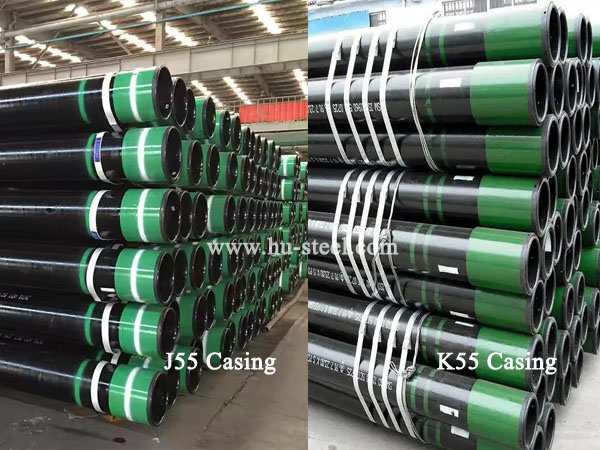
J55 casing is sprayed with a bright green welding strip, the casing neck is painted bright green, and a white welding strip is added;
K55 steel pipe is sprayed with two bright green welding strips, the casing neck is painted bright green, and no welding strip is added.

8. J55 vs K55 Casing Application: How to Choose?

Application
J55 Casing K55 Casing Recommended 
Shallow well (<3000m) 
Applicable (low cost)
Applicable (but the cost performance is not as good as J55)
J55 is more economical
Medium-deep well (3000-4500m)
Available, but stress assessment is required
Better (higher tensile strength)
K55 is more reliable
Corrosive environment
Requires additional anti-corrosion treatment
Both require enhanced measures
Shale gas/horizontal wells
Can be used in non-fracture sections
More suitable for fracturing sections (high tensile strength)
K55 is better


Key differences:

J55 advantages: low cost, suitable for shallow wells, low stress environments, such as conventional water wells or surface casings.

K55 advantages: higher tensile strength, suitable for deep wells, horizontal well fracturing sections and high stress environments.


Influence of production process:
J55: Generally, normalizing treatment can meet the performance requirements, and the production process is relatively simple.
K55: Some manufacturers may use tempering treatment (quenching + tempering) or microalloying (such as V, RE) to ensure higher tensile strength (≥655 MPa).

Latest technology trends:
Economic rare earth-containing K55: The latest research shows that adding a small amount of rare earth (RE) can reduce the Mn content while maintaining the mechanical properties of K55 and reducing the alloy cost.
37Mn5 steel: Some K55s use 37Mn5 steel (Mn 1.25-1.50%), while J55 usually uses ordinary C-Mn steel.

In short, based on the comprehensive evaluation of specific well depth, formation pressure and economy, J55 has low cost and low Mn content, which is suitable for conventional low-stress wells, while K55 has a higher Mn content, may contain V or RE, has higher tensile strength, and is suitable for more demanding working conditions.


Read more: N80 VS J55 Casing or Steel Grade of OCTG Casing

Recruiting Agents - Check Policies Here

Copyright @2017 Hunan Standard Steel Co.,Ltd and Husteel Industry Group All Rights Reserved

linkin  youtube

We use cookies to offer a better browsing experience, analyze site traffic, and personalize content. By using this site, you agree to our use of cookies.

Accept
Decline