sales@hu-steel.com
 English
 Español
Seamless steel pipes (SMLS pipe) are widely used in the petroleum, chemical, and natural gas industries. Before being put into service, these pipes must undergo a hydrostatic test to verify their pressure-bearing capacity, sealing integrity, and structural reliability. This guide covers the complete hydrostatic test process, test pressure calculation, holding time requirements, and key industry standards to help engineers and buyers understand this critical quality assurance step.
Hydrostatic testing is a method of testing the strength and leak resistance of pipes by internally pressurizing them with water. It is an effective way to detect potential defects in seamless steel pipes and is one of the essential conditions for ensuring the safe and reliable operation of pipeline systems.
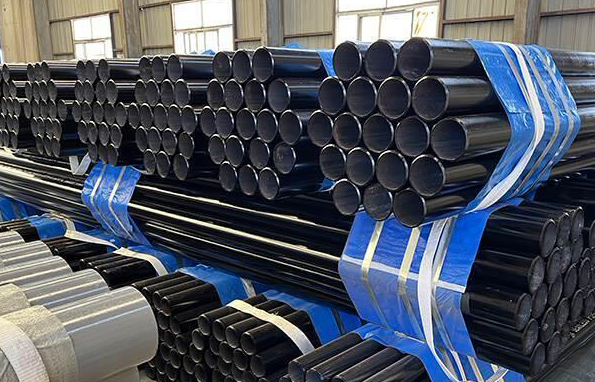
Hydrostatic test is a key method to detect the pressure bearing capacity, sealing and structural integrity of seamless steel pipes. It is suitable for high-pressure pipelines in the fields of petroleum, chemical, boiler, machinery manufacturing, etc. Hydrostatic testing can ensure that seamless pipes maintain stable performance, prevent corrosion and increase their service life in actual use.
Gradually increase the pressure in the pipe (avoid pressure fluctuations) until the required test pressure is reached. The maximum pressure is usually required to be 1.5 times the working pressure. After maintaining the test pressure for a period of time (10~30 minutes), release the internal pressure.
c. Leakage detection
Observe whether the seamless steel pipe leaks. If leaks occur, find out the cause of the leak and repair it.
Based on the test results, determine whether the seamless steel pipe is qualified and whether it needs to be repaired or replaced.
| Standard | Test Pressure Requirement | Holding Time | Key Notes |
|---|---|---|---|
| ASTM A53 | Min. 2.4 MPa (350 psi) for ≤ NPS 3; ≤ 2500 psi max | ≥ 5 seconds | For seamless and ERW pipe |
| API 5L | Based on 90% SMYS hoop stress | ≥ 10 seconds | Mill test requirement |
| ASME B31.3 | 1.5 × design pressure × (St / Sd) | Typically ≥ 10 minutes | For process piping systems |
| GB/T 8163 | P = 2SR/D, ≤ 19 MPa | ≥ 5 seconds | China standard for seamless steel pipes |
Note: For large-diameter pipes, hydrostatic testing may be combined with UT+RT (ultrasonic and radiographic testing) to ensure comprehensive quality assurance.
While hydrostatic testing is a destructive (or pressure-based) test that verifies the pipe's ability to hold pressure, non-destructive testing (NDT) methods (such as ultrasonic testing and eddy current testing) detect internal and surface defects without damaging the pipe.
● Hydrostatic testing is typically mandatory for seamless pipes under most standards.
● NDT is often used as an alternative or supplement to hydrostatic testing, especially when the purchaser accepts NDT in lieu of hydrostatic testing.
The method of water pressure test can be divided into two types: static water pressure test and dynamic water pressure test. The static water pressure test is to press the static water in the water cylinder or pool into the pipeline for testing, and the dynamic water pressure test is to use a water pump to inject water into the pipeline for testing.
| Problem | Possible Cause | Solution |
|---|---|---|
| Pressure drop | Head leakage or steel pipe defect | Reseal or replace the pipe |
| Pipe bulge | Insufficient local wall thickness | Scrap and check the rolling process |
| Weld leakage | Unqualified welding quality | Repair weld or cut off defective section |
5. After the test, the test equipment and test materials should be cleaned and disinfected to ensure that they are clean and hygienic.
A: Yes, the water pressure test should be carried out according to the standard procedure, follow the specifications, and shall not be modified at will.
Q4: How long should the test pressure be held?
A: The holding time depends on the applicable standard. For ASTM A53, it is at least 5 seconds; for API 5L, at least 10 seconds; for ASME B31.3, typically 10 minutes or more.
The hydrostatic test of seamless steel pipes is one of the necessary conditions to ensure the safety and reliability of the pipeline. The correct water pressure test methods and techniques can effectively ensure the safety and reliability of the pipeline operation. When conducting a water pressure test, it is necessary to follow the standard procedures, pay attention to details and strictly follow the process to obtain accurate and reliable test results.
Read more:
● Non-destructive Testing of Seamless Pipes
Related information
Copyright @2017 Hunan Standard Steel Co.,Ltd and Husteel Industry Group All Rights Reserved