What are pipe fittings?
Pipe fittings are a general term for the parts in the pipeline system that play a role in connecting, controlling, changing direction, diverting, sealing, supporting, etc.
Steel pipe fittings are all pressure-bearing pipe fittings. According to different processing techniques, they are divided into four categories, namely butt welding pipe fittings (with and without welds), socket welding and threaded pipe fittings, and flange pipe fittings.
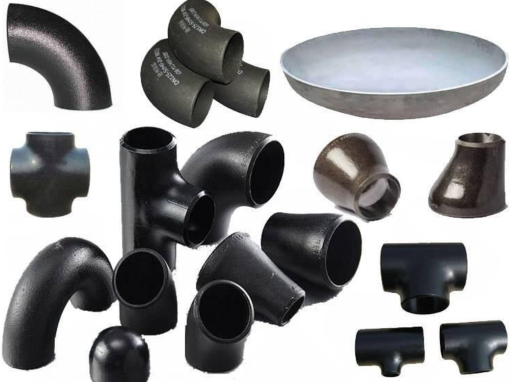
Classification of Pipe Fittings:
There are many types of pipe fittings, which are classified according to their uses, connections, materials, and processing methods.
According to use:
1. Pipe fittings used to connect pipes to each other include:
pipe flanges, unions, pipe hoops, clamps, ferrules, hose hoops, etc.
2. Pipe fittings that change the direction of the pipe:
pipe elbow, bend pipe
3. Pipe fittings to change the diameter of the pipe:
pipe reducer, reducing elbow, branch pipe stand, reinforcing pipe
4. Add pipe fittings for pipeline branches: tee, four-way
5. Pipe fittings used for pipeline sealing: gaskets, raw material tapes, linen, flange blind plates, pipe plugs, blind plates, heads, and welding plugs
6. Pipe fittings used for pipeline fixation: snap rings, tow hooks, lifting rings, brackets, brackets, pipe clamps, etc.
According to the connection points:
1. Welded pipe fittings; 2. Threaded pipe fittings; 3. Clamp pipe fittings; 4. Clamp pipe fittings; 5. Socket pipe fittings; 6. Adhesive pipe fittings; 7. Hot melt pipe fittings; 8. Curved elastic double melt pipe fittings;9. Rubber ring connected pipe fittings
According to material:
1.
Carbon steel pipe fittings; 2. Cast iron pipe fittings; 3.
Stainless steel pipe fittings; 4. Plastic pipe fittings; 5. PVC pipe fittings; 6. Rubber pipe fittings; 7. Graphite pipe fittings; 8. Forged steel pipe fittings; 9. PPR pipe fittings; 10. Alloy Pipe fittings; 11. PE pipe fittings; 12. ABS pipe fittings
Materials and manufacturing standards for steel pipe fittings:
1. Steel pipe fittings are mainly divided into the following categories according to material:
● Carbon steel:
ASTM/ASME A234 WPB, WPC (Applicable temperature: -29℃ ~ 425℃, general petrochemical piping)
● Alloy steel:
ASTM/ASME A234 WP11, WP22 (Suitable for high-temperature creep conditions, such as steam piping)
ASTM/ASME A234 WP91 (Used for high-temperature and high-pressure piping in ultra-supercritical units)
15CrMoV, 35CrMoV (Commonly used for heat-resistant and wear-resistant pipe fittings)
● Stainless Steel:
ASTM/ASME A403
WP304/304L/304H/304LN/304N (Applicable Temperature: -196℃ ~ 870℃)
WP316/316L/316H/316LN/316N/316Ti (Applicable Temperature: -196℃ ~ 870℃, contains molybdenum, superior pitting resistance)
WP321/321H (Applicable Temperature: -196℃ ~ 870℃, titanium stabilized, resistant to intergranular corrosion)
WP347/347H (Applicable Temperature: -196℃ ~ 900℃, niobium stabilized, superior high-temperature strength)
● Low temperature steel:
ASTM/ASME A420 WPL3-WPL 6
● High performance pipeline steel fittings:
ASTM/ASME A860 WPHY 42/46/52/60/65/70 (mainly used for long-distance pipelines)
● Cast steel (such as ASTM A216 WCB), copper and copper alloys, aluminum alloys, plastics (such as PVC, PPR, RFPP), etc.
2. According to the production method, it can be divided into pushing, pressing, forging, casting, etc.
3. According to manufacturing standards, it can be divided into: Chinese Standard (GB), Petrochemical Standard (SH), Chemical Standard (HG), Power Standard (DL), American Standard (ASTM/ASME), German Standard (DIN), Japanese Standard (JIS), etc.
4. According to its radius of curvature: it can be divided into long radius elbow and short radius elbow. A long-radius elbow means that its radius of curvature is equal to 1.5 times the outer diameter of the pipe, that is, R=1.5D; a short-radius elbow means that its radius of curvature is equal to the outer diameter of the pipe, that is, R=1.0D. (D is the elbow diameter, R is the radius of curvature).
5. If divided by pressure level: there are about seventeen types, which are the same as the American pipe standards, including: Sch5s, Sch10s, Sch10, Sch20, Sch30, Sch40s, STD, Sch40, Sch60, Sch80s, XS, Sch80, Sch100, Sch120, Sch140, Sch160, XXS; the most commonly used ones are STD and XS.
Standard system of pipe fittings:
There are two main international pipe flange standards, namely the European pipe flange system represented by German DIN (including the former Soviet Union) and the American pipe flange system represented by American ANSI pipe flanges. In addition, there are Japanese JIS pipe flanges, but they are generally only used in public projects in petrochemical plants and have little impact internationally. The following is an introduction to pipe flanges in various countries:
1. European system pipe flanges represented by Germany and the former Soviet Union
2. American system pipe flange standards, represented by
ANSI B16.5 and ANSI B 16.47
3. British and French pipe flange standards, each country has two casing flange standards.
To sum up, the internationally accepted pipe flange standards can be summarized into two different and non-interchangeable pipe flange systems: one is the European pipe flange system represented by Germany; the other is represented by the United States. American pipe flange system.
IOS7005-1 is a standard promulgated by the International Organization for Standardization in 1992. This standard is actually a pipe flange standard that merges two series of pipe flanges from the United States and Germany.
 sales@hu-steel.com
 English
 Español