Dimensions and Specifications of Oil Drill Pipe and Geological Drill Pipe:
Oil Drill Pipe: API standard, outer diameters typically 2 3/8", 2 7/8", 3 1/2", 4", 4 1/2", 5", etc., steel grades include E75, X95, G105, S135, single pipe length approximately 9-10 meters, used for drilling oil and gas wells at depths of several thousand meters.
Geological Drill Pipe: DCDMA standard, common models are AQ, BQ, NQ, HQ, PQ (i.e., Q series), used for geological exploration, drilling depths generally from several hundred meters to two thousand meters.
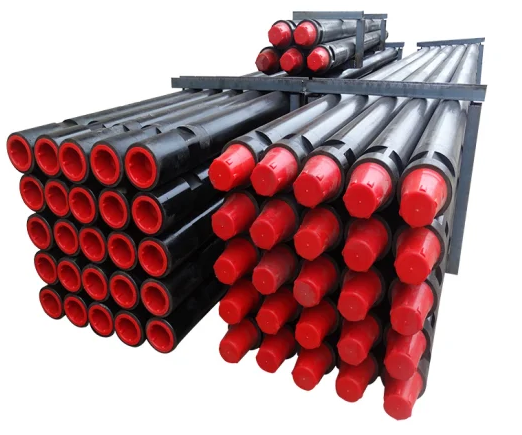
Oil Drill Pipe Dimensions and Specifications:
Drill pipe is the core tool in oil drilling, connecting the surface drilling rig to the bottom hole drill bit, responsible for transmitting torque and delivering drilling fluid. Choosing the appropriate drill pipe size directly affects drilling efficiency, wellbore quality, and operational safety. This article will systematically introduce the common dimensions, steel grades, and selection principles of API standard oil drill pipe.
Common Outer Diameter Dimensions of Oil Drill Pipes:
The outer diameter of an oil drill pipe is its most basic specification parameter. According to API Spec 5DP, the most commonly used drill pipe outer diameters are as follows:
● 2 3/8 inches (approximately 60.3 mm): Primarily suitable for shallow wells with depths not exceeding 1500 meters and small-diameter well workover operations.
● 2 7/8 inches (approximately 73.0 mm): Suitable for medium-shallow wells of 1500 to 2500 meters, offering flexibility and economy.
● 3 1/2 inches (approximately 88.9 mm): The most commonly used size on the market, suitable for medium-deep wells of 2500 to 4000 meters.
● 4 inches (approximately 101.6 mm): Suitable for deep wells of 4000 to 5500 meters, capable of supporting higher torque transmission.
● Drill pipe with an outer diameter of 4 1/2 inches (approximately 114.3 mm) is suitable for deep or ultra-deep wells exceeding 5500 meters, enabling high-volume and high-intensity drilling.
● Drill pipe with an outer diameter of 5 inches (approximately 127.0 mm) is primarily used for ultra-deep or large-bore operations, capable of withstanding extremely high torque and providing extremely high displacement.
Oil Drill Pipe Steel Grades and Strength:
Besides size, the steel grade of the drill pipe determines its load-bearing capacity. Common API oil drill pipe steel grades include E75, X95, G105, and S135.
The E75 steel grade has a minimum yield strength of 517 MPa and is suitable for conventional shallow wells and well workover operations.
The X95 steel grade has a minimum yield strength of 655 MPa and is suitable for medium-deep wells.
The
G105 steel grade has a minimum yield strength of 724 MPa and is the main steel grade used in deep well operations.
The
S135 steel grade has a minimum yield strength of 931 MPa and is specifically used for ultra-deep wells, horizontal wells, and complex operating conditions.
Note: Numbers in steel grades, such as 105, are in ksi (kilopounds per square inch). A higher number indicates higher drill pipe strength.
Drill Pipe Length:
The standard length of a single oil drill pipe is typically around 9 meters, approximately 30 feet. In actual drilling operations, multiple drill pipes are connected into a drill string using couplings to accommodate drilling needs at different depths.
Selection Recommendations:
● For shallow wells less than 1500 meters deep, 2 3/8 inch or 2 7/8 inch drill pipes are recommended, with E75 or X95 steel grade sufficient for operational requirements.
● For medium-deep wells between 2500 and 4000 meters deep, 3 1/2 inch drill pipes are the mainstream choice, and should be paired with G105 steel grade.
● For deep or ultra-deep wells exceeding 4000 meters deep, 4-inch or 4 1/2 inch drill pipes are recommended, paired with G105 or S135 high-strength steel grade to ensure sufficient strength safety margin.
● For horizontal wells or extended reach wells, high-strength, high-torsional-resistance drill pipes are required, such as 5-inch S135 steel grade drill pipes.
Geological Exploration Drill Pipe Dimensions and Specifications:
In the field of geological core drilling, drill pipes are essential tools for obtaining underground core samples and exploring mineral resources. The Q-series wireline coring drill pipes under the internationally recognized DCDMA standard are currently the most widely used specification system.
Q-series wireline coring drill pipe specifications:
1. AQ type drill pipe: Outer diameter 1.625 inches (approximately 41.3 mm), inner diameter 27.0 mm.
Application: Primarily used for shallow hole drilling to depths not exceeding 300 meters; single pipe length 1.5 m or 3.0 m.
2. BQ type drill pipe: Outer diameter 2.125 inches (approximately 54.0 mm), inner diameter 36.5 mm.
Application: Suitable for medium-shallow hole drilling to depths of 300 to 600 meters; single pipe length 1.5 m or 3.0 m.
3. NQ type drill pipe: Outer diameter 2.750 inches (approximately 69.9 mm), inner diameter 47.6 mm.
Applications: Suitable for medium-depth drilling (600-1000 meters), this is the most frequently used model in geological exploration. Single pipe lengths are 1.5 meters or 3.0 meters.
4. HQ Drill Pipe: Outer diameter is 3.750 inches (approximately 95.3 mm), and inner diameter is 63.5 mm.
Applications: Suitable for deeper boreholes (1000-1500 meters), allowing for the extraction of larger diameter core samples. Single pipe lengths are 1.5 meters or 3.0 meters.
5. PQ Drill Pipe: Outer diameter is 4.500 inches (approximately 114.3 mm), and inner diameter is 83.3 mm.
Applications: Suitable for deep-hole drilling (1500-2000 meters and above), providing ultra-large diameter core samples. Single pipe lengths are 1.5 meters or 3.0 meters.
In addition, thicker specifications such as NQ3 and HQ3 are used in some drilling scenarios to suit deeper or more complex formations.
Features and Applications of Q-Series Models:
AQ Drill Pipe: Smallest outer diameter, lightweight, and easy to transport; primarily used in ultra-shallow holes or scenarios with extremely low drilling load requirements.
BQ Drill Pipe: Entry-level model, suitable for shallow to medium geological surveys and exploration.
NQ Drill Pipe: The most frequently used model, achieving a good balance between performance and portability; suitable for most medium-depth solid mineral exploration projects.
HQ Drill Pipe: Used for deeper boreholes or projects requiring large-diameter cores; better able to handle fractured formations and improve core recovery rates.
PQ Drill Pipe: Largest outer diameter and core diameter; primarily used for deep ore body exploration and scientific research requiring large-size cores.
Drill Pipe Material:
Q-series drill pipes are typically made of alloy structural steel such as R780, ZT series, or 42CrMo. These materials, after quenching and tempering, possess high strength, high toughness, and good fatigue resistance, effectively handling torsional, tensile, and impact loads generated during drilling in complex formations.
When selecting geological exploration drill pipes, it is necessary to comprehensively consider the exploration depth, target core diameter, drilling rig capacity, and on-site transportation conditions. The NQ model, as the most balanced option, is the top choice for most geological projects. However, for deep mineral exploration projects, it is recommended to prioritize the HQ or PQ models to obtain more reliable core samples and higher drilling efficiency.
Conclusion:
This article introduces a list of common drill pipe sizes and specifications, the application range and characteristics of each drill pipe. When selecting drill pipe, factors such as well depth and the hardness and density of the well wall must be taken into consideration. Proper selection of drill pipe can improve drilling efficiency and reduce costs.
Furthermore, because drill pipe and drill tools are the "lifeline" connecting the surface to the drill bit underground, their failure can have catastrophic consequences, directly impacting the safety, efficiency, and economic costs of drilling operations. Therefore, it is essential to understand the usage guidelines and maintenance recommendations for drill pipe and drill tools.
Go here to learn more: Casing Pipe vs. Drill Pipe or Drill Pipe HS Code
 sales@hu-steel.com
 English
 Español