sales@hu-steel.com
 English
 Español
In geological exploration and drilling engineering, the geological drill pipe is a key component connecting the drilling rig and the drill bit, and its performance directly affects drilling efficiency, core quality, and construction safety. Correct drill pipe selection requires a systematic consideration of key factors such as materials, specifications, connections, and maintenance. This article aims to provide a concise and practical selection guide.
Geological Drill Pipe Introduction:
Applications: Primarily used for solid mineral exploration, hydrogeological surveys, engineering geological surveys, and scientific drilling.
Core Requirements: Core sampling quality, portability, and adaptability to complex terrain.
Features: Available in self-contained specifications (e.g., AQ/BQ/NQ/HQ/PQ), often used with wireline coring systems, with high requirements for weight and core recovery rate.
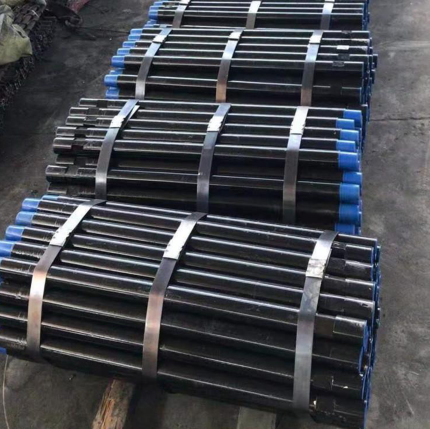
How to Choose the Right Geological Drill Pipe?
1. Drill Pipe Material Selection
Carbon steel is the most common drill pipe material, with advantages such as high strength and low price, but it also has disadvantages such as being prone to rust and wear. Alloy steel has relatively better material properties, but its price is also relatively high. Composite material drill pipes are a new type of drill pipe material that has emerged in recent years, with advantages such as light weight, high strength, and good wear resistance, but its price is also relatively high.
Specifically:
a. Carbon steel/low-alloy steel: Carbon steel boasts high strength, low cost, and mature manufacturing processes, but its corrosion and wear resistance are generally poor, and it is prone to rusting in humid or corrosive environments. Suitable for conventional formations, shallow to medium-deep holes, and cost-sensitive projects.
b. High-strength alloy steel: Offers better overall mechanical properties (e.g., superior strength and toughness) and durability, but has a higher procurement cost. Suitable for deep-hole drilling, hard rock drilling, and projects with high requirements for drill pipe lifespan.
Material selection recommendations:
For most onshore solid mineral exploration, high-strength alloy steel is the mainstream choice due to its excellent cost-effectiveness. When relocation efficiency is extremely important or there are special requirements for corrosion resistance, the long-term value of composite material drill pipes can be evaluated.
Drill Pipe Diameter:
Following the "drill pipe-hole-casing pipe" gradation relationship.
Small diameter drill pipes (such as the AQ/BQ series, outer diameter approximately 75mm) are suitable for shallow hole sampling; standard specifications (such as the NQ/HQ series, outer diameter approximately 96mm) are the mainstay for most core drilling; large diameter (such as the PQ series) are used for deep holes or projects requiring large-diameter coring. For hard rock formations, larger diameter, thicker-walled drill pipes with better rigidity are preferred to enhance bending resistance and ensure drilling stability.Process Considerations: If wireline coring is used, double-walled drill pipes and their dedicated internal and external thread connection system are required.
4. Process Compatibility
Wireline Coring: Double-walled wireline coring drill pipes with a unique internal tube assembly design are essential.
Impact Drilling: Thickened or specially reinforced drill pipes are required to withstand high-frequency impact loads.
Directional Drilling: Drill pipes with high bending strength and better wear resistance are required, and non-magnetic drill collars may be necessary.
Drill Pipe Storage and Maintenance:
4. Regular Inspection: Establish a regular inspection system, focusing on thread wear, pipe bending, and surface cracks. Severely damaged drill pipes should be scrapped immediately.
Frequently Asked Questions about Geological Drill Pipe Procurement:
1. What are the main specifications of geological drill pipes? How should I choose?
Geological drill pipes use the "letter specification" series. The core specifications are:
AQ: Outer diameter approximately 48mm, small core diameter, used for shallow holes in complex formations.
BQ: Outer diameter approximately 60mm, widely used.
NQ: Outer diameter approximately 75mm, mainstream specification, perfect balance between strength and core size.
HQ: Outer diameter approximately 96mm, used for deeper holes or those requiring larger core diameters.
PQ: Outer diameter approximately 122mm, used for deep hole exploration.
Selection criteria: Prioritize selecting the series based on the core diameter and depth required by the borehole design, then determine the specific material and wall thickness based on the rock type and hardness.
2. What is the fundamental difference between wireline coring drill pipes and ordinary drill pipes?
The core difference lies in the structure and manufacturing process. Wireline coring drill pipes are double-walled tubes. The inner tube is used to hold and lift the core, while the outer tube is used to transmit torque and deliver flushing fluid. Its advantage is that core drilling can be performed without lifting the drill, resulting in extremely high efficiency. When purchasing, it is essential to clarify whether it is compatible with wireline coring technology.
3. How does the material of the drill pipe (e.g., steel, aluminum alloy) affect performance and price?
High-strength alloy steel: The mainstream choice, high strength, durable, and cost-effective.
Aluminum alloy: Lightweight (30%-50% weight reduction), corrosion resistant, but high cost and low bending stiffness; suitable for areas with extremely difficult handling.
Selection: Alloy steel is preferred for deep holes and hard rock; for relocation areas such as high mountains and swamps, the long-term comprehensive benefits of aluminum alloy can be evaluated.
4. Are there international or domestic unified standards for geological drill pipes?
Yes, but they differ from the API standard for petroleum. Internationally, ISO standards are mainly referenced, while China has industry standards such as "DZ/T Geological Drilling Drill Pipe". When purchasing, suppliers should be required to clarify the standards upon which the product is based.
5. What quality certification documents should be provided for newly purchased drill pipes?
Required: Material certificate (chemical composition, mechanical performance test report).
Non-destructive testing report (e.g., ultrasonic testing).
Third-party inspection report (if applicable).
Conclusion:
Choosing suitable drill pipes is crucial for geological drilling. Factors such as the material, diameter, length, thread type, and compatibility with drilling techniques need to be comprehensively considered. Attention to detail in drill pipe storage and maintenance is also necessary to ensure their service life and performance. It is recommended to communicate closely with experienced drilling engineers or reputable suppliers at the initial project design stage to determine the optimal drill pipe combination based on specific hole depth, lithology, coring requirements, and budget.
Read more: Types of Oil Drill Pipe or API 5DP Drill Pipe Specification
Related information
Copyright @2017 Hunan Standard Steel Co.,Ltd and Husteel Industry Group All Rights Reserved