sales@hu-steel.com
 English
 Español
X80 Steel (Welded Carbon Steel Pipe) is the number in the American Petroleum Institute's API Spec 5L Pipeline Specification. X represents the pipeline steel in the API Spec 5L standard, 80 is the strength grade, the unit is kpsi, and X80 is the pipeline steel with a minimum yield strength of 80 kpsi, which is converted to a metric unit of approximately 551 MPa.
The table below shows the upper limit values for the chemical composition of X80 steel (PSL2 grade) according to the API 5L standard:
|
Chemical composition (%)
|
||||||||||
|
C
|
Si
|
Mn
|
P
|
S
|
Cr
|
Ni
|
Ti
|
Nb
|
V
|
Mo
|
|
0.10
|
0.30
|
1.85
|
0.020
|
0.005
|
0.30
|
0.30
|
0.04
|
0.005-0.10
|
0.10
|
0.30
|
The X80 is an American classification of high strength pipeline steel. The minimum yield value (MPa) is 551; this concept belongs to the concept of material mechanics. The yield value refers to the stress value at the yield stage when the material is stretched, and the yield stress refers to the critical value of the yield stage to the contraction stage.
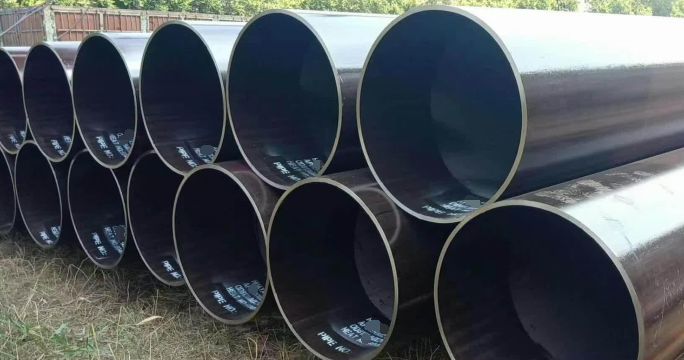
Because X80 strength grade pipeline steel is a high-grade product among pipeline steels, it has high strength requirements. According to API 5L standards, for higher quality PSL2 grade X80 pipeline steel, its mechanical properties must meet the following requirements:
Yield strength: Not less than 551 MPa.
Tensile strength: Not less than 620 MPa.
Yield-to-tensile strength ratio: Not higher than 0.93.
In actual production, to consistently meet all the above requirements, manufacturers usually control the performance within a narrow range. For example, the measured yield strength is commonly between 555 and 705 MPa, and the measured tensile strength is commonly between 625 and 825 MPa. This ensures both minimum strength and a satisfactory yield-to-tensile strength ratio, thus achieving an excellent balance between strength and ductility.
Performance Characteristics and Technical Requirements of X80 Steel:
X80 steel is a high-strength, high-toughness pipeline steel suitable for acidic environments (resistant to hydrogen-induced cracking). It is the mainstream and key material for modern long-distance, high-pressure, high-capacity oil and gas pipelines, representing advanced technology in the pipeline steel field.
1. X80 steel has extremely high strength.
Minimum yield strength: 80,000 psi (551 MPa).
Minimum tensile strength: 90,000 psi (621 MPa).
High strength means that thinner pipe walls can be used at the same transport pressure, significantly reducing pipeline weight and lowering steel consumption, transportation, and welding costs.
2. Extremely high toughness.
Even at extremely low temperatures (e.g., -10°C to -30°C or even lower), it still requires high Charpy impact energy to prevent brittle fracture of the pipeline under internal pressure, external load, or accidental impact, ensuring that crack propagation can be stopped.
3. Excellent Weldability
Despite its high strength, X80 steel exhibits excellent weldability through its low-carbon and microalloying design. Field circumferential welding requires the use of matching high-strength steel welding consumables and strict welding process specifications.
4. Resistance to Hydrogen-Induced Cracking
For transporting acidic oil and gas containing hydrogen sulfide (H₂S), X80 steel has specific hydrogen-induced cracking resistance testing requirements to ensure it does not develop internal cracks due to hydrogen atom intrusion in a wet hydrogen sulfide environment.
5. Advanced Metallurgical Structure
Through controlled rolling and controlled cooling processes, a microstructure dominated by acicular ferrite is obtained. This microstructure provides excellent toughness and weldability while ensuring high strength.
Types of X80 Steel Pipes:
In engineering practice, almost all X80 steel pipes are welded pipes, especially high-frequency straight seam welded pipes (ERW) and submerged arc welded pipes (LSAW/SSAW). X80 Seamless line pipes are rarely seen.
1) X80 High-Frequency Straight Seam Welded Pipe: Complies with the ERW grade in the API 5L standard.
API 5L ERW line pipes have high production efficiency and low cost. Modern high-frequency welding technology provides very stable quality, and the weld performance is comparable to the base material. Commonly used for small to medium diameter (but up to about 24 inches) X80 pipelines.
2) X80 Submerged Arc Welded Straight Seam/Spiral Welded Pipe: Complies with the SAW grade in the API 5L standard.
Straight Seam Welding: Employs UOE or JCOE forming processes. This is the mainstream choice for large-diameter, thick-walled X80 pipelines, offering the most controlled quality and high pressure resistance.
Spiral Welding: Although X80 can also be produced, due to the longer weld and more complex stress state, it is used less frequently than straight seam welding on the most demanding main lines.
Why are there almost no seamless X80 pipes?
a. Technical Feasibility: Theoretically, seamless X80 steel pipes can be produced through special smelting and piercing rolling processes. However, this requires extremely complex process control.
b. Poor economics: As mentioned earlier, for the large-diameter range that is the main demand for pipelines, seamless pipes cannot compete with welded pipes in terms of cost.
c. Standards and demand: The market (pipeline engineering companies, oil and gas operators) and standards (API 5L) have established a complete design, construction, and inspection system mainly around X80 welded pipes. There is no incentive to promote the much more expensive seamless pipe solution.
Application areas of API 5L X80 pipeline steel:
● Onshore/submarine long-distance pipelines: Used for transporting natural gas and crude oil, and are the main pipe material for national backbone pipeline networks such as the West-East Gas Pipeline III and IV.
● High-pressure, high-flow pipelines: Designed to improve transportation efficiency and reduce pumping energy consumption.
● Pipelines in polar or cold regions: Its excellent low-temperature toughness allows it to adapt to harsh environments.
● Pipelines in acidic environments: X80 steel, specifically designed to resist HIC, can be used in oil and gas fields containing hydrogen sulfide.
Comparison with other pipeline steel grades:
X65/X70 steel: Minimum yield strength of 65/70 ksi (448/483 MPa), the previous generation's main steel grade, with mature technology and widely used in various pipelines.
X80 steel: Minimum yield strength of 80 ksi (551 MPa), currently the highest strength grade that can be widely used, with advanced technology and optimal economy.
X90/X100/X120: Strength approximately 90/100/120 ksi (620/690/827 MPa), the future and demonstrative steel grade, with higher strength, allowing for further wall thickness reduction, but welding and toughness control are more difficult, currently mostly used in pilot sections or specific projects.
Common wall thickness dimensions for API 5L pipeline steel:
The wall thickness of pipeline steel is determined through calculation based on the pipeline design pressure, pipe diameter, steel grade, and safety specifications. Common wall thickness series typically follow the Schedule series system specified in standards such as API 5L (line pipe specification) and ASME B36.10M (welded and seamless steel pipe), including Sch 20, Sch 30, Sch 40, Sch 80, and Sch 160. For steel pipes of the same outer diameter, the higher the number, the thicker the wall and the stronger the pressure-bearing capacity.
Common pipeline steel wall thickness ranges for reference:
Small diameter: e.g., 6″/168.3mm. Wall thickness range: 3.0 mm ~ 7.0 mm, commonly used for intra-station pipelines, branch lines, and low-pressure gathering and transmission pipelines.
Medium diameter: e.g., 24″/610mm. Wall thickness range: 8.0 mm ~ 15.0 mm, commonly used for regional gas transmission pipelines and crude oil pipelines.
Large Diameter (Main Pipeline): e.g., 48″/1219mm. Wall thickness range: 14.0 mm ~ 25.0 mm, this size is the core range for modern long-distance natural gas trunk pipelines.
Advantages and challenges of X80 steel:
Advantages:
Economy: High strength allows for wall thickness reduction, saving approximately 15-20% of steel, significantly reducing the total pipeline investment.
Efficiency: Allows for higher design pressures, improving gas transmission efficiency.
Reliability: Mature metallurgical and pipe-making technologies ensure its long-term service safety.
Challenges:
Stringent welding process requirements: Circumferential welds are the weakest point in pipelines, demanding extremely high levels of welder skill, welding materials, and process parameter control.
Yield-to-strength ratio limitation: Standards require a yield-to-strength ratio not exceeding 0.93 to prevent insufficient material plasticity reserve.
On-site construction quality control: Higher precision is required for pipeline hoisting, laying, and alignment.
Read more: Seam Pipe and Seamless Pipe or ERW Pipe Size Chart
Related information
Copyright @2017 Hunan Standard Steel Co.,Ltd and Husteel Industry Group All Rights Reserved