Spiral welded arc welded (SSAW) pipes are commonly used for water supply pipelines. Because the spiral weld seam forms a certain angle with the pipe axis, the stress distribution at the weld seam is more uniform, which improves the pipe's pressure-bearing capacity. In contrast, straight seam submerged arc welded pipes require the pressing of single steel plates during large-diameter production, resulting in a complex process and higher costs. Therefore, spiral welded arc welded pipes are more commonly used for large-diameter water supply pipelines.
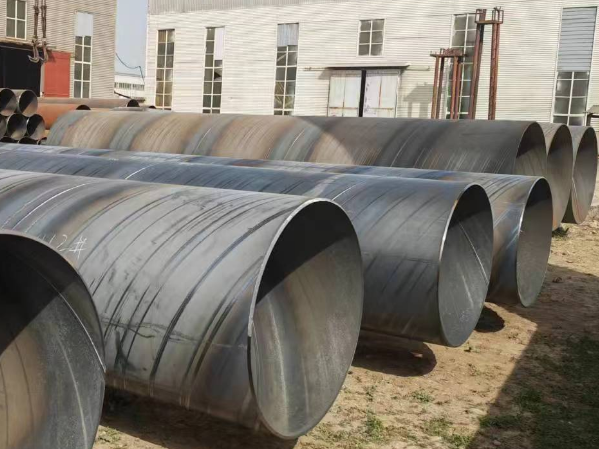
The main advantages of SSAW steel pipes for water supply are:
1. Good pressure-bearing performance: The spiral weld seam forms a certain angle with the pipe axis, resulting in uniform pressure distribution and strong resistance to internal pressure.
2. Wide diameter range: Large diameters from DN200 to DN3000 and above can be produced to meet the needs of main pipeline networks.
3. Low production cost: Continuous rolling process, high efficiency, and lower cost compared to
straight seam welded pipes.
4. Flexible wall thickness: Wall thickness ranges from 4.0 to 25.4 mm, allowing for flexible selection according to different pressure ratings.
5. Convenient transportation and installation: Custom-length production reduces the number of on-site welding joints and shortens the construction cycle.
Common Specifications and Standards:
Common Specification Range:
Nominal Diameter (DN): DN200 ~ DN3000
Outer Diameter (OD): 219mm ~ 3048mm
Wall Thickness (WT): 4.0mm ~ 25.4mm
Single Length: 6m ~ 18m (Custom length production)
Standards:
1. Commonly Used American Standard Water Supply Pipes
ASTM A53: Black and hot-dip galvanized welded seamless steel pipes, mainly used for general water supply and low-pressure fluid transportation.
Common Steel Grades: Gr.A, Gr.B
ASTM A252: Welded and seamless steel pipe piles, commonly used for water supply engineering pile foundations and water intake structures.
Common Steel Grades: Grade 1, 2, 3
API 5L: Pipeline specification, mainly used for long-distance water transmission trunk lines.
Common Steel Grades: Gr.B, X42, X52, X60
2. Commonly Used European Standard Water Supply Pipes
EN EN 10217-1: Pressure-grade welded steel pipes (non-alloy steel), mainly used for pressurized water supply pipelines.
Common grades: P195TR, P235TR, P265TR
EN 10217-5: Pressure-grade submerged arc welded steel pipes, mainly used for large-diameter pressurized water transmission.
Common grades: P235GH, P265GH
EN 10219-1: Cold-formed welded hollow profiles, mainly used for structural components and supports in water supply projects.
Common grades: S235JRH, S275JOH, S355J2H
Internal corrosion protection requirements—Drinking water pipelines:
Spiral steel pipes used for transporting drinking water must have their inner walls treated with anti-corrosion coating to ensure water quality safety. Anti-corrosion materials used in drinking water pipelines must hold a sanitary permit for drinking water safety products issued by a provincial-level or higher health department and meet the relevant national standards.
Common Internal Corrosion Protection Methods:
a. Fusion-bonded Epoxy Powder (FBE): Food-grade epoxy resin
Features: Strong adhesion, smooth surface, hygienic and non-toxic, suitable for drinking water main pipes.
b. Cement Mortar Lining: Cement mortar
Features: Low cost, corrosion resistant, but rough surface, suitable for raw water and industrial water.
c. Liquid Epoxy Coating: Two-component epoxy
Features: Easy construction, easy repair, suitable for on-site joint repairs and small-diameter pipes.
d. Polyurethane Coating: Polyurethane
Features: Good wear resistance, suitable for pipes subject to erosion and abrasion.
Identification and Traceability of Large-Diameter Spiral Steel Pipes:
Large-diameter spiral steel pipes are a primary choice for water supply pipelines. The pipe body should be clearly marked with the following information for easy traceability and acceptance:
Manufacturer's name or trademark
Product standard number
Steel grade and specifications (outer diameter × wall thickness)
Furnace number or batch number
Production date
In the daily maintenance of household water supply pipelines, the key to preventing leaks lies in strictly following the process requirements during construction to ensure project quality. Meanwhile, it is essential to establish an awareness of regular maintenance, master correct cleaning methods, and take preventative measures.
Installation Requirements:
● Small-diameter water supply pipes can be connected by threads, with 2-3 threads exposed at the joint; large-diameter pipes should be connected by welding or flanges.
● After installation, pipes should be secured with pipe clamps or supports promptly, with spacing meeting design requirements.
● Pipe connections to fittings and valves should be secure and free from looseness.
● A hydrostatic pressure test should be conducted after installation, with a pressure holding time not less than the specified value. Visually and tactilely check for leaks.
● Check all faucets and valves for levelness, smooth operation, unobstructed water flow, and leaks.
● Check that the water meter is functioning properly.
Winter Protection and Pipeline Maintenance:
a. Regularly use professional pipeline maintenance agents to clean, disinfect, and sterilize pipes, keeping the water supply unobstructed and preventing pathogen growth.
b. When cleaning pipes, use high-sterilization products certified by professional institutions to achieve sterilization, deodorization, cleaning, and anti-clogging effects.
Recommendations for Water Supply Pipeline Selection:
1. General Municipal Water Supply (DN200-DN1000, Pressure ≤1.6MPa):
US Standard:
ASTM A53 Gr.B or API 5L Gr.B
European Standard: EN 10217-1 P235TR
2. Long-Distance Water Transmission Trunk Lines (DN800-DN2000, Pressure 1.6-4.0MPa):
US Standard: API 5L X42 / X52 (PSL2)
European Standard: EN 10217-5 P265GH
3. Drinking Water Pipelines
Regardless of whether US or European standards are used, internal corrosion protection treatment (such as FBE, cement mortar lining) is required, and the corrosion protection material must meet drinking water safety certification.
4. Structural Applications (Intake Piles, Supports):
US Standard: ASTM A252 Grade 2/3
European Standard: EN 10219-1 S355J2H
Read more: SSAW Steel Pipe Process Performance or SSAW Steel Pipe Sizes Chart
 sales@hu-steel.com
 English
 Español