sales@hu-steel.com
 English
 Español
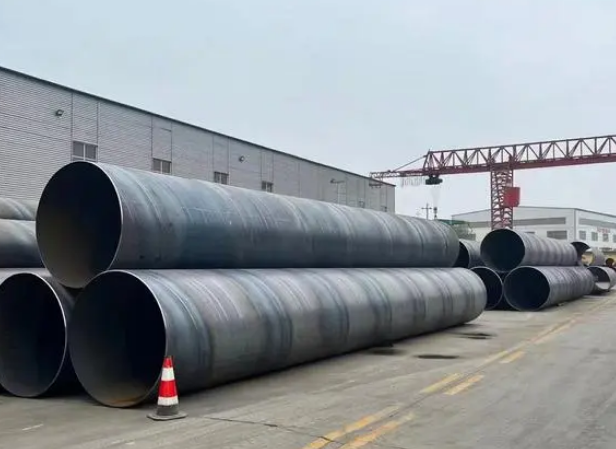
SSAW (Spiral Submerged Arc Welding) steel pipe uses hot-rolled or cold-rolled strip steel coils as raw material. After uncoiling, leveling, and milling, the strip steel is gradually extruded and coiled into a tubular shape using a continuous spiral forming unit at room temperature. Simultaneously, an automatic double-sided submerged arc welding process is used to perform internal and external welding on the spiral joint, ultimately forming a steel pipe with a continuous spiral weld. This process features long weld lengths, flexible pipe diameter adjustment, and continuous production capabilities, and is widely used in medium and low-pressure fluid transportation and structural pipe applications.
1. Bending Performance
When bent at a specified angle of 90°, the weld and the surface of the bent portion of the heat-affected zone must not crack.
2. Reverse Bending Performance
A reverse bending performance test can be performed upon request. The bending angle and bending diameter for the reverse bending test should comply with the product standard (e.g., GB/T 9711). Typically, the pipe is first bent in one direction to the specified angle, and then bent in the opposite direction to the same angle. After the reverse bending test, the weld and the bent portion of the heat-affected zone must not crack.
3. Surface Quality
The inner and outer surfaces of the steel pipe must be free from defects such as cracks, folds, overlapping layers, and delamination. Minor scratches and indentations with a depth not exceeding the negative deviation of the wall thickness are permissible, but must be smoothly transitioned. Local excess height is permissible on the weld surface, but must not exceed the permissible height specified in the relevant standards. The depth and height of other surface defects must not exceed the permissible deviations specified in the product standards (such as GB/T 9711, API 5L).
4. Dimensional and Shape Permissible Deviations
The outer diameter, wall thickness, ovality, and curvature of the steel pipe should conform to the requirements of GB/T 9711 or API 5L standards. The pipe ends should be beveled, with a permissible deviation of ±0.5mm for the blunt edge.
5. Mechanical Properties
The yield strength and tensile strength of the steel pipe base material and weld should meet the requirements of the corresponding steel grade. The impact energy of the weld and heat-affected zone (e.g., under -20℃ conditions) should meet the specified values in the standard.
6. Hydrostatic Pressure Test
Each steel pipe shall undergo a hydrostatic pressure test. The test pressure shall be calculated according to the standard specifications, and the pressure holding time shall not be less than 5 seconds. The pipe is considered qualified if there is no leakage or visible deformation.
7. Non-destructive Testing
Welds shall undergo 100% ultrasonic online flaw detection. T-joints (where the butt weld of the strip steel intersects with the spiral weld) shall undergo X-ray inspection. Weld defects such as cracks, lack of fusion, and incomplete penetration are not permitted.
8. Application Areas
SSAW steel pipes are widely used in medium and low pressure fluid transportation pipelines for oil, natural gas, city gas, water supply, and heating, as well as in piling, structural support, and other fields.
Read more: Seamless pipe vs Spiral pipe: What's the difference? or SSAW Steel Pipe Sizes
Related information
Copyright @2017 Hunan Standard Steel Co.,Ltd and Husteel Industry Group All Rights Reserved