sales@hu-steel.com
 English
 Español
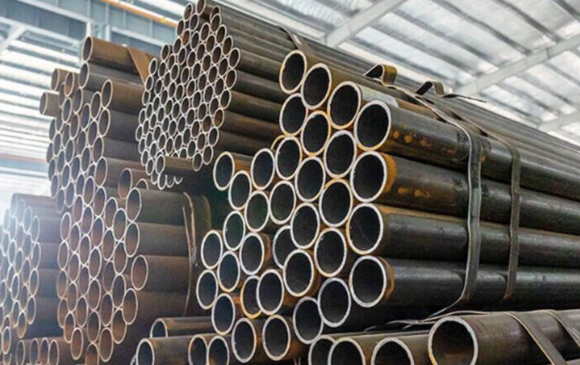
Black iron pipe, also known as ordinary welded steel pipe, is a welded steel pipe formed by rolling and welding steel plates or strips. It is mainly used for transporting low-pressure fluids or gases. It is made of carbon steel and has not undergone rust-proofing treatment, hence its black surface. Black iron pipes are usually round, but can also be other shapes, such as square or rectangular. It is widely used in construction, plumbing, fire protection, and low-pressure industrial fields.
Difference between black steel pipe and black iron pipe:
Black steel pipe includes all ungalvanized steel pipes (such as seamless structural pipes, boiler tubes, etc.), while black iron pipe specifically refers to welded steel pipes used for transporting low-pressure fluids.
1. Material and Performance
Typically made of common low-carbon steel (such as ASTM A53 GR.B or Q235), with moderate strength and excellent plasticity, toughness, and weldability.
Mechanical strength (tensile and compressive strength) is higher than most plastic pipes but lower than alloy steel pipes.2. Surface and Corrosion Protection
The surface has a black oxide scale, providing some short-term rust prevention, but long-term exposure to humid environments will continue to cause rusting.
It lacks long-term corrosion resistance. Therefore, secondary anti-corrosion treatment (such as applying anti-rust paint, asphalt anti-corrosion layer, epoxy resin coating, etc.) is necessary before burying or exposing to the elements.3. Manufacturing Characteristics
Mature manufacturing process: High-frequency resistance welding (ERW) production lines are highly efficient, automated, and produce large volumes, thus reducing manufacturing costs. However, as it is a welded pipe, there is a longitudinal weld seam, which is a structural weakness.
The pipe wall thickness is relatively uniform, with a complete range of sizes and lengths available for customization.4. Economic Efficiency
Inexpensive, with mature manufacturing processes and low raw material costs, black iron pipes offer excellent value for money as a general-purpose pipeline. Considering the pipe itself, connectors, and installation labor, the price is far lower than stainless steel, copper, and alloy pipes. Black iron pipe systems are typically the lowest-cost metal piping solution.
1. Highly Susceptible to Corrosion and Rust
The black oxide scale on the surface is very thin, making it highly susceptible to corrosion and rust once damaged or exposed to prolonged humid environments.
2. Limited Pressure Bearing Capacity
As a welded pipe, its longitudinal weld seam is a weak point in terms of strength. Its yield strength and compressive strength are lower than seamless and alloy pipes. Therefore, it is only suitable for medium- and low-pressure systems (such as fire water, low-pressure gas, and heating) and cannot be used in high-pressure, high-temperature critical conditions.
3. Poor Hygiene
The rough inner wall is prone to rust and easily breeds bacteria, forming a biofilm. This is the main reason why it has been completely phased out in domestic water supply pipelines.
4. Relatively Inconvenient Installation
Traditional connection methods use threaded connections, requiring on-site threading, which is labor-intensive, inefficient, and demands high-quality sealing materials (hemp fiber, PTFE tape). The significant weight also increases the difficulty of handling and installation.
5. Rough Appearance
The untreated black surface is unsightly when installed exposed and clashes with modern architectural styles.
Conclusion:
Black iron pipe is the industry term for welded steel pipes used for low-pressure fluid transportation. It is economical, practical, technologically mature, and has good weldability, but external anti-corrosion treatment is necessary. Its core manufacturing process is resistance welding (ERW), and the most common materials are Q235B or ASTM A53 Gr. B. Although it has been replaced in the domestic water supply of new buildings, it is still one of the main pipe materials in fire protection systems, low-pressure industrial pipelines and other fields.
Read more: Black Iron Pipe vs. Black Steel Pipe or MS and GI Pipe Difference
Related information
Copyright @2017 Hunan Standard Steel Co.,Ltd and Husteel Industry Group All Rights Reserved