In oil drilling engineering, casing pipe is not only the skeleton supporting the wellbore and isolating the formation, but also a barrier ensuring the safe and efficient production of oil and gas wells throughout their entire life cycle. The lifespan of the casing directly determines the lifespan of the oil well, which in turn determines the lifespan of the oilfield. Therefore, scientifically selecting the best casing material based on specific downhole conditions (depth, temperature, pressure, corrosive media, etc.) is crucial for improving drilling efficiency and extending the production cycle of oil and gas wells.
An ideal metal casing material needs to find the optimal balance between sufficient strength, good toughness, excellent corrosion resistance, and economy.
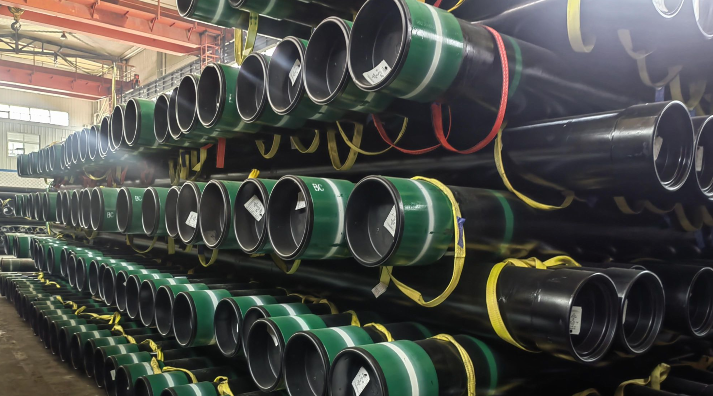
Performance Comparison and Applicability Analysis of Commonly Used Casing Materials:
Different steel grades of casing pipe exhibit vastly different mechanical properties and microstructures due to differences in chemical composition and heat treatment processes, making them suitable for different downhole environments.
1) API Standard Series: K55, N80, P110
These three materials are currently the most widely used standard carbon steel/low alloy steel casings in oil and gas fields.
● K55 Steel: — Composed of pearlite and network ferrite.
Mechanical Characteristics: It has a high strain hardening index and good adaptability to accidental large overloads and temperature changes. However, its impact toughness is low, and it performs poorly under high impact conditions.
Applications: Suitable for shallow wells, conventional formations, and other surface or technical casing where impact toughness requirements are not high.
● N80 Steel: Includes N80-1 and N80-Q.
Mechanical Characteristics: Performance is between K55 and P110; fatigue performance is higher than K55 but lower than P110.
Applications: Commonly used in medium-depth oil and gas wells with relatively simple geological conditions. It has a moderate cost and is a common choice for conventional development wells.
● P110 Steel: — Composed of tempered martensite.
Mechanical Characteristics: Possesses high strength and good comprehensive mechanical properties. As a benchmark material for deep and complex well casing, P110 is also widely used in shale gas development.
Applications: Suitable for deep wells, high external pressure environments, and conventional fracturing operations. However, it's important to note that P110 is highly sensitive to H₂S and CO₂ corrosion and is not suitable for acidic environments.
2. Corrosion-Resistant Series: 13Cr-95, 11Cr-110, HP13Cr-110
As oil and gas exploration moves towards deeper, higher-temperature, and more corrosive media, ordinary carbon steel is no longer sufficient, leading to the development of corrosion-resistant alloy (CRA) casing.
● 13Cr-95:
Performance Shortcomings: While possessing some resistance to CO₂ corrosion, its hardness and impact toughness often become limiting factors in deeper and more demanding well conditions. Studies have shown that in deep gas wells (>3000m), its impact toughness may not meet safety standards.
Applicable Scenarios: CO₂-containing wells with low corrosion requirements or shallow depths.
● HP13Cr-110:
Performance Characteristics: Excellent overall performance, combining high strength and CO₂ corrosion resistance, making it a commonly used and preferred choice for deep CO₂-bearing gas fields.
Economic Drawback: High price, severely restricting development efficiency in a low oil price environment.
● 11Cr-110:
Performance Advantages: Tests show that the mechanical properties of 11Cr-110 are comparable to HP13Cr-110, while exhibiting good CO₂ corrosion resistance. Its optimized Cr content improves corrosion resistance at specific high temperatures (<140℃).
Outstanding Economic Efficiency: Significantly lower price than HP13Cr-110, making it a preferred alternative for similar operating conditions in Daqing Oilfield's Xushen Gas Field, saving approximately 550,000 yuan per well.
Casing Material Selection for Different Working Conditions:
Based on the characteristics of the downhole environment, the following material selection strategies can be referenced:
Working Condition Type
|
Drilling Efficiency Impact
|
Extending Service Life
|
Recommended Material Selection
|
Deep/Ultra-Deep Wells (>6000m)
|
High strength and resistance to crushing
|
Excellent impact toughness and fatigue resistance
|
High-grade thick-walled pipe (e.g., TLM140, Q125), supplemented with special gas-tight threads.
|
Shat Gas Horizontal Wells
|
High resistance to internal pressure (fracturing) and torsion
|
Fatigue resistance and resistance to complex stress
|
P110, Q125 and above steel grades, combined with special gas-tight threads.
|
CO₂ Corrosion Environment
|
Corrosion resistance directly determines the maintenance-free period
|
Slow down corrosion rate and inhibit pitting corrosion
|
Selection based on CO₂ partial pressure: Low CO₂ environment can use carbon steel such as P110 (corrosion inhibitor required); medium-high CO₂ and medium-temperature environments prefer 11Cr-110; high-temperature and high-pressure environments prefer HP13Cr-110.
|
Conventional/Tight Gas Wells
|
Meets design load requirements
|
To control costs and avoid over-design
|
Strength verification was performed using the maximum load method, prioritizing cost-effective P110 or N80.
|
Read more: Specifications and Dimensions of Drilling Casing Pipe or Casing Pipe vs. Drill Pipe Differences
 sales@hu-steel.com
 English
 Español