sales@hu-steel.com
 English
 Español
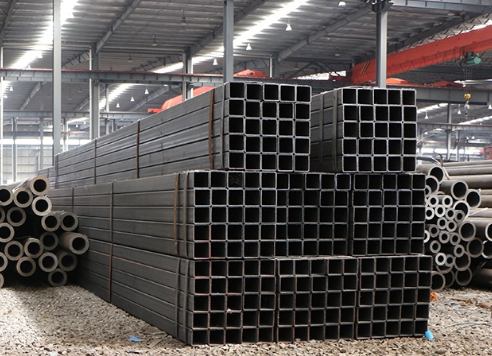
MS square tube, also known as mild steel square tube, is a hollow structural section (HSS) made of mild steel (low-carbon steel). It is one of the most commonly used structural profiles in construction, machinery manufacturing, and related industries. Its popularity comes from one main reason: it offers reliable strength and good workability at a low cost.
▶ For more details on the classification and terminology of hollow steel sections (HSS), please refer to: [Steel Hollow Sections: What are HSS, SHS, RHS, and CHS?]
1) Compared to stainless steel or aluminum: MS square tube is less resistant to corrosion and heavier, but it costs about 1/3 to 1/2 as much. For indoor or general-purpose structures, it is often the more economical choice.
2) Compared to wood or concrete: Steel provides a better strength-to-weight ratio, faster installation, and more precise dimensions. It is also fully recyclable.
3) Compared to I-beams or angle steel: As a closed section, MS square tube resists bending and twisting in multiple directions. Its flat surfaces also make it easier to weld and bolt to other components.
Mild steel (MS) refers to carbon steel with a carbon content below 0.25%. It is called "mild" because it has lower strength and hardness than higher-carbon steels, making it softer and more formable. Its annealed structure consists of ferrite with small amounts of pearlite, which gives it good ductility and toughness.
1. Good weldability: The low carbon content allows most common welding processes (arc welding, MIG, TIG, etc.) without special preheating or post-weld heat treatment.
2. Easy to form: Can be cut, drilled, bent, and stamped using standard shop equipment.
3. Takes surface treatments well: Can be galvanized, painted, or powder-coated to improve corrosion resistance or appearance.
4. Predictable mechanical properties: Grades like S235JR (yield strength ≥235 MPa) and S355J2H (yield strength ≥355 MPa) provide enough strength for most structural applications, from light frames to industrial buildings.
▶ Learn more about the [Application Advantages of Grade S355J2H in Low-temperature Environments].
MS square tubes are used across many industries because they are versatile and affordable:
● Building construction: Columns, beams, roof trusses, scaffolding, and support frames.
● Industrial equipment: Machine frames, conveyor supports, workbenches, and safety guards.
● Transportation: Trailer frames, bus bodies, roll cages, and chassis components.
● Furniture and displays: Table and chair frames, shelving, display racks, and store fixtures.
● Infrastructure: Bridge railings, signposts, light poles, and solar panel mounting brackets.
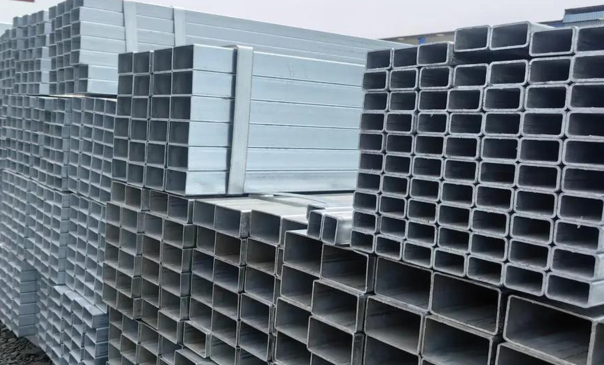
MS square tubes can be divided into Welded (ERW) square tubes and Seamless square tubes based on how they are made:
● Welded (ERW) Square Tubes
Made by forming steel strip into shape and welding the seam.
Advantages: Lower cost, high production speed, readily available in most sizes.
Limitation: The weld seam may have slight stress concentration under certain loading conditions.
Use this for: Most general structural and fabrication work.
● Seamless Square Tubes
Made by piercing and rolling solid steel billets—no weld seam.
Advantages: Uniform structure, better pressure resistance, no seam-related weak points.
Cost: Significantly higher than welded tubes.
Use this for: High-pressure applications, hydraulic systems, or situations where the absence of a weld seam is a design requirement.
△ In short: For the vast majority of structural applications, welded ERW tubes are the practical choice. Seamless tubes are only needed when the application specifically requires them.
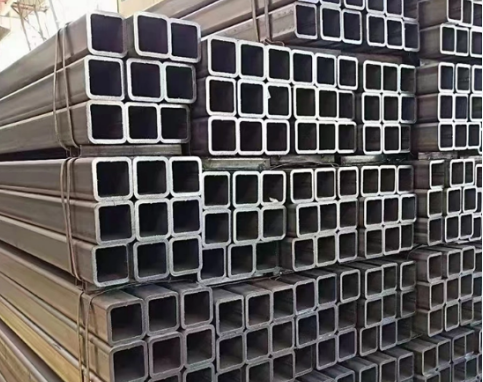
| Application Type | Typical Side Length Range | Typical Wall Thickness |
|---|---|---|
| Light (furniture, railings) | 20×20 mm – 50×50 mm | 1.0 – 3.0 mm |
| General (frames, supports) | 60×60 mm – 150×150 mm | 3.0 – 6.0 mm |
| Heavy (columns, main beams) | 200×200 mm and above | 6.0 mm and above |
MS square tube is widely used because it combines three things that matter in real projects: reliable strength, easy fabrication, and low cost.
For most structural applications, welded ERW MS square tubes offer the best value. Seamless tubes are reserved for specialized conditions where the added cost is justified.
▶ Need a complete size and weight table? [View our MS Square Tube product page →]
▶ Have a specific project in mind? [Contact us for selection help and a quote →]
Read more:
● Manufacturing Process of MS Square Tube
Related information
Copyright @2017 Hunan Standard Steel Co.,Ltd and Husteel Industry Group All Rights Reserved