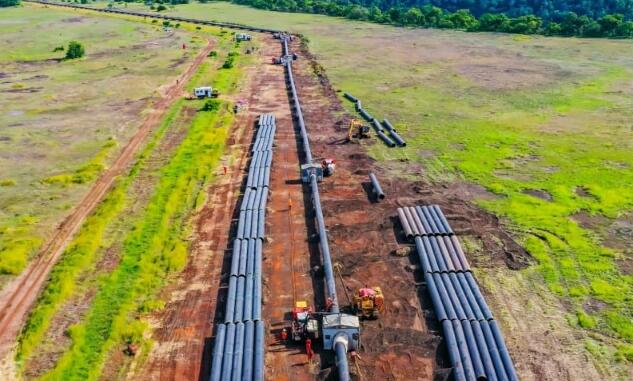
Steel pipes for long-distance pipelines, also known as line pipes, are pipeline materials used to transport media such as oil, natural gas, and water over long distances from extraction sites or production areas to processing plants or consumer markets. These pipelines typically have large diameters (up to 1422 mm) and lengths reaching thousands of kilometers, and are equipped with various auxiliary equipment, forming an independent operating system.
Pipe material costs usually account for 30%-35% of the total investment in long-distance pipelines (fluctuating depending on pipe diameter, steel grade, terrain, etc.). For example, China's trunk pipelines commonly use low-carbon, low-alloy steel with a yield strength of 290-480 MPa, corresponding to X42 to X70 steel grades in the API 5L standard. This type of line steel, through the addition of trace elements such as niobium, vanadium, and titanium, and controlled rolling processes, ensures high strength while also possessing good low-temperature toughness and weldability.
Requirements:
Steel pipes used for long-distance pipelines have strict technical requirements. Ordinary steel pipes cannot be used, and there are specific manufacturing standards (such as API 5L). The main requirements are as follows:
1. Material Requirements
Long-distance pipelines use special pipeline steel materials, characterized by:
◆ High strength: High yield strength and tensile strength, commonly used steel grades are X42~X80 (the number after X indicates the minimum yield strength, in klb/sq inch);
◆ High impact toughness: Able to meet the requirements for preventing crack initiation;
◆ Low ductile-brittle transition temperature: Does not experience brittle fracture at low temperatures, the shear area in the drop hammer tear test (DWTT) is generally required to be ≥85%;
◆ Good weldability: Ensures the integrity of the pipeline and welding quality;
◆ Excellent corrosion resistance: Including resistance to hydrogen-induced cracking (HIC) and sulfide stress corrosion cracking (SSCC).
Pipeline steel, through the addition of trace elements such as niobium, vanadium, and titanium, and controlled rolling processes, results in a fine-grained internal structure, making it both strong and tough, while having a low carbon content and significantly lower levels of harmful elements (sulfur, phosphorus) than ordinary steel.
2. Standard Requirements
Steel pipes for long-distance pipelines must comply with specific domestic and international standards:
● International Standard: American Petroleum Institute
(API) Spec 5L Line Pipe Specification
● Chinese National Standards: GB/T 9711 "Steel Pipes for Pipeline Transportation Systems in the Oil and Gas Industry", GB/T 8163 "Seamless Steel Tubes for Fluid Transportation"
● Specific Specification for Long-Distance Pipelines: GB/T 34275-2024 "Pressure Piping Specification - Long-Distance Pipelines" (Published on December 31, 2024, covering the entire life cycle requirements including materials, design calculations, construction and installation, inspection and testing, safety protection, and operation and maintenance)
3. Manufacturing and Inspection Requirements
Strict requirements apply to the steel pipe manufacturing process:
a. Each weld must undergo non-destructive testing (e.g., ultrasonic, X-ray).
b. High dimensional accuracy is required for the steel pipes (roundness, straightness, and wall thickness tolerances are strictly controlled).
c. A hydrostatic test is required to verify the pipe's strength and sealing performance.
d. The manufacturer must provide material certificates, factory certificates of conformity, and other quality documents.
Common Steel Pipe Types:
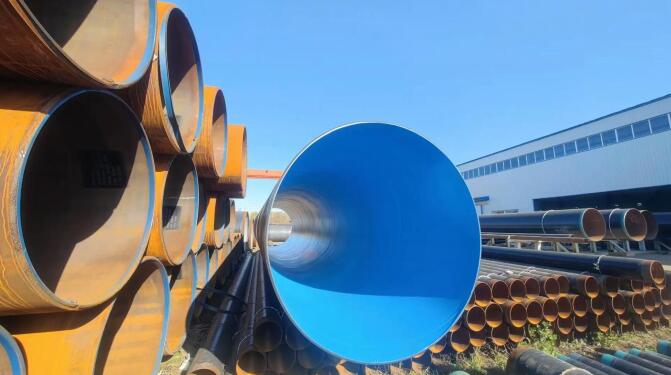
Modern long-distance oil and gas transmission pipelines are mainly classified into the following three categories based on their manufacturing process:
Type
|
Manufacturing Process
|
Characteristics
|
Common Specifications
|
Application Scenarios
|
Spiral Submerged Arc Welded Pipe (SSAW)
|
Continuously rolled and welded from strip steel, the weld is spiral-shaped.
|
Continuous process, high production efficiency, suitable for large-diameter thin-walled pipes.
|
Out Diameter: Φ406~1219mm, Wall Thickness: 10~25mm
|
Main transmission pipelines, low-pressure large-diameter pipelines
|
Straight Seam Submerged Arc Welded Pipe (LSAW)
|
Single steel plate pressed and welded using the UOE forming method.
|
Straight weld, high dimensional accuracy, good mechanical properties.
|
Large diameter (up to 1422mm)
|
High-pressure trunk lines (such as the West-East Gas Pipeline and the China-Russia East Route Gas Pipeline)
|
Seamless Steel Pipe (SMLS)
|
Round steel ingots formed by piercing, expanding, drawing, or extrusion.
|
No weld seams, high strength, and strong pressure resistance.
|
Small diameter (Φ114~700mm)
|
Branch transmission pipelines, urban pipe networks, high-pressure transmission.
|
Among them,
welded pipes (spiral welded pipes and straight seam welded pipes) are the most widely used and have the largest consumption in large-diameter pipelines.
Main Applications:
The application of steel pipes for long-distance transmission pipelines covers traditional energy, new energy (such as hydrogen energy transmission), deep-sea development, and industrial fields.
1. Oil and Natural Gas Transportation
This is the primary application area for pipelines, including:
Crude Oil Pipelines: Transporting crude oil from oil fields to refineries, terminals, or transshipment stations.
Natural Gas Pipelines: Transporting natural gas from gas fields to city gas networks or industrial users.
Refined Oil Pipelines: Transporting refined oil products such as gasoline and diesel.
Project Examples:
China's West-East Gas Pipeline Project (total investment exceeding 140 billion yuan, procurement of 1.57 million tons of steel pipes, using X70 and X80 pipeline pipes);
China-Russia East Route Gas Pipeline (over 8,000 kilometers long, using X80 grade steel, 1422mm diameter straight seam submerged arc welded pipes);
China's Sichuan-East Gas Pipeline II Project, etc.
International Pipeline Projects:
● Saudi Arabia's East-West Pipeline Expansion and Development of New Export Terminals along the Red Sea Coast (Middle East Strategic Oil Pipeline)
● US Gulf Coast Deepsea Pipeline System (Offshore Oil and Gas Export)
● Panama Canal LPG Pipeline (Transoceanic Energy Corridor)
● Canada West Coast Oil Sands Export Pipeline
● Leviathan-Egypt Gas Pipeline (Eastern Mediterranean)
● Irpa Deepsea Pipeline (Norwegian Sea)
● Abu Dhabi is considering expanding a second pipeline to the port of Fujairah;
● Iraq plans to restart the Haditha-Aqaba pipeline project to the port of Aqaba, Jordan;
● Iraq is close to resuming the Kirkuk-Ceyhan pipeline to the port of Ceyhan, Turkey.
2. Hydrogen Energy Transportation (Emerging Field)
With the energy transition, hydrogen pipelines have become an important growth point. Currently, China's first long-distance hydrogen-blended pipeline (Baotou-Linhe, 258 km) has been put into operation. In 2024, 12 hydrogen pipeline projects made progress, adding approximately 2363.77 km of new mileage.
Internationally, the North Africa-Europe hydrogen pipeline project (SoutH2 corridor, approximately 3,300 kilometers long) is one of the world's largest cross-border hydrogen pipeline projects. Italian energy giant Snam has been confirmed as the lead contractor for the project, planning to invest €20 billion in hydrogen infrastructure construction between 2026 and 2030. Currently listed as a "Project of Common Interest" by the EU, it will receive expedited approval. Upon completion, it will provide a large-scale green hydrogen alternative for European heavy industries and is a key infrastructure for the EU to achieve its 2050 carbon neutrality target.
3. Other Media Transportation
Water Supply Pipelines: Long-distance water transfer projects
Industrial Slurry Pipelines: Transporting solid materials such as mineral slurries
Chemical Media Pipelines: Transporting corrosive or high-temperature media (using stainless steel or alloy steel pipes)
4. Application Scenarios
Based on pipeline function, they can be divided into:
Main Line Transmission Pipelines: Pipe diameter Φ406~1219mm, steel grade X42~X80, used for long-distance, high-flow transmission
Branch Line Transmission Pipelines: Pipe diameter Φ114~700mm, used to transport oil and gas from the main line to branch points
Urban Pipeline Network: Used for oil and gas distribution and supply within cities
Development Trends:
Currently, steel pipes for long-distance pipelines are developing towards higher strength (X80 steel and above), larger diameter (1422mm and above), higher toughness, and corrosion resistance. At the same time, the demand for green new infrastructure such as hydrogen energy transmission pipelines and carbon capture and transportation pipelines is becoming a new growth point.
Read more:
● Advantages and Disadvantages of Pipeline Transportation
● Seamless vs. Welded Pipe
● How to Choose the Right Pipeline Transportation System
 sales@hu-steel.com
 English
 Español