In modern industry, the choice of pipe material directly impacts the quality, cost, and service life of projects. ERW pipes (straight seam resistance welded pipes), as a mature steel pipe product, demonstrate significant advantages in numerous industry applications due to their unique processing characteristics and comprehensive performance. Whether in oil and gas transportation, municipal engineering, or machinery manufacturing, ERW pipes are playing an increasingly important role.
4 Core Advantages of ERW Pipes in Industrial Applications:
1. Significant Cost-Effectiveness and Outstanding Economic Advantages
For any engineering project, cost is always a core consideration. Compared to seamless steel pipes, ERW pipes are typically 20% to 40% cheaper while maintaining performance. This cost advantage stems from their efficient manufacturing process: using hot-rolled coils as raw materials, and through automated processes such as continuous forming, welding, and heat treatment, production efficiency is high, and material utilization is also higher.
More importantly, by using special microalloyed steel grades, modern ERW pipes can even eliminate some traditional manufacturing processes (such as annealing, phosphating, and cold drawing), reducing costs while making the production process more environmentally friendly. For projects with large-volume purchases, this cost advantage translates into considerable budget savings.
2. High Dimensional Accuracy and Stable, Reliable Quality
Dimensional accuracy is a crucial indicator of steel pipe quality. ERW steel pipes use hot-rolled coils as raw material, with wall thickness uniformity controlled to approximately ±0.2mm. The tolerance control for outer diameter and wall thickness is even stricter than that of seamless pipes. This means that ERW pipes offer higher compatibility during installation and welding, making construction more convenient.
The weld seam is key to the quality of ERW pipes. Modern ERW technology employs high-frequency welding, utilizing the skin effect and proximity effect to rapidly heat the steel strip edge to the welding temperature before extrusion molding. After online normalizing heat treatment, the microstructure and mechanical properties of the weld seam area can be almost identical to the base material, achieving a weld coefficient of 1.0. Combined with 100% online ultrasonic or eddy current non-destructive testing, the weld seam quality and overall reliability of ERW pipes have reached a very high level.
3. Excellent Surface Quality
The smooth inner and outer surfaces of ERW steel pipes are an often overlooked but very important advantage. A smooth inner surface means lower frictional resistance and lower energy loss when transporting fluids. In applications such as municipal water supply and natural gas transmission, this characteristic helps improve transmission efficiency.
Furthermore, ERW pipes, after internal and external burr removal, not only have a more aesthetically pleasing appearance but also provide a good foundation for subsequent coating and anti-corrosion treatments. For pipes requiring external coatings, the smooth surface ensures better coating adhesion and a longer service life.
4. Wide Range of Applications, Covering Diverse Needs
The comprehensive advantages of ERW pipes have led to their widespread use in numerous industrial sectors.
● In the oil and gas industry, ERW pipes conforming to
API 5L standards are widely used in medium and low-pressure gathering and transmission pipelines, station pipelines, and oilfield auxiliary pipelines. Their cost advantage and reliable weld quality make them a strong competitor to seamless pipes.
● In municipal engineering, ERW pipes are one of the main pipe types for urban water supply, drainage, and gas supply networks. Their uniform wall thickness and precise dimensions make network connections more reliable.
● In the field of building structures, ERW pipes, with their good load-bearing capacity and dimensional stability, are used in structural components such as building frames, scaffolding, and foundation piles. In the automotive industry, ERW tubing is used in the manufacture of components such as chassis and exhaust systems, and its precision and consistency meet the requirements of high-performance manufacturing.
Potential and Limitations of Replacing Seamless Tubing:
With advancements in welding technology, ERW tubing is increasingly replacing seamless tubing in various applications. In medium-pressure fluid systems, general structural applications, and non-critical oil and gas auxiliary pipelines, ERW tubing provides sufficient performance while offering significant economic advantages.
However, in ultra-high pressure conditions, high-temperature environments, or highly corrosive media (such as acidic environments containing H₂S), seamless steel tubing still possesses irreplaceable advantages due to its seamless, continuous structure. Therefore, the key to selection lies in fully understanding the actual operating conditions and making the most suitable choice.
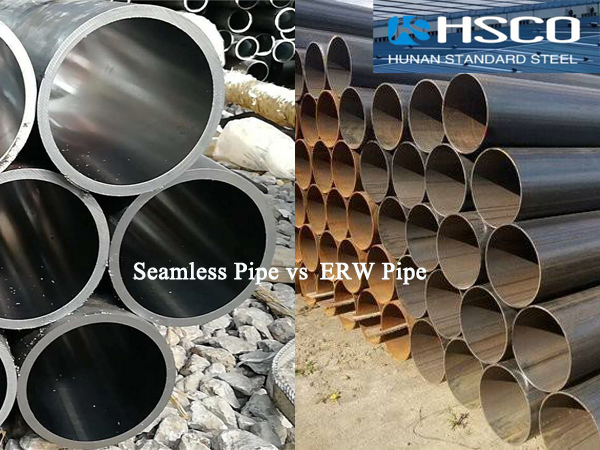
Comparison Dimensions
|
ERW Pipe
|
Seamless Pipe
|
Raw Materials
|
Hot-rolled steel strip/coil
|
Solid round steel billet
|
Manufacturing Process
|
Cold bending + high-frequency electric resistance welding
|
Heated piercing + extrusion/stretching
|
Weld
|
With longitudinal weld
|
No weld
|
Price
|
Low, 20-40% cheaper
|
High
|
Dimensional Accuracy
|
Uniform wall thickness, high accuracy
|
Possible wall thickness deviation
|
Application
|
Medium and low pressure pipelines, structural components
|
High temperature and high pressure, strong corrosion
|
Frequently Asked Questions (FAQ):
Q1: Can ERW pipe be used in high-pressure oil and gas pipelines?
A: Yes, but with clear limitations. ERW pipes conforming to
API 5L PSL2 standards and undergoing weld heat treatment can be used in medium-pressure oil and gas gathering pipelines with pressures not exceeding 20 MPa (approximately 2900 psi). However, for trunk lines or deep-sea pipelines exceeding this pressure, seamless or LSAW pipes should still be given priority. The key to selection is considering the design pressure and whether it meets relevant standard requirements.
Q2: Will the welds of ERW pipes rust or corrode?
A: The welds themselves are not "more prone to rusting," but two situations need attention.
If the ERW pipe has not undergone online solution annealing, carbide precipitation in the weld area may lead to a decrease in localized corrosion resistance. For ERW pipes that have undergone proper heat treatment, the corrosion resistance of the weld is essentially the same as that of the base material. When purchasing, it should be confirmed whether the supplier provides weld heat treatment processes and related corrosion test reports.
Q3: What is the service life of ERW pipes?
A: Under standard design and operating conditions, the service life of ERW pipes can reach 20 to 50 years. The actual lifespan depends on three factors:
① Operating conditions (temperature, pressure, corrosiveness of the medium);
② Corrosion protection measures (internal and external coatings, cathodic protection, etc.);
③ Installation quality (welding construction, on-site treatment).
In conventional applications such as municipal water supply and natural gas transmission, the design life of ERW pipes is typically considered to be over 30 years.
Q4: How do I determine if ERW pipes are suitable for my project?
A: It is recommended to evaluate in the following three steps:
Step 1: Determine the operating parameters—maximum working pressure, working temperature, and whether the transported medium contains corrosive components (such as H₂S, CO₂).
Step 2: Compare with standards—determine whether the project requires compliance with standards such as
ASTM A53, API 5L, or
EN 10219, and confirm whether ERW pipes are permitted for use.
Step 3: Assess costs—if seamless pipes are technically "overkill," ERW pipes are likely a more cost-effective choice.
Conclusion:
ERW pipe, with its high cost-effectiveness, good dimensional accuracy, excellent surface quality, and wide range of applications, has become an indispensable basic material in modern industry. In situations where it is sufficient and economical, it is a highly competitive solution. With the continuous development of materials science and welding technology, the performance boundaries of ERW pipe will continue to expand, bringing value to more industries.
Read more: ERW Pipe Size Chart or MS ERW Pipe Weight Chart
 sales@hu-steel.com
 English
 Español