New Advances in Oil Drill Pipe Manufacturing Technology: Materials, Processes, and Intelligentization
Oil Drill Pipe is an indispensable tool in oil drilling, used to drill holes underground and extract oil and gas resources. With the continuous development of oil exploration technology, the processing technology and manufacturing technology of oil drill pipe are also constantly improving to meet the needs of oilfield exploration and development.
Advances in Oil Drill Pipe Processing Technology:
1. Advances in Drill Pipe Materials
Oil drill pipe is mainly made of high-strength alloy steel or composite materials. With the development of the steel industry, the production technology of high-strength alloy steel has been continuously improved, significantly enhancing the strength and corrosion resistance of drill pipe materials.
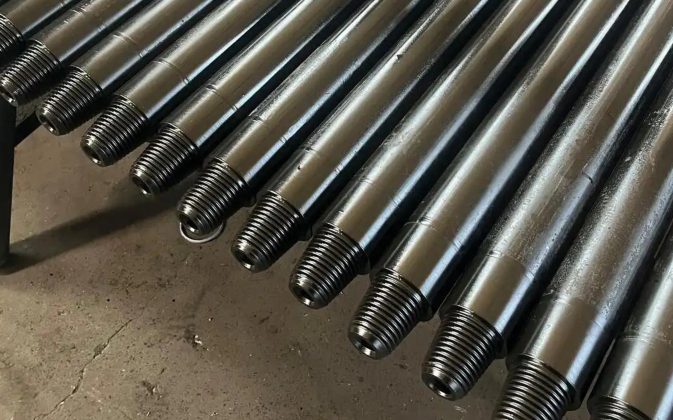
Specifically, this manifests as:
● Steel Grade Upgrades: The most direct manifestation of material advancements is the continuous improvement in steel grades. From the initial E-75 to the current mainstream
S-135 material for deep wells, and even V-150 for extreme working conditions, each leap in steel grade means achieving higher strength at the same weight, or achieving a lighter design at the same strength.
●Purity and Uniformity: The core breakthrough in modern metallurgical technology lies in controlling the purity and compositional uniformity of molten steel. Through ladle refining and vacuum degassing, the sulfur, phosphorus, and gas content in steel is significantly reduced, greatly improving the material's fatigue resistance and resistance to sulfide stress corrosion—the cornerstone of improved drill pipe performance.
●Current Status of Composite Material Applications: Composite material drill pipes (such as carbon fiber reinforced polymer) are an important research and development direction in the industry due to their lightweight, high strength, and corrosion resistance. However, in main drilling operations subjected to enormous torque, pressure, and wear, their reliability and cost cannot yet fully replace alloy steel. Currently, they are mainly used in specific working conditions or as a technological reserve.
2. Improvement of Drill Pipe Processing Technology
Oil drill pipes undergo heat treatment, forging, and drilling processes during processing. With the development of machine tool technology and the application of CNC technology, improvements in drill pipe processing technology mainly lie in breakthroughs in hot working processes, achieving automation and precision, thus improving production efficiency and product quality.
Specifically, this manifests in the following ways:
●
Seamless Tube Forming: Modern drill pipe tubes are formed using hot continuous rolling or precision rolling processes, achieving high-precision and high-efficiency forming. The application of controlled rolling and controlled cooling technologies allows for preliminary optimization of microstructure and properties during the rolling stage.
● Key Heat Treatment Process – Quenching and Tempering Heat Treatment.
This is the core process that imparts the final performance of the drill pipe. Through quenching and high-temperature tempering, a fine tempered sorbite microstructure is obtained, achieving a perfect combination of high strength and high toughness. Precise control of heating temperature, cooling rate, and tempering time is crucial to ensuring consistent performance across batches of drill pipe.
●
Friction Welding: Inertial friction welding has become the dominant process for connecting tubes and tool joints. As you mentioned earlier, it is a solid-state welding method that effectively avoids defects such as inclusions and porosity caused by fusion welding, forming a forged microstructure with strength no less than the base material. It is the cornerstone of modern drill pipe manufacturing technology.
3. Application of Drill Pipe Surface Treatment Technology
Oil drill pipes are susceptible to corrosion and wear during use, therefore surface treatment is necessary to improve their corrosion resistance and wear resistance. Common surface treatment technologies include galvanizing, chrome plating, and coating. These technologies effectively extend the service life of drill pipes.
Advances in Oil Drill Pipe Manufacturing Technology:
1. Improvements in Drill Pipe Connection Technology
Oil drill pipe connections need to maintain good connection performance under high temperature, high pressure, and high load environments. Traditional threaded connections suffer from problems such as thread stripping and wear. Therefore, researchers are constantly improving and developing new connection technologies, such as threaded connections and sealing connections, to improve the reliability and durability of the connection.
Specifically, this manifests in:
● Evolution of
API Standard Threads: From early round threads to trapezoidal threads, significantly improving the tensile strength and torque resistance of the connection.
● High-Performance Special Threads: To cope with harsh conditions such as high-pressure gas wells and extended reach wells, major manufacturers have developed a wide variety of special threads. Their core designs include: metal-to-metal sealing (replacing thread grease sealing to achieve airtightness), torque shoulders (precisely controlling the thread position to resist over-torque and bending stress), and optimized thread profiles (improving stress distribution and increasing fatigue life). This has become a core technological barrier for high-end drill pipes.
2. Digitalization and Intelligentization of Drill Pipe Manufacturing Technology
With the development of industrial automation and informatization, digitalization and intelligentization have permeated every aspect of oil drill pipe manufacturing. By introducing advanced manufacturing equipment and management systems, real-time monitoring, data collection, and analysis of the drill pipe manufacturing process can be achieved, thereby improving production efficiency and product quality.
Specifically, this manifests as:
● Full-process quality traceability: From the chemical composition of steelmaking and the temperature curves of heat treatment to the welding parameters of friction welding, data from each process is collected and bound to a unique number on each drill pipe, achieving full lifecycle traceability from the steel mill to the well site.
● Online non-destructive testing: Automated flaw detection systems such as ultrasonic, eddy current, and magnetic particle testing have been integrated into the production line, achieving 100% automatic inspection of the pipe body, welds, and threaded areas, reliably detecting defects at the micron level.
● Internet of Things (IoT) and Manufacturing Execution System (MES): Through IoT sensors and MES systems, real-time visualization and optimized scheduling of production scheduling, equipment status, and quality data are achieved, which is key to improving production efficiency and consistency.
3. Lightweight Design of Oil Drill Pipe
During drilling operations, oil drill pipes bear significant loads. Traditional drill pipe designs utilize large diameters and thick wall thicknesses to ensure strength. However, this increases drilling costs and energy consumption. Therefore, the concept of lightweight design has emerged in recent years. By optimizing materials and structural design, the weight of drill pipes can be reduced, improving production efficiency and economic benefits.
Specifically, this manifests as:
● "High-strength steel + thin-walled" design: This is currently the most successful lightweighting approach. By using higher-strength steel grades (such as replacing
G-105 material with S-135), the wall thickness can be reduced without compromising strength, thus reducing the weight per unit length. This lowers the overall weight of the drill string, increases the rig's load capacity, or allows drilling to deeper under the same load.
● Double-shoulder joint design: By optimizing the joint structure and adding an auxiliary torque shoulder, a larger torsional cross-sectional area can be obtained with the same outer diameter, or the joint's outer diameter can be reduced while maintaining torsional strength, thereby reducing friction with the wellbore. This is also an important direction for lightweighting.
In summary, with the continuous improvement of oil exploration technology and demands, the processing and manufacturing technologies of oil drill pipe are also constantly advancing and improving. In the future, people will further explore new materials, processes, and equipment to meet the complex and ever-changing needs of oil exploration and development.
Read more: What is Drill Pipe Made of? or Drill Pipe Structure and Common Specifications
 sales@hu-steel.com
 English
 Español