The selection of galvanized (GI) square and rectangular tube specifications by customers essentially involves seeking the optimal balance between the application scenario, structural strength, and economic cost. Typical requirements in different application fields do exhibit regular differences.
1. Building Decoration
In the building decoration field, common specifications include: 20×20×1.2, 30×30×1.5, 40×40×1.8, 50×50×2.0, etc., in smaller sizes, used for door and window railings, frames, handrails, and small decorative structures. Wall thickness is typically 1.2mm - 2.5mm. These specifications meet the general building decoration requirements for strength and aesthetics while controlling costs.
2. General Machinery and Warehousing
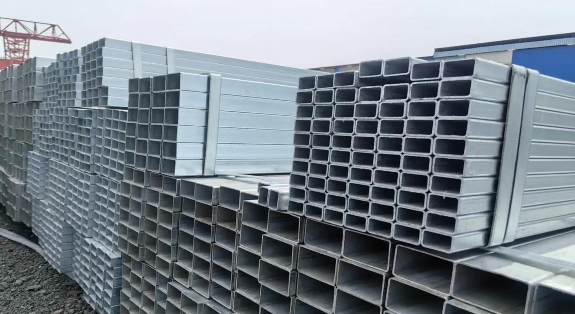
In the general machinery and warehousing field, a balance of strength, cost, and ease of processing is required. Customers commonly choose sizes such as 50×50×2.5, 80×80×3.0, 100×50×3.0, and 120×60×3.0, which can be used to manufacture light machinery frames, medium-duty shelves, workbenches, conveyor line supports, etc. Their moderate dimensions facilitate processing and installation. This is the most widely used size range.
100×50 mm rectangular tubes are favored due to their excellent bending strength-to-weight ratio.
3. Industrial and Heavy Structures
In the field of large structural steel, load-bearing capacity and safety factor are primary considerations. Customers tend to choose sizes such as 100×100×4.0, 150×100×5.0, 200×200×6.0, and 300×200×8.0, for use in manufacturing factory platforms, heavy equipment bases, and main steel structure frames. However, the specifications of square and rectangular tubes must be determined through structural calculations, significantly increasing the wall thickness (often ≥4.0mm), and often requiring custom orders from steel mills.
4. Agriculture and Simple Greenhouses
In the construction of agricultural and simple greenhouses, economic efficiency and sufficient strength are crucial. Smaller sizes such as 40×20×1.5, 50×30×1.8, and 60×40×2.0 are more popular and are commonly used for greenhouse arches and longitudinal beams. Customers typically choose a large number of rectangular tubes to optimize bending resistance, with wall thicknesses mostly between 1.5mm and 2.2mm, achieving lightweight and low cost.
There are also some design-specific needs where customers choose non-standard, special-specification galvanized square and rectangular tubes to achieve specific engineering goals based on their unique design and functional requirements.
Selection Considerations:
a. Complete Specification Description: Must be "Outer Side Length × Outer Side Width × Wall Thickness". Wall thickness is the most critical variable determining price and load-bearing capacity.
b. Advantages of Rectangular Tubes in Load-Bearing: When components are primarily subjected to bending (such as beams), choosing rectangular tubes with their higher sides raised is a far more economical and efficient choice than
square tubes of the same weight.
c. From "Standard Inventory" to "Custom Production":
High-traffic specifications: such as 40×40, 50×50, 100×50, etc., square and rectangular tubes of various wall thicknesses are kept in stock by steel mills and agents, with transparent pricing and fast delivery.
Special/Heavy-duty specifications: such as those with a side length of 300mm or more or a wall thickness exceeding 10mm, usually require custom production, resulting in longer lead times and higher unit prices.
d. Consult professionals: For critical load-bearing structures, it is essential to provide the load conditions to a structural engineer or a trusted supplier for verification and calculation. Do not rely solely on "industry practice" for selection.
Conclusion:
While the variety of galvanized square and rectangular tube specifications may seem appealing, it is actually determined after comprehensively considering factors such as the application scenario, strength requirements, and cost. The 50×50×2.5 to 100×50×3.0 size range is the dominant force in the market due to its optimal balance of performance, cost, and availability. Understanding this trend can help you make more accurate market judgments, product planning, or procurement decisions.
If you can provide specific target application scenarios (e.g., for load-bearing shelving or outdoor curtain wall framing), please contact us for more precise specification recommendations and selection points: info@hu-steel.com
Read more: MS and GI Pipe Difference or MS Square Tube Material
 sales@hu-steel.com
 English
 Español