Application Scenarios of Seamless Steel Pipes in High-Speed Cutting Tools:
High-speed cutting tools (cutting speeds typically ≥500m/min, some carbide tools can reach over 2000m/min) need to withstand high-frequency impacts, high-temperature friction, and instantaneous loads.
Seamless steel pipes, with their structural integrity, dimensional accuracy, and adjustable mechanical properties, play a crucial role in the tool's "support structure," "functional channels," and "auxiliary components." Specific application scenarios are as follows:
1) Tool Body Support Structure – Ensuring High-Speed Operation Stability
1. High-Speed Spindle Sleeve
The spindle of a high-speed cutting machine tool needs to operate at speeds of 10000-40000r/min or higher. As the core support component of the spindle, the spindle sleeve needs to withstand radial centrifugal force (up to 1000-5000N) and cutting vibration (frequency 500-2000Hz).
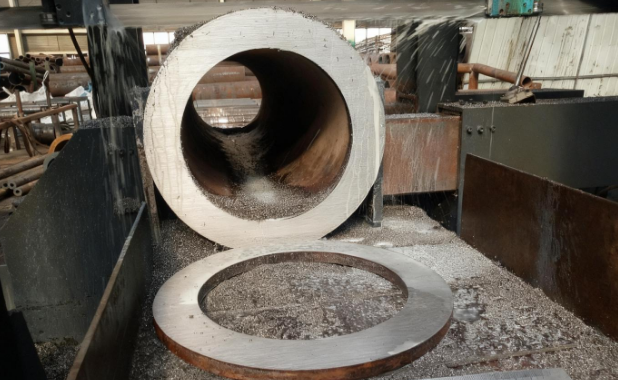
When seamless steel pipes are used to manufacture spindle sleeves, their "seamless" characteristic avoids stress concentration at weld seams (the weld area is prone to residual stress concentration up to the material's yield strength level), preventing cracking during high-speed operation. Simultaneously, the uniformity of the seamless steel pipe's wall thickness (deviation ≤2%) ensures balanced centrifugal force distribution, reducing spindle runout (controlled within 0.005-0.01mm) and improving cutting accuracy. For example, the Φ80×15mm spindle sleeves of CNC machining centers often use 40CrNiMoA seamless steel pipes that have undergone quenching and tempering to ensure support stability.
2. High-Speed Tool Holder Connecting Rod
The tool holder connecting rod is used to connect the spindle to the cutting tool (such as a milling cutter or drill bit), and needs to transmit torque (100-500 N·m) and withstand axial cutting forces (500-3000 N). The "integral forming" structure of seamless steel pipes ensures uniform torque transmission and avoids the risk of weld fracture. Furthermore, by adjusting the pipe wall thickness (e.g., Φ50×10mm), a balance can be achieved between lightweighting (reducing spindle load) and rigidity (bending strength ≥800MPa). A typical application is high-speed milling tool holders, which use 20CrMnTi seamless steel pipes that have undergone carburizing and quenching treatment, achieving a surface hardness of HRC58-62, thus improving wear resistance and torsional strength.
2) Cooling and Lubrication Functional Channels – Controlling Temperature Rise in High-Speed Cutting
During high-speed cutting, the friction between the tool and the workpiece generates high temperatures of 300-800℃. If not cooled in time, this will lead to accelerated tool wear (reducing tool life by 50%-80%). Seamless steel tubes can serve as "cooling/lubrication channels" for tools, enabling precise temperature control and lubrication. Specific applications include:
1. Internal Cooling Tool Sleeves
A Φ8-15mm seamless steel tube is embedded inside the shank of high-speed drills and end mills as a cooling channel. High-pressure coolant (5-20MPa) is delivered to the cutting edge through the tube, directly removing cutting heat. The steel tube must possess excellent corrosion resistance (resistance to emulsions and cutting oils) and dimensional accuracy (inner diameter tolerance ≤0.1mm) to ensure a stable coolant flow rate (5-15L/min). For example, the internal cooling channels of high-speed deep-hole drills often use 304 stainless steel seamless pipes to avoid channel blockage caused by rust.
2. High-Speed Spindle Cooling Jackets
During high-speed operation, the spindle itself generates a temperature rise of 100-200℃ due to friction, requiring a "cooling jacket" on the outside of the spindle for circulating cooling. The cooling jacket is made of seamless steel pipe, bent and welded (only partially welded to avoid stress concentration in the main body). An internal spiral flow channel is formed, through which cooling oil (temperature controlled at 20-30℃) is introduced for heat exchange. The steel pipe must possess good plasticity (elongation after fracture ≥30%) to facilitate bending into complex flow channels, while also withstanding 1-5MPa of cooling oil pressure to prevent cracking. The commonly used material is #10 (corresponding to A53/A106 GR.A) seamless steel pipe, annealed to improve plasticity.
3) Auxiliary Functional Components – Adapted to High-Speed Cutting Conditions
1. High-Speed Fixture Guide Sleeve
In high-speed automatic feeding mechanisms, the guide sleeve guides the movement trajectory of the workpiece or tool and must withstand high-frequency reciprocating friction (speed 1-5m/s). Seamless steel pipe guide sleeves can have their hardness increased (HRC55-60) through surface hardening (such as induction hardening), reducing wear; and their inner wall smoothness (Ra≤0.8μm) can reduce frictional resistance and prevent workpiece jamming. For example, the feed guide sleeve of a high-speed lathe, made of #45 (corresponding to American standard A53/A106 GR.B) seamless steel pipe, treated with "quenching and tempering + surface hardening", can have a service life of 1000-3000 hours.
2. High-Speed Cutting Protective Sleeves
To prevent injury from flying chips (speeds up to 100-300m/s) generated by high-speed cutting, protective sleeves need to be installed around the tools. The high strength (tensile strength ≥600MPa) of seamless steel pipe can withstand chip impact and prevent deformation; and sleeves of different lengths (100-1000mm) can be made by cutting and welding (partially) to fit different tool sizes. Q235B seamless steel pipe is commonly used, balancing cost and protective performance.
Core Material Requirements for Seamless Steel Pipes for High-Speed Cutting Tools:
The operating conditions of high-speed cutting tools (high speed, high temperature, high frequency impact) impose four core requirements on the material of seamless steel pipes: high strength, high toughness, high wear resistance, and high temperature resistance. Specific indicators and technical logic are as follows:
1) Mechanical Performance Requirements – Resisting High-Speed Loads and Vibrations
1. High Strength: Ensuring resistance to deformation and fracture
Yield Strength: Main support components (such as spindle sleeves and tool holders) must have a yield strength ≥ 800 MPa to prevent plastic deformation during high-speed operation (e.g., radial deformation of the spindle sleeve ≤ 0.005 mm); auxiliary components (such as protective sleeves) must have a yield strength ≥ 345 MPa to resist chip impact.
Tensile Strength: Core components (such as tool holder connecting rods) must have a tensile strength ≥ 1000 MPa to ensure no fracture occurs when transmitting torque; cooling channel components (such as internal cooling sleeves) must have a tensile strength ≥ 500 MPa to withstand high-pressure coolant impact.
Hardness: Surface friction components (such as guide sleeves and tool holders) require heat treatment to achieve a surface hardness of HRC55-62 (corresponding to Vickers hardness HV580-700) to reduce wear; the matrix hardness needs to be controlled at HRC25-35 to ensure a balance of toughness.
2. High Toughness: Suppressing High-Frequency Vibration and Impact Fracture
Impact Toughness: Components used in low-temperature environments (such as cold-region workshops, temperatures -10℃ to -20℃) must ensure an impact energy ≥30J at -20℃ (e.g., 40Cr steel after quenching and tempering); components in normal temperature environments must have ≥20J to avoid brittle fracture caused by vibration (e.g., spindle sleeves at 20000r/min speed are prone to cracking due to vibration and impact).
Fracture Toughness (KIC): Core support components must have ≥60MPa・m^1/2 to prevent micro-cracks (such as 0.1mm cracks caused by machining defects) from rapidly propagating under high-speed loads (propagation rate ≤10^-6 m/s).
2) Wear and Corrosion Resistance Requirements – Adapting to High-Speed Friction and Media Corrosion
1. High Wear Resistance: Reducing High-Speed Friction Loss
Surface Wear Resistance: Friction components (such as the inner wall of the guide sleeve and the connecting surface of the tool holder) must have a low wear rate. They must pass bench tests under simulated working conditions to prove their excellent wear resistance. Wear resistance can be improved through "carburizing and quenching" (carburized layer depth 0.8-1.2mm, hardness HRC58-62) or "chrome plating" (plating thickness 5-10μm, hardness HV800-1000).
Microstructure and Wear Resistance: The matrix structure must be fine-grained (grain size ≤ 10 μm) and contain dispersed hard phases (such as Cr₂₃C₆ carbides, size 50-100 nm). Dispersion strengthening enhances overall wear resistance (e.g., after carburizing and quenching, 20CrMnTi steel exhibits dispersed carbide distribution, increasing wear resistance by 3-5 times).
2. Corrosion Resistance: Resistant to corrosion from cooling media and the environment.
Coolant Corrosion Resistance: Cooling channel components (such as internal cooling jackets) must withstand corrosion from emulsions (pH 8-10) and cutting oils (containing sulfur and chlorine additives). A neutral salt spray test (NSS) of ≥48 hours is required without rust (e.g., 304 stainless steel seamless pipes with 18%-20% chromium and 8%-10% nickel content, forming a passivation film).
Atmospheric Corrosion Resistance: Components used in workshop environments (potentially containing dust and moisture) must maintain a surface corrosion rate ≤0.01mm/year at 80% humidity and 25℃ (e.g., Q355ND low-temperature toughness steel, containing copper, phosphorus, and other corrosion-resistant elements to enhance atmospheric corrosion resistance).
3) Thermal Stability and Dimensional Accuracy Requirements – Addressing High Temperature and High Precision Needs
1. Thermal Stability: Suppressing High-Temperature Performance Degradation
High-Temperature Strength: At operating temperatures of 100-200℃ (e.g., spindle sleeves), a high-temperature yield strength ≥700MPa must be maintained (e.g., 40CrNiMoA steel, yield strength retention ≥90% at 200℃) to prevent high-temperature deformation; at operating temperatures of 300-500℃ (e.g., cooling sleeves near cutting tools), heat-resistant steel (e.g., 12Cr1MoV steel, chromium content 1%-1.5%, molybdenum and vanadium elements to enhance high-temperature stability) must be used, with a high-temperature tensile strength ≥400MPa.
Coefficient of Thermal Expansion: The coefficient of thermal expansion of core support components (such as the spindle sleeve) must be controlled to match that of other components in the system, or thermal compensation design should be used to ensure accuracy and reduce dimensional deviations caused by temperature changes (e.g., for a 1000mm long spindle sleeve, the length deviation should be ≤0.6mm when the temperature changes by 50℃), ensuring cutting accuracy.
2. Dimensional Accuracy: Ensure assembly and functional compatibility.
Wall Thickness Deviation: For main support components, the deviation should be ≤2% (e.g., for a Φ80×15mm spindle sleeve, the wall thickness deviation should be ≤0.3mm) to avoid uneven distribution of centrifugal force; for cooling channel components, the deviation should be ≤1% (e.g., for a Φ10×2mm internal cooling sleeve, the wall thickness deviation should be ≤0.02mm) to ensure stable coolant flow.
Roundness Error: For ultra-high precision high-speed spindle sleeves, tool holders, and other rotating components, the roundness error must be ≤0.002mm to reduce runout during high-speed operation; for guide components such as guide sleeves, the roundness error must be ≤0.003mm to ensure accurate workpiece or tool movement trajectory; for general high-speed components, the roundness error should be better than 0.01mm.
Surface Finish: The inner wall of the cooling channel must have Ra≤0.8μm to reduce coolant flow resistance; the surface of friction components must have Ra≤0.4μm to reduce the coefficient of friction (≤0.15) and avoid heat generation and wear.
4) Process Adaptability Requirements – Meeting Complex Machining and Heat Treatment Needs
1. Machinability: Facilitates machining into complex shapes (such as steps or threads on the spindle sleeve), requiring a surface roughness Ra≤1.6μm and a tool life ≥1000 pieces (e.g., #45 steel with a hardness of HB180-220 exhibits excellent machinability, suitable for milling and grinding).
2. Heat Treatability: Properties can be controlled through processes such as tempering, quenching, and carburizing. For example, 40Cr steel can achieve a balance of strength and toughness through "quenching (830-860℃ oil cooling) + high-temperature tempering (550-650℃)"; 20CrMnTi steel can improve surface hardness and wear resistance through "carburizing (900-930℃) + quenching (850-880℃ oil cooling) + low-temperature tempering (180-220℃)".
3. Formability: For bent parts (such as cooling jackets), good plasticity is required. No cracks should appear when the cold bending angle is ≥90° (bending radius ≥3 times the pipe diameter) (e.g., #10 steel, elongation after fracture ≥31%, excellent cold formability).
Read more: High Carbon Steel Seamless Pipe or Seamless Steel Pipe Sizes and Weights
 sales@hu-steel.com
 English
 Español