The selection of seamless steel pipe wall thickness is a critical decision in design, directly affecting safety, economy, process feasibility, and final performance. If the wall thickness is too thin, it may lead to catastrophic failure, frequent leaks, high production downtime losses, and personnel casualties; if the wall thickness is too thick, it may result in significant material waste, unnecessary weight burden, and low project investment efficiency. Therefore, an appropriate wall thickness selection for seamless steel pipes is crucial.
How are Thin-walled and Thick-walled Pipes Defined?
Thin-walled and thick-walled steel pipes are not absolute concepts, but are usually classified relatively by the ratio of "outer diameter to wall thickness." Multi-objective optimization is required during selection.
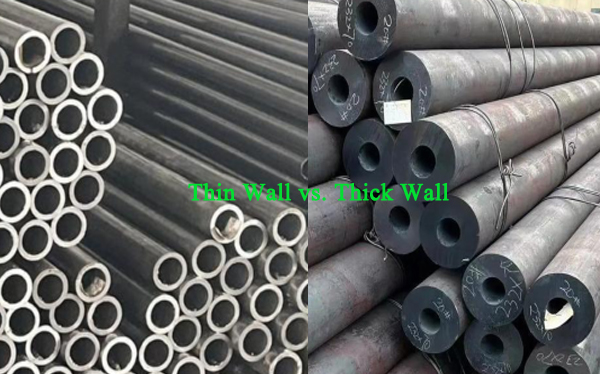
Thin-walled pipe: Generally refers to steel pipes with an outer diameter/wall thickness ≥ 20.
Characteristics: Lightweight, material-saving, good flexibility, but sensitive to defects and limited pressure-bearing capacity.
Thick-walled pipe: Generally refers to steel pipes with an outer diameter/wall thickness < 20.
Features: High strength, high rigidity, and strong pressure resistance, but heavy, costly, and difficult to process.
Five Major Factors Influencing the Selection of Seamless Pipe Wall Thickness:
1. Mechanical properties and safety
Pipe wall thickness is the first and most important line of defense against internal pressure (e.g., hydraulic systems, boilers) and external pressure (e.g., deep-sea pipelines, underground casings). Insufficient wall thickness can lead to plastic deformation, bulging, and even catastrophic bursting. Secondly, sufficient wall thickness can resist unexpected mechanical loads such as external impacts, compression, and foundation settlement, preventing pipe denting and breakage. Furthermore, increasing the wall thickness beyond the design calculations provides a valuable safety margin for material defects, unforeseen overloads, and long-term corrosion.
Scenarios where thin-walled pipes are preferred:
For medium to low internal or external pressure.
Primarily for tensile or small bending moment loads.
For weight-sensitive moving parts.
Scenarios where thick-walled pipes are preferred:
For high and ultra-high pressure (e.g., hydraulic systems, boilers).
Sustaining Complex Stresses such as Large Bending Moments, Torsion, and Extrusion.
Requirements for Fatigue, Impact, or Wear Resistance.
Applications with Extremely High Safety Factors.
2. Process and Manufacturing
Steel mill production capacity limits
seamless pipe wall thickness range. Ultra-thin wall tubes require high-precision cold drawing technology, while ultra-thick wall tubes require large-tonnage extrusion or piercing equipment. Wall thicknesses exceeding conventional ranges lead to procurement difficulties, long lead times, and abnormally high prices.
Scenery Preferred for Thin-Wall Tubes:
Requires secondary forming processes such as cold bending and rolling.
Requires high surface finish on the inner surface (easy polishing and honing).
Connection methods are primarily welding and
flanges, with low requirements for beveling.
Scenery Preferred for Thick-Wall Tubes:
Requires thread machining (to ensure thread strength).
As mechanical structural components, they must withstand assembly stresses (such as interference fits).
As cylinder barrels and bushings, they require sufficient guiding length and wear-resistant layers.
3. Economy and Cost-Effectiveness
Wall thickness is a major driver of material costs, and its selection involves precise financial calculations.
a. Direct Material Costs: For every 1mm increase in wall thickness, the tonnage and procurement cost of steel for the entire pipeline increase significantly. In large projects, optimizing wall thickness can save millions or even hundreds of millions of dollars.
b. Indirect Cost Impacts:
Transportation and Installation: Thicker pipes are heavier, increasing the difficulty and cost of hoisting, transportation, and construction.
Lifespan Costs: Although thin-walled pipes have lower initial investment, if insufficient wall thickness leads to early failure, leakage, production downtime, or safety accidents, the total lifespan cost will be far higher than that of thick-walled pipes, which have a higher initial investment.
Scenarios Where Thin-Walled Pipes are Preferred:
For applications requiring the lowest possible material costs.
For media such as ordinary water or air, with no stringent corrosion requirements.
For one-off or short-term projects.
Scenarios Where Thick-Walled Pipes are Preferred:
For applications involving expensive or hazardous media, where leakage costs far exceed the cost of the pipe itself.
For applications requiring long lifespan and low maintenance costs (thicker walls offer greater resistance to corrosion and wear).
For applications with high installation costs (such as deep sea or high altitude), requiring extremely high reliability.
4. Fluid Properties
Scenarios where thin-walled pipes are preferred:
For conveying ordinary liquids and gases where pressure drop is not a critical factor.
High flow rates and large flow volumes are required (larger inner diameter for the same outer diameter).
Scenarios where thick-walled pipes are preferred:
For conveying high-pressure, high-temperature, toxic, flammable, and explosive media.
In cases of transient loads such as water hammer and pressure pulsations.
For corrosive media requiring a "corrosion allowance".
5. Standards and Specifications
Wall thickness selection is not a matter of free choice but a technical decision under strict constraints. All industrial sectors (petroleum, chemical, power, pressure vessels) have mandatory national and industry standards (such as ASME B31.3). These standards specify the minimum wall thickness calculation formulas and design requirements based on pressure, temperature, and material. Wall thickness selection must first meet the standards; otherwise, the design is invalid.
Scenarios where thin-walled pipes are preferred:
Following the dimensional series ASME B36.10M, EN 10216, etc., specifically Schedule 5S, 10S, or similar series.
Used for low-pressure instrument tubing and general heat transfer tubing.
Preferred scenarios for thick-walled pipes:
Following the size series ASME B36.10M Schedule 80, 160, XXS or API 5L high-strength thick-walled series.
Used for pressure vessels, boilers, and high-pressure process piping, as mandated by regulations.
General wall thickness series: The larger the Schedule number, the thicker the wall.
Sch40 and Sch80 are the most common wall thickness series standards.
6. System Adaptability
Wall thickness is a parameter in a piping system and must be matched with other connections.
a. Matching with fittings and valves: Piping systems need to connect with
pipe fittings such as elbows, tees, and valves. These fittings typically have standard pressure ratings and connection end dimensions; the pipe wall thickness must match these to ensure consistent pressure ratings throughout the piping system.
b. Stress analysis: In complex piping systems, pipes not only bear internal pressure but also thermal stress, stress transmitted from equipment vibration, and stress generated by support constraints. Wall thickness is a critical input for pipeline stress analysis and flexible design, directly affecting the vibration characteristics and stress levels of the pipeline system.
Conclusion:
The selection of seamless steel pipe wall thickness is a highly standardized and regulated process. A proper wall thickness selection is a systems engineering decision that seeks the optimal balance between strength, weight, cost, manufacturing processes, and safety. For critical applications, detailed calculations and reviews by professional engineers are essential.
Read more: Seamless vs. Welded pipe or Advantages and Disadvantages of Pipeline Transportation
 sales@hu-steel.com
 English
 Español