sales@hu-steel.com
 English
 Español
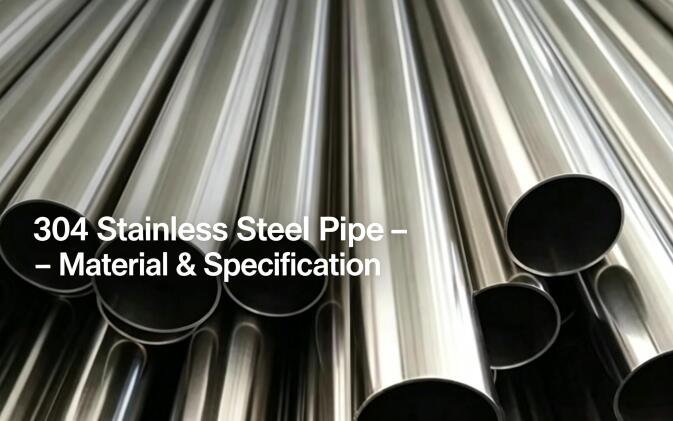
304 Stainless Steel Pipe (UNS S30400), with its 18/8 chromium-nickel composition (18% Cr / 8% Ni), is the most widely used austenitic stainless steel, offering an optimal balance of corrosion resistance, strength, and cost-effectiveness. It is available in seamless, welded, and EFW forms, meeting ASTM A312 and ASME SA312 standards. This guide provides complete material and specification information to support your procurement and engineering decisions.
Quick Navigation:
● Specifications & Size Chart
● Chemical Composition
● Mechanical Properties
● 304 vs 304L Comparison
● FAQs & Contact
Stainless steel pipes have excellent corrosion resistance due to the addition of Ni and Cr chemical elements to adapt to different environments. Commonly used materials are 304/L and 316/L, and the standards are ASTM A312, A213, A270, etc. It is safe, reliable, hygienic, environmentally friendly, economical and applicable, and can resist corrosion from weak corrosive media such as air, steam, and water, and chemically corrosive media such as acids, alkalis, and salts.
304 stainless steel pipe is a common stainless steel pipe with excellent corrosion resistance and a beautiful surface. It is widely used in construction, decoration, machinery, and other fields.
Key properties of 304 stainless steel pipe:
● Corrosion Resistance: Excellent resistance to a wide range of corrosive environments, including many acids and alkalis.
● Heat Resistance: Can operate continuously at temperatures up to approximately 870°C, with short-term service up to 1000-1200°C.
● Strength: Minimum yield strength of 205MPa and minimum tensile strength of 515MPa.
● Formability: Excellent formability and weldability, making it suitable for various fabrication methods.
ASTM A312 TP304 pipe is used for high-pressure and high-temperature applications. ASME SA312 Grade 304 welded pipes are among the most cost-effective and widely used stainless steel pipes in the world.
▶ For a more detailed introduction to 304 seamless pipe (including production process and property analysis), please refer to our [304 Seamless Stainless Steel Pipe Guide].
| Specification | Details |
|---|---|
| Standards | ASTM A312 / ASME SA312 (Seamless & Welded), ASTM A358 / ASME SA358 (EFW) |
| Dimensions | ASTM, ASME and API |
| SS 304 Seamless Pipe Size | 1/8″ NB – 16″ NB |
| SS 304 ERW Pipe Size | 1/8″ NB – 24″ NB |
| SS 304 EFW Pipe Size | 6″ NB – 100″ NB |
| Schedule | SCH 20, SCH 30, SCH 40, STD, XS, SCH 60, SCH 80, SCH 120, SCH 140, SCH 160, XXS |
| Type | Seamless / ERW / Welded / Fabricated / LSAW Pipes |
| Form | Round, Square, Rectangular, Hydraulic, etc. |
| Length | Single Random, Double Random & Cut Length |
| End Finish | Plain End, Beveled End, Threaded |
| Pipe Size | Outside Diameter | Available Schedules |
|---|---|---|
| 1/8" IPS | .405" O.D. | SCH 40, 80 |
| 1/4" IPS | .540" O.D. | SCH 10, 40, 80 |
| 3/8" IPS | .675" O.D. | SCH 10, 40, 80 |
| 1/2" IPS | .840" O.D. | SCH 5, 10, 40, 80, 160, XXH |
| 3/4" IPS | 1.050" O.D. | SCH 10, 40, 80, 160, XXH |
| 1" IPS | 1.315" O.D. | SCH 5, 10, 40, 80, 160, XXH |
| 1-1/4" IPS | 1.660" O.D. | SCH 10, 40, 80, 160, XXH |
| 1-1/2" IPS | 1.900" O.D. | SCH 10, 40, 80, 160, XXH |
| 2" IPS | 2.375" O.D. | SCH 10, 40, 80, 160, XXH |
| 2-1/2" IPS | 2.875" O.D. | SCH 10, 40, 80, 160, XXH |
| 3" IPS | 3.500" O.D. | SCH 5, 10, 40, 80, 160, XXH |
| 3-1/2" IPS | 4.000" O.D. | SCH 10, 40, 80, 160, XXH |
| 4" IPS | 4.500" O.D. | SCH 10, 40, 80, 160, XXH |
| 5" IPS | 5.563" O.D. | SCH 10, 40, 80, 160, XXH |
| 6" IPS | 6.625" O.D. | SCH 5, 10, 40, 80, 120, 160, XXH |
| 8" IPS | 8.625" O.D. | SCH 5, 10, 40, 80, 120, 160, XXH |
| 10" IPS | 10.750" O.D. | SCH 10, 20, 40, 80 |
| 12" IPS | 12.750" O.D. | SCH 10, 20, 40, 80 |
| 14" IPS | 14.000" O.D. | SCH 10, 40 |
| 16" IPS | 16.000" O.D. | SCH 10, 40 |
| 18" IPS | 18.000" O.D. | SCH 40 |
| Element | Content (%) |
|---|---|
| Carbon (C) | ≤0.08 |
| Silicon (Si) | ≤1.0 |
| Manganese (Mn) | ≤2.0 |
| Chromium (Cr) | 18.0 – 20.0 |
| Nickel (Ni) | 8.0 – 10.5 |
| Sulfur (S) | ≤0.03 |
| Phosphorus (P) | ≤0.045 |
| Nitrogen (N) | ≤0.1 |
| Property | Value |
|---|---|
| Tensile Strength | ≥515 MPa |
| Yield Strength (min) | ≥205 MPa |
| Elongation | ≥35% (typically) |
| Hardness (Brinell) | ≤201 HB |
| Max. Service Temperature (Continuous) | ~870°C |
| Feature | Grade 304 | Grade 304L |
|---|---|---|
| Carbon Content | ≤0.08% | ≤0.03% |
| Corrosion Resistance (General) | Excellent | Excellent |
| Corrosion Resistance (After Welding) | Good | Superior |
| Cost | Lower | Higher |
| Best For | General purpose, non-welded or thin-walled applications | Welded structures, thick sections, and applications without post-weld heat treatment |
Selection Advice: For most standard piping applications, 304 offers the best value. For welded components without post-weld heat treatment, especially those with wall thickness over 1/4 inch, 304L is the safer, more reliable choice to prevent weld decay.
304 seamless stainless steel pipes are made from steel ingots or solid tube blanks that are perforated into capillary tubes, and then hot rolled, cold rolled or cold drawn. The production process mainly includes smelting, rolling, piercing, straightening, cutting and other links. Each link has specific requirements and operating specifications to ensure high-quality products.
304 stainless steel pipes are widely used in the following fields:
1. Chemical industry: 304 stainless steel pipes are widely used in the chemical industry, such as manufacturing various chemical equipment, pipelines, valves, etc. Its excellent corrosion resistance can withstand the erosion of various corrosive media such as acids and alkalis.
2. Construction field: In the construction field, 304 stainless steel pipes are mainly used for decoration, railings, handrails, etc. Its beautiful appearance and excellent mechanical properties make it an ideal material for architectural decoration.
3. Mechanical equipment: 304 stainless steel pipes also occupy an important position in the field of mechanical equipment manufacturing. Such as manufacturing bearings, transmission parts, hydraulic systems, etc., its excellent mechanical properties and corrosion resistance can meet the needs of various complex working conditions.
4. Food processing: In the field of food processing, 304 stainless steel pipes are favored because of their non-toxic, odorless and easy to clean characteristics. It is widely used in the manufacture of various food processing equipment, pipelines, etc.
5. Other fields: In addition, 304 stainless steel pipes have also been widely used in environmental protection, medical equipment, shipbuilding and other fields.
Q1: What is the difference between 304 and 304L stainless steel pipe?
A: The key difference is carbon content. 304L has a lower carbon content (≤0.03%) than 304 (≤0.08%), which gives 304L better resistance to intergranular corrosion after welding. For most general applications, 304 is sufficient. For welded structures without post-weld heat treatment, 304L is recommended.
Q2: What sizes are available for 304 stainless steel pipe?
A: We supply 304 stainless steel pipe in seamless sizes from 1/8″ NB to 16″ NB, ERW sizes from 1/8″ NB to 24″ NB, and EFW sizes from 6″ NB to 100″ NB. Custom sizes are available upon request.
Q3: What schedules are available for 304 stainless steel pipe?
A: We offer SCH 20, SCH 30, SCH 40, STD, XS, SCH 60, SCH 80, SCH 120, SCH 140, SCH 160, and XXS.
Q4: Do you provide material test certificates?
A: Yes, we provide complete material test certificates (MTC) with full traceability, including chemical composition and mechanical property reports for all our 304 stainless steel pipes.
Q5: What is the maximum working temperature for 304 stainless steel pipe?
A: 304 stainless steel pipe can be used continuously at temperatures up to approximately 870°C. For short-term service, it can withstand temperatures up to 1000-1200°C.
Q6: What is the minimum order quantity (MOQ)?
A: Please contact our sales team for MOQ details, as it varies by size and specification.
Q7: Are there any special precautions for handling or installing 304 stainless steel pipe?
A: Yes. To maintain its corrosion resistance and appearance, avoid surface scratches during handling and installation. Use proper welding procedures and protect the pipe from heavy impact during transport and storage. Regular inspection is also recommended for critical systems.
△ Need ASTM A312 304 Stainless Steel Pipe?
Hunan Standard Steel Co., Ltd is a trusted supplier and manufacturer of high-quality stainless steel pipes. With years of experience and full material traceability, we serve industries worldwide. Contact us for competitive pricing and fast delivery.
▶ [Get a Quote Now]
Read more:
● 304 vs. 316 Stainless Steel: Which is Better?
● Stainless Steel Seamless Pipe Manufacturing Process
Related information
Copyright @2017 Hunan Standard Steel Co.,Ltd and Husteel Industry Group All Rights Reserved