sales@hu-steel.com
 English
 Español
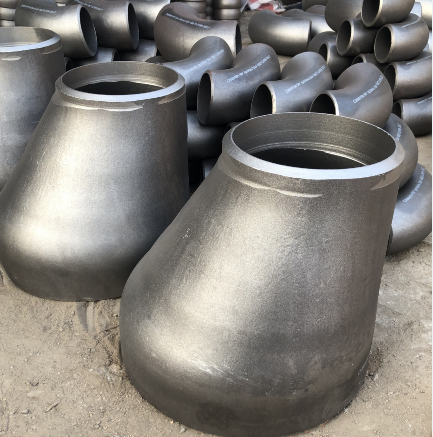
This guide provides a practical method for estimating the weight of steel pipe reducers. Whether you need to calculate shipping costs, prepare lifting equipment, or estimate material requirements, the simplified formula and reference table below will help you get a quick and reliable result.
ρ = Material density (7.85 g/cm³ for carbon steel / 7.93 g/cm³ for stainless steel)
Example Calculation (Carbon Steel):
For a concentric reducer: D = 406 mm, d = 219 mm, H = 356 mm, t = 10 mm
Step 1: D + d = 406 + 219 = 625
Step 2: (D + d) × H × t = 625 × 356 × 10 = 2,225,000
Step 3: 0.384 × 2,225,000 = 854,400
Step 4: 854,400 × 0.00000785 = 6.71 kg
Estimated weight ≈ 6.7 kg
△ Note: This simplified theoretical weight formula is suitable for rolled/welded reducers. Actual weight may vary due to tolerances and welding. For forged reducers (common in high-pressure, small-diameter applications), the weight may differ due to the solid wall thickness. Contact our engineering team for precise data on forged fittings.
Use the table below for a fast estimate of common SCH 40 pipe reducer sizes. ▶ [Learn more about ANSI B16.9 Pipe Reducer Dimensions Chart]
| Nominal Pipe Size (NPS) | Large End OD (mm) | Small End OD (mm) | Length (mm) | Approx. Weight (kg) |
|---|---|---|---|---|
| 4" x 3" | 114.3 | 88.9 | 102 | 2.8 |
| 4" x 2" | 114.3 | 60.3 | 102 | 3.2 |
| 6" x 4" | 168.3 | 114.3 | 140 | 6.5 |
| 6" x 3" | 168.3 | 88.9 | 140 | 7.8 |
| 8" x 6" | 219.1 | 168.3 | 152 | 11.2 |
| 8" x 4" | 219.1 | 114.3 | 152 | 13.5 |
| 10" x 8" | 273.1 | 219.1 | 178 | 19.8 |
| 12" x 10" | 323.9 | 273.1 | 203 | 28.5 |
To use this table: Find your required large and small end sizes, then read across for the estimated weight. These values are based on carbon steel (density 7.85) and standard wall thickness (Sch40). Adjust the result if your material or wall thickness differs.
Knowing the weight of a reducer is useful beyond just material estimation. Here are three common scenarios:
1. Shipping and Freight Cost Calculation
Freight costs (especially for air or sea freight) are often calculated per kilogram. Having an accurate weight estimate allows you to provide precise shipping quotes and avoid unexpected charges. For a typical 10" x 8" reducer weighing nearly 20 kg, this can significantly affect logistics planning.
2. Lifting Equipment Preparation
Before installation, you need to select the correct slings, chains, or lifting beams. As a general guide:
● For reducers up to DN200 (8"), prepare lifting gear rated for at least 50 kg.
● For DN500 (20") and above, we recommend preparing lifting equipment rated for 100 kg or more per fitting.
● Always add a safety margin of at least 20% above the estimated weight.
3. Material Receiving and Inventory Management
When you order multiple reducers, the total weight helps you plan storage areas, racking capacity, and even floor loading. Use the formula above or the reference table to quickly sum the weight of your entire order.
3. Wall thickness influence: For every 1mm increase in thickness, 530 pipes gain 13kg/m, and 219 pipes gain 5.3kg/m.
d. Lifting Preparation: When lifting a single 530mm reducer, the lifting equipment should be prepared with a load-bearing capacity of 80-100kg/piece; for a single 219mm reducer, prepare 35-50kg/piece.
Q1: Can I use this formula for both concentric and eccentric reducers?
A: Yes, the formula provides a good estimate for both types. The slight difference in shape between concentric and eccentric reducers has a minimal effect on the overall weight, and this simplification is widely accepted in engineering practice.
Q2: How do I calculate the weight for stainless steel or alloy reducers?
A: Simply replace the carbon steel density (ρ = 7.85) in the formula with the density of your material:
● Stainless steel (304/316): ρ ≈ 7.93
● Duplex stainless: ρ ≈ 7.80
● Nickel alloys: ρ can range from 8.1 to 8.9
Q3: Why is the table weight different from the actual weight of the reducer I receive?
A: Your actual reducer may have a slightly different wall thickness (due to manufacturing tolerances), or it may be a welded type with extra reinforcement at the seam. The table provides a theoretical weight for reference. For critical applications (like crane lifting), always use the certified weight from the manufacturer.
Q4: Do you provide certified weight data for your reducers?
A: Yes. Every reducer we supply comes with a material test report (MTR) that includes the actual measured weight. For large orders, we can also provide a packing list with individual or total weights for customs clearance.
Q5: Why is there no official weight table in ASME B16.9?
A: ASME B16.9 focuses on dimensional tolerances and connection sizes. It does not provide theoretical weights. For exact weight data, you need to refer to manufacturer-specific tables or certified weight reports.
If you have a specific reducer size, wall thickness, or material that is not listed above, our engineering team can provide a precise weight calculation for your order.
We can also supply custom-manufactured reducers with certified weight documentation.
▶ [Request your weight data now]
Estimating the weight of a pipe reducer is straightforward with the simplified formula W = 0.384 × (D + d) × H × t × ρ. For quick reference, use the weight table above for common carbon steel Sch40 sizes. Remember to apply the correct density for your specific material, and always add a safety margin when preparing lifting equipment.
When precision matters, contact our team—we provide certified weight data and can support your logistics, installation, and procurement planning.
Related Resources:
● Pipe Reducer Dimensions Chart
● Concentric vs Eccentric Reducer: When to Use Which
● Carbon Steel vs Stainless Steel Pipe Fittings – Material comparison for procurement decisions.
Related information
Copyright @2017 Hunan Standard Steel Co.,Ltd and Husteel Industry Group All Rights Reserved