Carbon steel square tubing, a commonly used structural and mechanical tubing material, has its processing technology directly determining the dimensional accuracy, mechanical properties, and applicable fields (such as construction, machinery manufacturing, and the automotive industry) of the final product. From raw materials to finished products, square tubing mainly undergoes two stages: forming and deep processing. Understanding the processing technology of carbon steel square tubing and the precautions during processing is crucial to ensuring the quality and performance of the tubing.
Processing Technology of Carbon Steel Square Tubes:
The manufacturing of carbon steel square tubing begins with two different forming processes, which determine its initial state and basic properties.
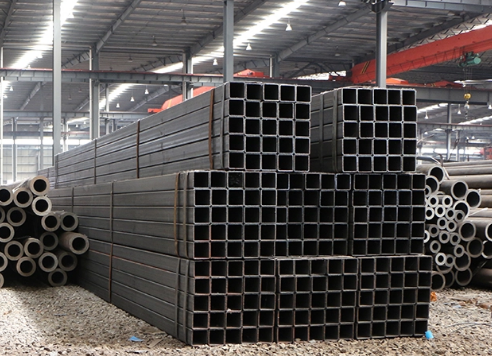
1. Seamless Square Tubes
Seamless square tubing is made from carbon steel round bars as raw material through hot piercing or cold drawing (cold rolling). The main characteristics of the seamless process are the absence of weld seams, uniform overall performance, and strong pressure resistance. However, the production process is long, the specifications and dimensions are limited, and the cost is high.
Hot Rolling Process:
- Hot rolling is one of the important processes in the processing of carbon steel square tubes. First, the steel billet is heated to a certain high temperature to give it good plasticity. Generally, the billet heating temperature is between 1000 and 1200 degrees Celsius. Within this temperature range, the internal structure of the steel changes, facilitating subsequent rolling operations.
- The heated billet is then rolled by a rolling mill. The rolls of the rolling mill apply pressure to the billet, gradually deforming it into the desired shape. During the rolling process, the billet undergoes multiple rolling steps, each of which further refines the size and shape of the billet. For example, the initial rolling stage mainly rolls the steel billet into a roughly square or rectangular cross-section. Subsequent finish rolling strictly controls dimensional accuracy to ensure uniform wall thickness and that the square tube's dimensions meet standard requirements.
- Hot-rolled square tubes possess good toughness and strength, with a uniform internal structure, making them suitable for engineering structures requiring high strength, such as building frame structures and bridge support structures.
Cold Rolling Process:
- Cold rolling involves further processing hot-rolled square tubes at room temperature. Unlike hot rolling, cold rolling does not require heating the tube; instead, pressure is applied directly to the tube using a rolling mill.
- The main purpose of cold rolling is to improve the dimensional accuracy and surface quality of the square tube. Because rolling is performed at room temperature, the deformation of the tube is relatively small, allowing for more precise control of the square tube's dimensions. Cold rolling allows for smaller wall thickness tolerances and significantly improves surface smoothness and finish.
- Cold-rolled square tubes have increased strength and hardness, but relatively reduced toughness. Therefore, cold-rolled square tubes are commonly used in fields requiring high dimensional accuracy and surface quality, such as automotive parts manufacturing and the frame structures of precision instruments and equipment.
2. Welded Square Tubes
This is currently the most mainstream manufacturing method on the market: using carbon steel strip (coil) as raw material, it is continuously rolled into a round tube shape by a forming unit, then the joint is closed by welding, and finally rolled into a square or rectangular shape by a shaping unit. The characteristics of welded square tube manufacturing are high production efficiency, flexible dimensions, and the ability to produce large-sized square tubes. The performance of the weld area is key to quality control.
Welding Process:
Welding is one of the key steps in manufacturing square tubes. Common welding methods include high-frequency welding and submerged arc welding.
-
High-frequency welding (ERW): Utilizing the skin effect and proximity effect of high-frequency current, the edges of the square tube are rapidly heated to the welding temperature. Then, the edges are pressed together by extrusion rollers to form a strong weld. High-frequency welding is fast and efficient, suitable for producing thin-walled square tubes. During the welding process, the frequency, intensity, and welding speed of the high-frequency current must be precisely controlled to ensure weld quality. For example, a suitable high-frequency current frequency ensures uniform heating of the square tube edges, avoiding localized overheating or incomplete penetration.
-
Submerged arc welding (SAW): This method involves burying the welding arc under a layer of granular flux. The advantages of this welding method are high weld quality and a stable welding process, making it suitable for welding thick-walled square tubes. When performing submerged arc welding, attention must be paid to the selection of flux and the adjustment of welding parameters. Different materials of square tubes require matching fluxes to ensure that the chemical composition and mechanical properties of the weld meet requirements. Simultaneously, the proper setting of parameters such as welding current, voltage, and welding speed plays a decisive role in the weld formation and quality.
Subsequent Deep Processing and Finishing:
The forming and processing of square tubes includes various operations such as bending, punching, and cutting.
- The forming process of square tubes includes various operations such as bending, punching, and cutting.
- Bending: Square tubes are bent using bending equipment to meet the shape requirements of different engineering structures. During bending, factors such as the material, wall thickness, and bending radius of the square tube must be considered. If the bending radius is too small, cracks may appear on the outer side of the square tube, and wrinkles may appear on the inner side. Therefore, appropriate bending processes and equipment must be selected according to the specific conditions of the square tube to ensure that the shape of the bent square tube meets the design requirements.
- Punching: Holes of various specifications are punched into the square tube using punching equipment. The accuracy and quality of punching directly affect the subsequent use of the square tube. During punching, the pressure and stroke of the punch must be carefully controlled to ensure accurate hole dimensions, smooth edges, and freedom from defects such as burrs and cracks.
- Cutting: According to actual needs, cutting equipment is used to cut the square tube into different lengths. Common carbon steel tube cutting methods include flame cutting and plasma cutting. Flame cutting is suitable for cutting thick-walled square tubes; its principle is to use a high-temperature flame to melt the square tube and blow it away, thereby achieving the cut. Plasma cutting has the advantages of fast cutting speed and good cut quality, and is suitable for cutting square tubes of various wall thicknesses, especially widely used in the cutting of thin-walled square tubes.
Surface Treatment: This includes sandblasting for rust removal, galvanizing, and painting or powder coating to improve corrosion resistance and aesthetics.
Precautions for Carbon Steel Square Tube Processing:
1. Raw Material Quality Control
- Before processing square tubes, the raw materials must undergo strict quality inspection. Check whether the chemical composition and mechanical properties of the steel meet the relevant standard requirements. For example, the content of elements such as carbon, silicon, and manganese in the steel directly affects the strength and toughness of the square tube. If the carbon content is too high, the hardness of the square tube will increase, but the toughness will decrease, making it prone to cracking during processing or use.
- Simultaneously, the surface quality of the raw materials must be inspected to ensure there are no obvious cracks, scratches, holes, or other defects. Defective raw materials should be processed or replaced promptly to avoid further quality problems during processing.
2. Maintenance and Adjustment of Processing Equipment
- The normal operation of processing equipment is crucial to ensuring the quality of square tube processing. Regular maintenance and upkeep of rolling mills, welding equipment, bending equipment, etc., are necessary. Check for normal wear on various components and replace severely worn parts promptly. For example, the rolling mill rolls will wear down after long-term use, leading to a decrease in the dimensional accuracy of the rolled square tubes; therefore, the rolls need to be repaired or replaced regularly.
- Before each processing run, the equipment must be adjusted to ensure that all parameters are set correctly. For example, parameters such as welding current, voltage, and welding speed of the welding equipment need to be adjusted according to the material and wall thickness of the square tube to ensure welding quality.
3. Control of the Processing Environment
- The processing environment also has a certain impact on the processing quality of square tubes. During high-temperature processing such as hot rolling and welding, changes in ambient temperature and humidity may affect the cooling rate and microstructure transformation of the square tube. Therefore, it is essential to maintain a relatively stable temperature and humidity environment during processing.
- Simultaneously, the processing workshop should be kept clean to prevent dust and debris from entering the square tube processing process and affecting its surface quality and internal properties.
4. Quality Inspection During Processing
- Real-time quality inspection is crucial during square tube processing. For example, during welding,
non-destructive testing methods (such as ultrasonic testing and X-ray testing) should be used to inspect the internal quality of the weld, promptly identifying defects such as porosity, slag inclusions, and incomplete penetration, and taking appropriate repair measures.
- After the square tubes are formed, their dimensional accuracy, shape deviation, and surface quality must be inspected. Using measuring tools such as calipers and micrometers, the wall thickness and side length of the square tubes should be measured to ensure they meet design requirements. Square tubes that do not meet quality standards should be reworked promptly to prevent unqualified products from entering the next process or the market.
How to Choose the Processing Technology for Carbon Steel Square Tubes?
The choice of processing technology for carbon steel square tubes primarily depends on their end application:
a. For cost-sensitive, multi-dimensional general structural applications, high-frequency welded square tubes are the economical choice;
b. For critical structures requiring high pressure resistance and reliability, submerged arc welded square tubes or seamless square tubes should be selected.
Understanding the key points of quality control throughout the entire process from forming to finishing is fundamental to ensuring that square tube products meet design expectations and serve safely and for a long time in fields such as construction, machinery, and infrastructure.
In summary, the processing technology of carbon steel square tubes involves multiple stages, including hot rolling, cold rolling, welding, and forming, each with its unique technical requirements and operational points. During processing, strict control of raw material quality, maintenance and debugging of processing equipment, control of the processing environment, and real-time quality inspection are crucial for ensuring the quality and performance of the square tubes, providing strong support for their reliable application in various fields.
Read more: Common Cutting Methods and Precautions for Carbon Steel Pipes or Square tube vs Round tube: Which is better?
 sales@hu-steel.com
 English
 Español