In oil and gas extraction, casing pipe is a core barrier ensuring wellbore integrity and long-term safe production. The primary principle for its selection is "matching with environmental loads." Different geological and fluid environments place drastically different demands on the mechanical properties, corrosion resistance, and long-term stability of casing. Incorrect selection can lead to catastrophic failure and huge economic losses.
Below is a comparison of selection from an environmental adaptability perspective, as different extraction environments have significantly different requirements for casing performance.
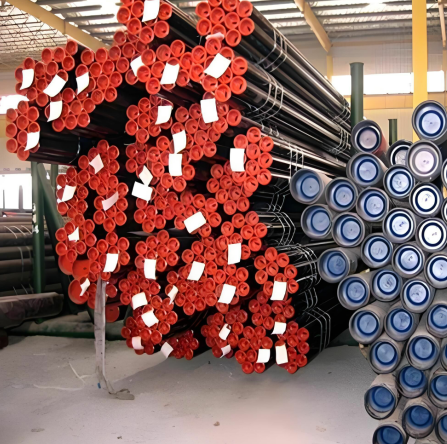
5 Typical Application Environments for Oil Casing Pipe are as Follows:
1. Conventional Onshore Environment
In conventional onshore oil wells, ordinary
carbon steel oil casing usually meets the requirements, characterized by low cost and mature processing technology. This type of casing performs well in environments with normal temperature, normal pressure, and no special corrosive media.
Environmental Challenges: Relatively mild. It mainly bears tensile loads from formation extrusion, internal fluid pressure, and its own weight. The corrosive environment is usually weakly corrosive (containing small amounts of CO₂ or bacteria).
Selection Strategy: Prioritize cost optimization while meeting strength design requirements.
Recommended Options:
Steel Grade:
J55/K55 (surface casing),
N80 (mainstay technical/production casing). For higher well depths or pressures, use P110.
Material: Standard carbon manganese steel or low-alloy steel.
Connection:
API standard threads (such as BTC) are sufficient for most situations.
2. Marine Environment
In offshore oil well engineering, especially in deep-sea environments, the high corrosiveness of seawater and complex geological conditions necessitate the selection of alloy steel casing with high corrosion resistance. These casings have high chromium and nickel content, effectively resisting seawater erosion.
Environmental Challenges: Complex extreme environments.
a. External Corrosion: Corrosion of the casing outer wall by seawater (chloride ions), and mixed corrosion from seawater and formation water.
b. Complex Loads: Withstanding fatigue and bending loads from platform movement, waves, and ocean currents.
c. Low Temperatures: The high temperatures at seabed require high material toughness.
d. High Day Costs: The non-productive time costs resulting from any failure are extremely high.
Selection Strategy: Preventative design, employing the highest reliability standards, prioritizing life-cycle safety over initial cost.
Recommended Solution:
Steel Grade and Strength: Generally use higher steel grades (e.g., P110, Q125) to achieve high strength and thin walls, reducing weight while ensuring strength.
Corrosion Control: Employ a full-body anti-corrosion internal coating. Use corrosion-resistant alloys, such as 22Cr duplex stainless steel, in critical well sections (e.g., splash zone, production casing).
Connections: Mandatory use of high-performance special threads, requiring excellent gas sealing, high bending resistance, and fatigue resistance.
Quality Control: Requires non-destructive testing and dimensional tolerance control exceeding API standards.
3. High-Temperature, High-Pressure Deep Well Environment
In high-temperature, high-pressure deep well environments, casing needs to possess good high-temperature strength and creep resistance. High-strength casing that has undergone special heat treatment is typically selected to ensure structural stability under extreme conditions.
Environmental Challenges:
a. Strength Degradation: The yield strength and creep resistance of steel decrease at high temperatures.
b. Sealing Failure: High temperatures cause thread sealant failure, and uneven thermal expansion of materials affects connection sealing.
c. High external extrusion and high internal pressure.
Selection Strategy: Materials science based on temperature and pressure coupling design.
Recommended Solution:
Material Selection: Use high-temperature resistant steel casing with a specially formulated and heat-treated design, which exhibits less strength reduction at rated temperatures.
Steel Grade: Q125 and higher grades (such as VM140, VM150) have become standard for deep wells.
Connection: Use special threads with elastic sealing elements or metal-to-metal seals to ensure seal integrity at high temperatures.
Design Criteria: Triaxial strength design software with temperature-pressure coupling must be used for verification, rather than non-temperature formulas.
4. Acidic Environment
For oil wells containing acidic gases such as hydrogen sulfide, casing resistant to hydrogen sulfide corrosion must be selected to prevent damage to the well casing due to corrosion.
Environmental Challenges: Under the combined effects of H₂S and tensile stress, oil well casing may experience brittle fracture without warning, posing an extremely high risk.
Selection Strategy: Safety is paramount; strictly adhere to industry standards.
Recommended Solution:
Mandatory Material Requirements: Sulfur-resistant steel grade must be used.
Mainstream Choice: L80 (all types of casing).
High Strength Requirements: C90, T95 (note that their hardness restrictions are stricter).
Prohibited Use: P110 and other non-sulfur-resistant steel grades, regardless of their strength.
Hardness Control: Strictly adhere to hardness limits such as "HRC 22" or "HRC 25," as hardness is a key indicator of resistance to H₂S SCC.
Connections: Threaded connection areas require special treatment to ensure uniform hardness and eliminate localized hardening points.
5. High Carbon Dioxide Environment
Environmental Challenges: In high carbon dioxide environments, electrochemical weight loss corrosion and localized pitting corrosion are prone to occur, leading to casing wall thinning and perforation.
Selection Strategy: Material selection based on corrosion severity.
Recommended Solutions:
Slight Corrosion: Carbon steel + corrosion inhibitor or internal coating.
Moderate to Severe Corrosion:
13Cr martensitic stainless steel (economical and efficient choice).
Severe Corrosion (Containing Cl⁻): Super 13Cr, 22Cr/25Cr duplex stainless steel.
Extremely Severe Corrosion: Nickel-based alloy.
Conclusion:
Selecting oilfield casing is essentially a process of screening under constraints. Environmental adaptability is a rigid constraint that must be met first, followed by strength optimization and economic selection within those constraints. Choosing the appropriate oilfield casing based on different mining environments can significantly improve mining efficiency, reduce costs, and ensure production safety.
It is recommended to have in-depth communication with experienced drilling engineers and materials engineers before procurement, and to utilize professional material selection software to ensure the best decision-making.
Read more: Drilling Casing Pipe Sizes and Specifications or Oil Casing Pipe vs. Drill Pipe
 sales@hu-steel.com
 English
 Español