Why are Square Tubes Preferred in Engineering Projects?
Square tubes (SHS tube) are hollow tubing with a square cross-section, belonging to the category of structural hollow profiles in metallurgical steel (distinct from seamless round tubes). Due to their structural stability and high load-bearing capacity, they are widely used in construction engineering, machinery manufacturing, and other fields. Their square cross-section design allows for more uniform stress distribution, making them particularly suitable for scenarios requiring high-strength support, such as building frames and bridge structures. Furthermore, the excellent processing adaptability of square tubes makes them a common structural material in industrial design.
1. Technical Characteristics and Processing Technology
The core characteristics of square tubes include good corrosion resistance and wear resistance, as well as a high surface finish. Corrosion resistance and wear resistance mainly stem from material selection and surface treatment processes. For example, hot-dip galvanizing or spraying anti-corrosion coatings can significantly extend the service life of the tube in humid or corrosive environments. Surface finish relies on high-precision processing technology. Cold bending or hot rolling processes control the uniformity of the tube wall thickness, followed by shot blasting or pickling to remove surface oxide scale and defects, ultimately obtaining a substrate surface that meets coating requirements.
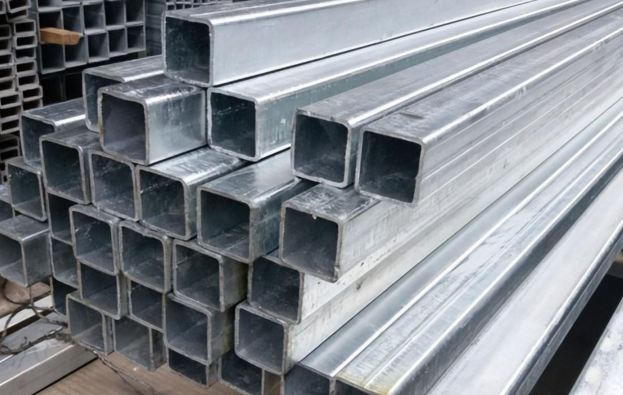
Furthermore, square tubes are manufactured using high-frequency resistance welding or submerged arc welding processes, achieving a weld strength of over 90% of the base material. This means the tube body and weld are almost a single unit, preventing loosening as easily as with traditional connections. On the construction site, the smooth surface of the square tube facilitates welding, allowing for direct butt welding, lap welding, or fixing with connecting plates and bolts. The regular weld seams also make inspection easier, ensuring higher quality.
2. Usage and Scenarios Adaptability
The use of square tubes requires selecting appropriate specifications based on the cross-sectional side length and wall thickness. Their size range covers various needs and can meet different load-bearing requirements. In construction projects, square tubes are often used as columns or beams. Material usage must be calculated using theoretical weight calculations or weighing to ensure structural stability. During installation, attention must be paid to rust prevention at welded areas, such as applying rust-preventive paint or using stainless steel welding rods to extend the overall service life.
In addition, square tubes support customized processing. Length, cross-sectional dimensions, or surface treatment processes can be adjusted according to project requirements, but the processing cycle and feasibility must be confirmed in advance.
Square Tube Specifications:
Common Side Length Range: 20mm × 20mm to 400mm × 400mm;
Wall Thickness Range: 1.5mm to 16mm;
Length: Usually 6m or 12m standard lengths, but can also be customized according to project requirements.
Typical Applications:
1) Building Engineering
Load-bearing Columns and Bracing: Serving as columns and braces in building frames, utilizing their bidirectional equal strength characteristics to withstand loads from different directions.
Roof Trusses and Rigs: In large-span structures, square tubes serve as truss chords and web members, achieving lightweighting and high strength.
Curtain Wall Skeleton: Serving as the supporting framework for glass curtain walls, combining strength and aesthetics.
2) Bridges and Traffic Facilities
Bridge Railings: Serving as columns and beams for crash barriers, meeting impact load requirements.
Pedestrian Bridges: Serving as main or secondary beams, achieving structural lightweighting.
Traffic Sign Brackets: Used for supporting traffic signs on highways and urban roads. Structure
3) Machinery Manufacturing and Industrial Equipment
Equipment Frames: Serving as the load-bearing framework for various production equipment and conveying systems.
Warehouse Shelves: Serving as the uprights and beams of heavy-duty shelving, bearing storage loads.
Lifting Machinery: Used as the supporting structure for tower cranes, gantry cranes, and other equipment.
4) Other Fields
Photovoltaic Brackets: Serving as the supporting structure for solar photovoltaic panels, requiring strong weather resistance.
Agricultural Facilities: Greenhouse frames, livestock equipment frames.
Public Facilities: Bus stops, waiting shelters, landscape features, etc.
3. Quality Grade and Actual Performance
High-quality square tubes must pass multiple quality tests, including wall thickness uniformity, weld strength, and mechanical properties. Taking
Hunan Standard Steel Co., Ltd (HSCO) as an example, its square tubes use high-precision processing technology, with wall thickness deviation controlled within ±0.1mm, and weld strength reaching over 90% of the base material, capable of withstanding high loads without deformation. Regarding corrosion resistance, through salt spray testing, its surface coating showed no rust after 500 hours in a salt spray environment, exceeding conventional requirements. These technical specifications ensure stable performance in humid environments or outdoor projects, effectively reducing later maintenance costs.
4. Advantages of Square Tubes vs. Round Tubes
Compared to round tubes, square tubes offer unique advantages in structural design. Their square cross-section allows for a tighter fit with connectors, reducing installation gaps and improving overall stability. For example, in building frames, the larger contact area between square tubes and bolts effectively disperses stress and prevents localized deformation.
Furthermore, square tubes are easier to stack and transport; their square cross-section allows for close arrangement, saving space and reducing logistics costs. However, round tubes still have advantages in fluid transport or scenarios requiring uniform stress (such as torque bearing), and the choice should be weighed based on specific needs.
Square Tubes vs. Round Tubes: How to Choose?
Scenarios where square tubes are preferred: Building frames, columns, beams, trusses, equipment racks, warehouse shelves, and other structures primarily subjected to bending and axial loads;
Scenarios where round tubes are preferred: Fluid transport pipelines, tall towers (such as power transmission towers and communication towers), drive shafts subjected to high torque, etc.
Read more: Carbon Steel Square Tube Size Chart or EN 10219-1 Cold-Formed Structural Steel
 sales@hu-steel.com
 English
 Español