sales@hu-steel.com
 English
 Español
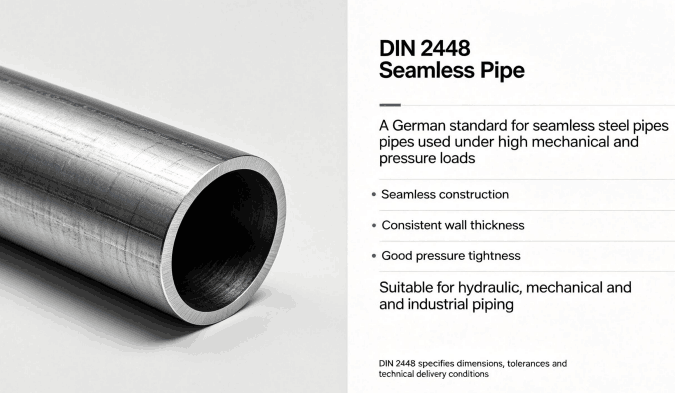
DIN 2448 is a standard for the size and conventional mass per unit length of seamless steel pipes & tubes formulated by the German Institute for Standardization (DIN). It is applicable to industrial seamless steel pipes and is commonly used in construction, boilers, petrochemicals and other industries.
DIN 2448 is a dimensional standard—specifying pipe sizes and weights, not material properties (which are defined by DIN 1629 or DIN 17175). This standard has been superseded by DIN EN 10220, with material standards updated to EN 10216.
Scope of application:
Applicable to seamless steel pipes with technical conditions specified in DIN1629 (Parts 1-4), DIN 17172 and DIN 17175.
It specifies the outer diameter, wall thickness and mass per unit length of steel pipes, aiming to promote the standardized selection of pipe sizes.
Scope of non-application:
Not applicable to precision steel pipes (precision steel pipes are applicable to standard DIN 2391)
Size series: Based on DIN ISO 4200, it defines the preferred wall thickness of different series and standardizes seamless steel pipes.
Unit length mass: Provides the basis for calculating the theoretical weight per meter of steel pipes of different specifications.Applicable materials: Covering carbon steel, low alloy steel, etc., the specific material needs to refer to supporting standards such as DIN 1629.
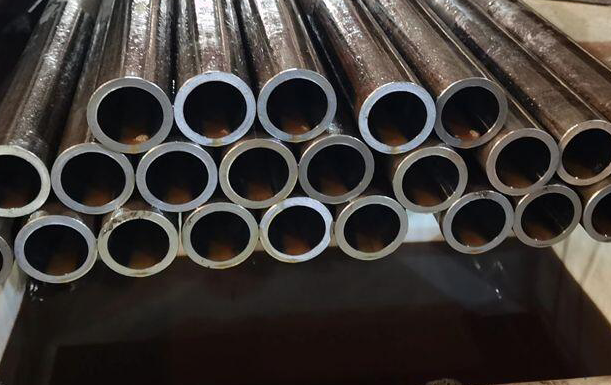
DIN 2448 seamless steel pipes are widely used across multiple industries:
● Machinery and equipment manufacturing: hydraulic cylinders, pneumatic cylinders, precision shafts, and transmission components.
DIN EN 10220 (EU standard replacing DIN 2448).
The DIN 2448 standard itself mainly stipulates the size and unit length mass of steel pipes, and the specific material needs to refer to other relevant standards, such as:
1) DIN 1629 (non-alloy steel seamless pipe)
St37 (ordinary carbon structural steel, similar to China Q235)
St44 (strength slightly higher than St37)
St52 (high-strength low-alloy steel, similar to China Q345).
2) DIN 17175 (heat-resistant seamless steel pipe)
St35.8, St45.8 (steel for boiler tubes and high-temperature and high-pressure pipelines).
Other common materials:
Q195, Q215, Q235, Q345 (materials corresponding to Chinese standards).
20G (material for seamless steel pipes for Chinese boiler tubes).
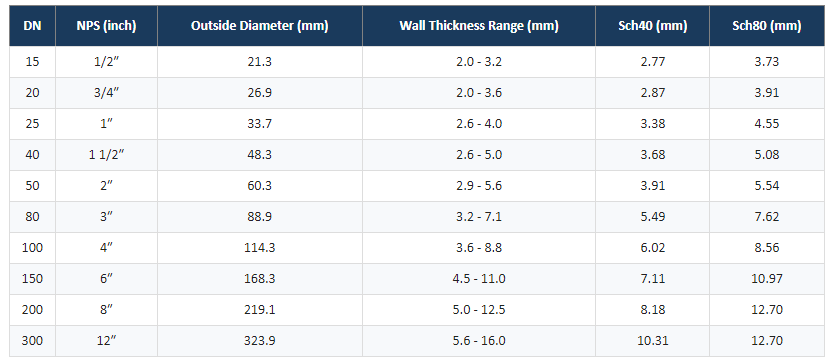
Below is the core dimensional data for seamless steel pipes per DIN EN 10220 (successor to DIN 2448), covering DN 15 to DN 300 with common wall thickness ranges and Sch40/Sch80 references.
The chemical composition and mechanical properties listed below are based on the material standards referenced by DIN 2448 (DIN 1629 for non-alloy steels, DIN 17175 for heat-resistant steels). ▶ Refer to our seamless steel pipe dimensions chart for complete dimensions and weight data.
| Std | Grades | Chemical compostion | |||||
| Carbon | Silicon | Manganese | phosphorus, Sulfur | chromium | Molybdenum | ||
| DIN 2448 | St35.8 | ≤0.17 | 0.10 To 0.35 | 0.40 To 0.80 | ≤0.030 | / | / |
| 10CrMo910 | 0.08 To 0.15 | ≤0.50 | 0.40 To 0.70 | ≤0.030 | 2.00 To 2.50 | 0.90 To 1.20 | |
| 15Mo3 | 0.12 To 0.20 | 0.10 To 0.35 | 0.40 To 0.80 | ≤0.030 | / | 0.25 To 0.35 | |
| St45.8 | ≤0.21 | 0.10 To 0.35 | 0.40 To 1.20 | ≤0.030 | / | / | |
| 13CrMo44 | 0.10 To 0.18 | 0.10 To 0.35 | 0.40 To 0.70 | ≤0.030 | 0.70 To 1.10 | 0.45 To 0.65 | |
| Element | Grade | Tensile Strength | Yield Strength | elongation |
| DIN 2448 | St35.8 | 360 To 480 | ≥235 | ≥25 |
| 10CrMo910 | 450 To 600 | ≥280 | ≥18 | |
| 15Mo3 | 450 To 600 | ≥270 | ≥20 | |
| St45.8 | 410 To 530 | ≥255 | ≥21 | |
| 13CrMo44 | 440 To 590 | ≥290 | ≥20 |
Please note: DIN 2448:1981 has been superseded by DIN EN 10220:2003.
However, the dimensional series defined in DIN 2448 are still widely used in engineering drawings and technical specifications. In actual procurement, suppliers typically manufacture and supply according to the equivalent EN standards while meeting DIN 2448 dimensional requirements.
Modern Correspondence:
For pressure equipment applications: Use the EN 10216 (seamless steel tubes) series, which integrates material, process, testing, and dimensional requirements.
For mechanical structural applications: Use EN 10297 (seamless steel tubes for mechanical and general engineering purposes) or EN 10305 (precision steel tubes) series.
1. What is DIN 2448? What does it specify?
The permissible deviations for these dimensions are generally more stringent than those for ordinary conveying pipes (such as DIN 2440/2441).
It does not specify: the chemical composition, mechanical properties, or processing methods of the material.
These must be defined using other material standards (such as DIN 17175, DIN 1629).
2. What does "special requirements" in the DIN 2448 standard refer to? Which applications fall under this category?
Special requirements mainly refer to requirements for the dimensional accuracy, mechanical strength, pressure resistance, surface quality, or processing performance of steel pipes that are higher than those for ordinary pipes.
Typical Application Areas:
Machinery and Equipment Manufacturing: Hydraulic cylinders, pneumatic cylinders, precision shafts, transmission components.
Automotive Industry: Chassis components, suspension bushings, steering system parts.
Energy and General Engineering: High-pressure fluid pipelines, heat exchanger tube bundles, internal components of pressure vessels.
High-Load-Bearing Structures: Load-bearing tubing for special building structures and sports equipment (such as high-end bicycle frames).
3. Is DIN 2448 a pressure piping standard?
Not entirely, but it is commonly used for pressure-related components. It is simply a dimensional standard. When used in conjunction with pressure equipment material standards (such as DIN 17175), the produced steel pipes can be used to manufacture pressure vessels or pressure-bearing components for piping.
4. Is the DIN 2448 standard still valid? Has it been superseded?
DIN 2448, as an independent dimensional standard, has now been absorbed and superseded by the more comprehensive and international European Standard (EN). However, certain dimensional series defined in DIN 2448 are still used and referenced in drawings and technical documents in specific industries (such as mechanical design). In actual procurement, suppliers usually supply according to equivalent EN standards. As detailed in the ‘Standard Status’ section above.
We offer a full range of seamless steel pipes conforming to DIN 2448 and equivalent EN standards. Please contact our sales engineers or [submit] your inquiry online.
Related Resources:
● How to Choose the Right Wall Thickness (Sch40 vs Sch80) for Your Application
● Pressure Rating Calculation for Seamless Steel Pipes
Related information
Copyright @2017 Hunan Standard Steel Co.,Ltd and Husteel Industry Group All Rights Reserved