sales@hu-steel.com
 English
 Español

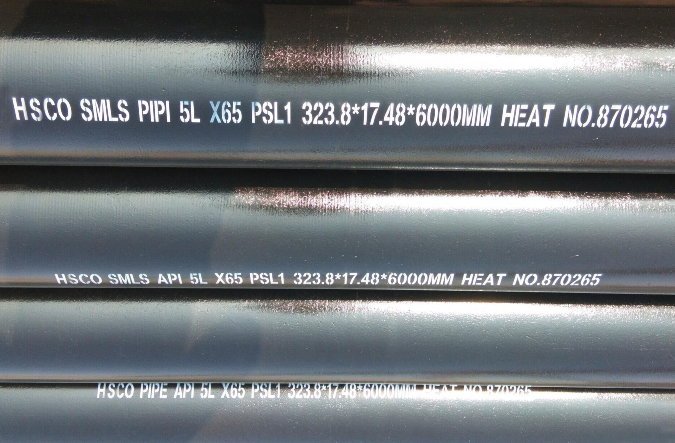
API 5L X65 pipe (also known as L450 pipe) is a high-strength carbon steel line pipe used for oil and gas transportation. In the API 5L standard, "X" stands for pipeline steel, and "65" indicates a minimum yield strength of 65,000 psi (450 MPa).
Among the two product specification levels, PSL2 represents an enhanced version. It requires stricter control over chemical composition, mandatory impact testing, and higher traceability. This makes X65 PSL2 pipe the standard choice for high-pressure and critical service environments.
X65 PSL2 costs more per ton than lower grades like X42 and X52, but it often saves money on the full project for long-distance pipelines. Thanks to its high yield strength, engineers can specify thinner walls, lowering total steel weight and freight spend.
● Excellent Field Weldability: Tight carbon equivalent (CE) limits keep the steel from hardening excessively, delivering reliable, safe girth welding in the field.
● Superior Low-Temperature Toughness: Mandatory Charpy impact testing ensures the pipe resists brittle fracture, even in extreme cold or deepwater environments.
Many buyers ask whether they can swap X65 for another grade to cut project costs.
● Upgrading to X70: X70 offers higher yield strength (485 MPa). If your pipeline operates at very high pressure, X70 can reduce the required wall thickness. However, the material cost is higher, and field welding becomes more demanding.
● Downgrading to X60: X60 (415 MPa) is cheaper, but you will need a thicker wall to maintain the same pressure rating. This increases the total tonnage and freight costs.
● The X65 Sweet Spot: X65 (450 MPa) is the global industry standard for high-pressure transmission. It offers the best balance between material cost, wall thickness, and weldability. (For full specs, view our [API 5L Line Pipe Grade Chart]).
While both meet the same 450 MPa minimum yield strength, PSL2 adds critical safety guarantees:
| Parameter | X65 PSL1 | X65 PSL2 (L450Q/M) |
|---|---|---|
| Chemistry Control | Standard (Higher C, P, S limits) |
Stricter (Lower C, P, S limits) |
| Carbon Equivalent (CE) | No mandatory limit |
CEq ≤ 0.43, CEpcm ≤ 0.25 |
| Impact Testing | Optional |
Mandatory (CVN) |
| Max Yield Strength | No limit | 450 – 600 MPa (capped to prevent brittleness) |
| Max Tensile Strength | No limit |
535 – 760 MPa |
Here is the maximum chemical limit comparison. Note that PSL2 strictly controls Sulfur, Phosphorus, and Carbon Equivalent to ensure weldability.
| Element (%) | X65 PSL1 (Max) | X65 PSL2 (Max) |
|---|---|---|
| Carbon (C) | 0.28% | 0.18% |
| Silicon (Si) | 0.45% | 0.45% |
| Manganese (Mn) | 1.40% | 1.70% |
| Phosphorus (P) | 0.030% | 0.025% |
| Sulfur (S) | 0.030% | 0.015% |
| Carbon Equivalent (CE) | Not required | CEq ≤ 0.43, CEpcm ≤ 0.25 |
Note: For PSL2, strict Carbon Equivalent (CE) formulas (Pcm and IIW) are mandatory to ensure field weldability. Please refer to API 5L standard or contact our engineers for detailed calculations.
Unlike PSL1, which only has minimum requirements, PSL2 sets strict maximum limits to prevent the steel from becoming overly hard and brittle.
| Property | X65 PSL1 | X65 PSL2 |
|---|---|---|
| Yield Strength | ≥ 450 MPa | 450 – 600 MPa (Upper limit) |
| Tensile Strength | ≥ 535 MPa | 535 – 760 MPa (Upper limit) |
| Yield-to-Tensile Ratio | No limit | ≤ 0.93 |
| Impact Testing (CVN) | Optional | Mandatory |
| Delivery Condition | As-rolled (R) |
Q (Quenched & Tempered) or M (Thermomechanical) |
Note: When ordering X65 PSL2, you must specify the heat treatment route (Q or M) on your PO and Mill Test Certificate (MTC).
We supply API 5L X65 (L450) line pipes in a wide range of dimensions, covering both seamless and welded manufacturing routes to meet your exact project requirements:
● Standard: API SPEC 5L (ISO 3183)
● Outer Diameter (OD): 21.3 mm up to 1026 mm (Custom OD options available)
● Wall Thickness (WT): 2.0 mm to 120 mm
● Manufacturing Process: Seamless and Welded Line Pipe
Seamless (SMLS): Hot rolling, cold drawing
Welded: ERW/HFW, LSAW (Longitudinal), SSAW (Spiral)
Note: Size limits depend on the manufacturing process. For custom lengths, beveled ends, or special sizes, please [contact our team with your specifications] for a fast quote and availability confirmation.
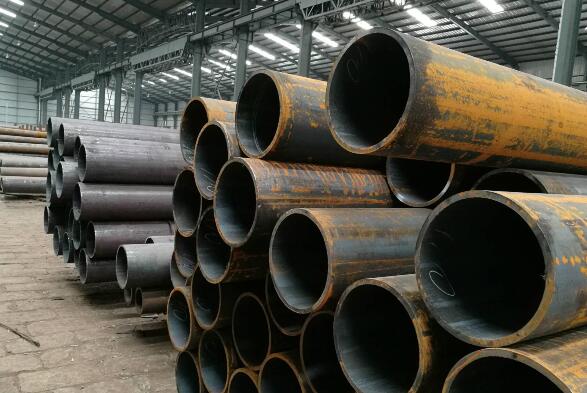
Because of its high strength and excellent toughness, X65 PSL2 is widely used in:
● High-pressure Oil & Gas Transmission: Cross-country pipelines and subsea flowlines.
● Sour Service Environments: If specified with Annex H (e.g., X65QS), it resists H₂S cracking.
● Offshore Engineering: Used in deepwater systems requiring strict NDT and fracture toughness.
Q1: Is X65 PSL2 better than PSL1?
A: PSL2 is not necessarily "better" in terms of strength, but it is safer and more reliable for critical applications. It guarantees impact toughness and weldability, which PSL1 does not. PSL2 costs 5%–15% more but is mandatory for high-pressure or low-temperature pipelines.
Q2: What does the "Q" or "M" mean in X65Q or X65M?
A: This indicates the delivery condition (heat treatment). "Q" stands for Quenched and Tempered, while "M" stands for Thermomechanical rolled. Both are PSL2 requirements. If your MTC does not state the delivery condition, the pipe is non-compliant.
Q3: What is the difference between X65 and L450?
A: They are the exact same material. X65 is the API 5L designation (based on 65,000 psi yield strength), while L450 is the ISO 3183 designation (based on 450 MPa yield strength).
Q4: Can X65 be used for sour service (H₂S)?
A: Yes, but you must specify Annex H (e.g., X65QS). Standard X65 PSL2 is not suitable for sour environments unless it undergoes HIC and SSC testing and meets strict hardness limits.
Q5: What is the difference between X65 and X70?
A: X70 has a higher minimum yield strength (485 MPa) compared to X65 (450 MPa). If your pipeline design pressure can be met with X65, it is usually more cost-effective than X70. However, for higher pressure or larger diameter lines, X70 may reduce wall thickness and overall project cost.
API 5L X65 PSL2 is a highly engineered material designed for the most demanding oil and gas environments. Its tightly controlled chemistry, mandatory impact testing, and capped maximum strength ensure pipeline safety under extreme pressure.
Looking for API 5L X65 PSL2 steel pipes?
HSCO Steel supplies fully certified pipes with 100% traceable MTCs and mandatory NDT.
▶ Email: sales@hu-steel.com
Related Resources:
● PSL1 vs PSL2 Pipe: What's the Difference?
● API 5L ERW Line Pipe Standard & Grade
● Steel Pipe MTC: What It Is & How to Verify It
Related information
Copyright @2017 Hunan Standard Steel Co.,Ltd and Husteel Industry Group All Rights Reserved