sales@hu-steel.com
 English
 Español

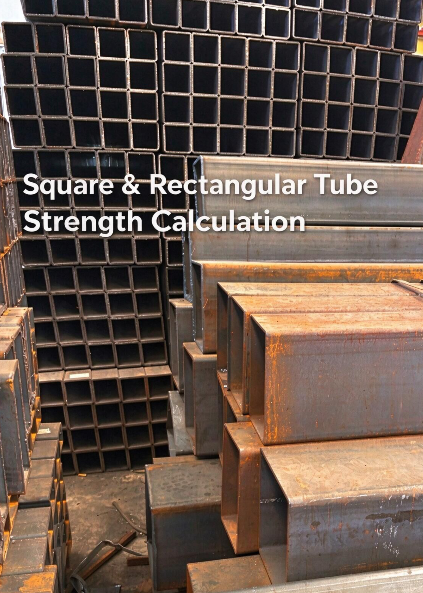
Square and rectangular tubes (SHS/RHS) are widely used in structural frames and machinery. However, before specifying a tube size, engineers must calculate its strength and load capacity to ensure it can safely withstand the applied forces.
Disclaimer: The formulas below are for preliminary estimation only. All structural designs must be verified by a qualified structural engineer.
To calculate the strength of a tube, you first need two geometric properties based on its exact dimensions:
Section Modulus (W or Z): Determines the tube's resistance to bending.
Moment of Inertia (I): Determines the tube's stiffness (resistance to deflection).
How to calculate them yourself:
● Square Tube (SHS): W = (A³ - a³) / 6 and I = (A⁴ - a⁴) / 12
(Where A = outer side, a = inner side).
● Rectangular Tube (RHS): W = (B × H³ - b × h³) / (6 × H)
(Where H = outer height, B = outer width, h = inner height, b = inner width).
(👉 Note: For rectangular tubes, the W and I values depend on how the tube is oriented. Always calculate using the axis parallel to the applied load.)
When a tube is used as a horizontal beam, it is subjected to bending. The most common scenario is a simply supported beam carrying a central point load.
Step 1: Calculate the Maximum Bending Moment (M)
M = (P × L) / 4
M = Maximum bending moment (N·mm)
P = Applied load (N)
L = Span length (mm)
Step 2: Calculate the Bending Stress (σ)
σ = M / W
σ = Bending stress (MPa or N/mm²)
W = Section modulus (mm³)
Step 3: Check the Safety Factor
The calculated stress (σ) must be lower than the material's yield strength. For example, if you are using ASTM A500 Grade B (Yield Strength = 315 MPa), your calculated σ must be < 315 MPa. Always apply a safety factor (e.g., keep stress below 60% of yield strength).
When a tube is used vertically as a column, the primary risk is not the steel being crushed, but the tube buckling (bending sideways under pressure).
For Short Columns (Low Slenderness Ratio): The load capacity depends on the cross-sectional area (A) and the yield strength (Fy).
P = A × Fy
For Long Columns (High Slenderness Ratio): The tube will fail by buckling before the steel reaches its yield point. This requires calculating the slenderness ratio (KL/r) and using Euler's critical load formula.
(Note: Rectangular tubes have a weak axis and are highly prone to buckling if not oriented correctly.)
A beam may not break, but it might bend too much, causing cracks or vibrations. The deflection (δ) for a simply supported beam with a central load is calculated as:
δ = (P × L³) / (48 × E × I)
δ = Deflection (mm)
E = Modulus of elasticity for steel (approx. 200,000 MPa)
Engineers usually limit the maximum deflection to L/250 or L/360 depending on the building code.

Calculating the math is your job, but supplying the right material is ours.
We supply high-strength ASTM A500 Grade B & C and EN 10219 S355J2H square and rectangular tubes that meet strict international yield strength standards.
● What is Carbon Steel Square Tube?
● S235JRH and S355J2H Structural Steel
● Comparison of Load-Bearing Capacity Between Square and Rectangular Tubing
Related information
Copyright @2017 Hunan Standard Steel Co.,Ltd and Husteel Industry Group All Rights Reserved