sales@hu-steel.com
 English
 Español

Calculating the theoretical weight of a tube is essential for material estimation, shipping costs, and structural design. This guide provides the exact calculation formulas for Square Tubes (SHS), Rectangular Tubes (RHS), and Round Pipes (CHS) in both metric (kg/m) and imperial (lbs/ft) units.
Note: The weight calculated using the formulas below is the theoretical weight. Actual product weight may vary by approximately ±3.5% due to manufacturing tolerances (such as wall thickness variations and corner radii).
👉 Try our interactive calculator below for instant results:
Note: For Square Tubes (SHS), simply enter the same value for both Width and Height.
For carbon steel square tubes, the most widely used formula in international engineering is:
Weight (kg/m) = [4 × (Side A – Wall Thickness) × Wall Thickness × 0.00785]
● Side A: Outer side length (mm)
● Wall Thickness: (mm)
● 0.00785: Density of carbon steel (g/mm³)
Example Calculation:
For a 100 × 100 × 5 mm square tube:
Weight = [4 × (100 - 5) × 5 × 0.00785] = 14.92 kg/m
(If you need the weight for a 6-meter bar: 14.92 kg/m × 6m = 89.52 kg)
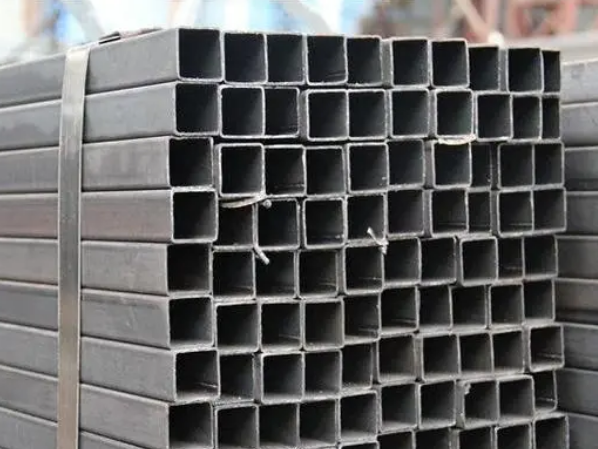
For the North American market (ASTM A500), the formula using inches is:
Weight (lbs/ft) = [4 × (Side A – Wall Thickness) × Wall Thickness × 0.284]
● Side A: Outer side length (inches)
● Wall Thickness: (inches)
● 0.284: Density of steel (lbs/in³)
Example Calculation:
For a 4" × 4" × 0.250" square tube:
Weight = [4 × (4 - 0.250) × 0.250 × 0.284] = 1.065 lbs/ft
For rectangular hollow sections, the formula adjusts to account for the two different side lengths (Height and Width):
● Metric Formula (kg/m):
Weight = [2 × (Height + Width – 2 × Wall Thickness) × Wall Thickness × 0.00785]
● Imperial Formula (lbs/ft):
Weight = [2 × (Height + Width – 2 × Wall Thickness) × Wall Thickness × 0.284]
(Note: Actual product weight may vary by ±3.5% due to manufacturing tolerances.)
Example:
For a 100 × 50 × 4 mm rectangular tube:
Weight = [2 × (100 + 50 – 8) × 4 × 0.00785] = 8.91 kg/m
For clients also dealing with circular hollow sections, the theoretical weight of a round steel pipe is calculated as:
Metric Formula (kg/m):
Weight (kg/m) = (Outer Diameter – Wall Thickness) × Wall Thickness × 0.02466
(Note: Outer Diameter and Wall Thickness must be in mm).
Weight charts published in Asia and Europe typically use kilograms per meter (kg/m), while many North American HSS specifications use pounds per foot (lb/ft). To convert between the two units:
lb/ft = kg/m × 0.67197
Example: A tube weighing 10.80 kg/m is approximately 7.26 lb/ft.
When comparing supplier quotations or international project specifications, always confirm whether the published weight is expressed in kg/m or lb/ft to avoid calculation errors.
(If you don't want to calculate manually, here are the weights for the most common sizes)
| Size (mm) | Wall Thickness (mm) | Weight (kg/m) | Weight (lb/ft) | Weight (kg/6m) |
|---|---|---|---|---|
| 40 × 40 | 2.0 | 2.31 | 1.55 | 13.86 |
| 50 × 50 | 3.0 | 4.39 | 2.95 | 26.34 |
| 60 × 60 | 3.0 | 5.40 | 3.63 | 32.40 |
| 80 × 80 | 4.0 | 9.61 | 6.46 | 57.66 |
| 100 × 100 | 5.0 | 14.92 | 10.02 | 89.52 |
| 150 × 150 | 6.0 | 27.13 | 18.23 | 162.78 |
| Size (H × W mm) | Wall Thickness (mm) | Weight (kg/m) | Weight (lb/ft) | Weight (kg/6m) |
|---|---|---|---|---|
| 50 × 25 | 2.0 | 2.24 | 1.50 | 13.44 |
| 60 × 40 | 3.0 | 4.39 | 2.95 | 26.34 |
| 80 × 40 | 3.0 | 5.37 | 3.61 | 32.22 |
| 100 × 50 | 3.0 | 6.78 | 4.56 | 40.68 |
| 120 × 60 | 4.0 | 10.80 | 7.26 | 64.80 |
| 150 × 100 | 5.0 | 18.84 | 12.66 | 113.04 |
(👉 For a complete list of metric and imperial dimensions, please view our [Square Tube Sizes Chart].)
The weights shown in this guide are theoretical values calculated using the standard carbon steel density of 7.85 g/cm³.
In actual production, the measured weight of a tube may vary slightly due to:
● Wall thickness tolerances (usually ±10%)
● Corner radius geometry
● Manufacturing process variations
● Length measurement tolerances
For most structural steel tubes, the difference between theoretical and actual weight is typically within ±3.5% to ±5%. When purchasing steel tubes by tonnage, the actual shipping weight (weighed at the port) should always take precedence over theoretical calculations.
Related Resources
● What is Carbon Steel Square Tube? - Sizes, Grades & Processes
● Square Tube vs. Rectangular Tube Load-bearing Capacity
● Square Tube Sizes & Dimensions Chart (SHS)
● Rectangular Tube Sizes & Dimensions Chart (RHS)
● Square Tube Strength Calculation Formula and Use
Don't want to calculate the weight manually for a whole container? Send us your size list (e.g., 100×100×5mm, 50 tons), and our team will provide an exact weight and quotation within 24 hours.
👉 [Contact Us for a Fast Quote]
Related information
Copyright @2017 Hunan Standard Steel Co.,Ltd and Husteel Industry Group All Rights Reserved